
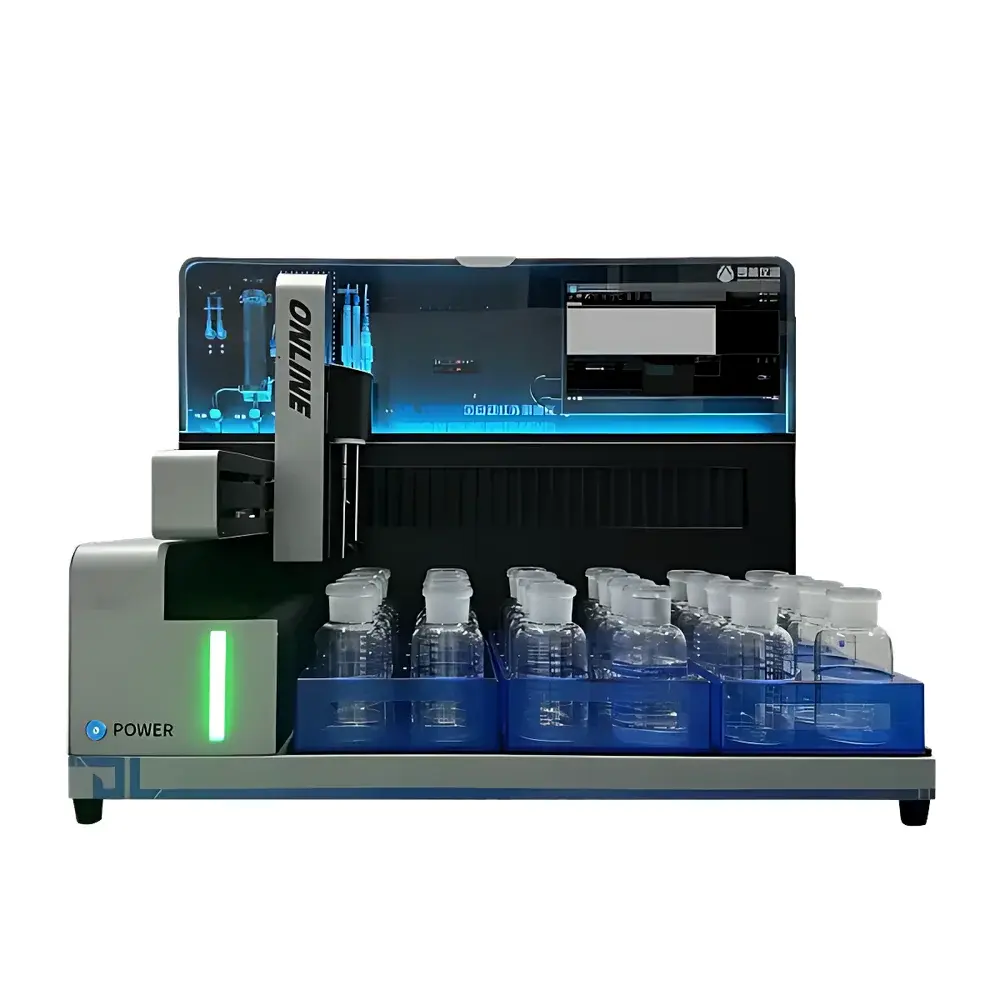
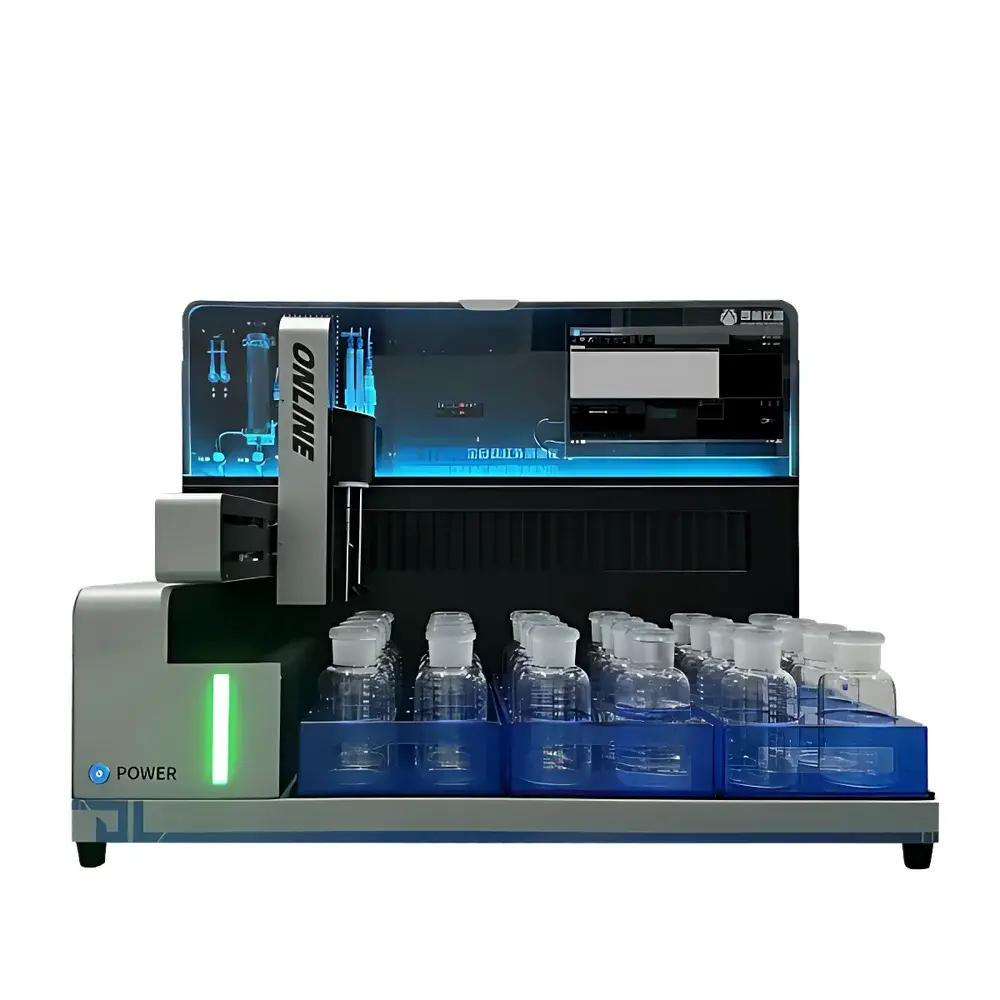
Online Instrument OL1120N Fully Automated Infrared Oil Content Analyzer
| Brand | Online Instrument |
|---|---|
| Origin | Shanghai, China |
| Model | OL1120N |
| Instrument Type | Laboratory-Based |
| Measurement Principle | Infrared Spectrophotometry (ASTM D7066, ISO 9377-2, HJ 637–2018) |
| Sample Capacity | 24-position carousel (expandable) |
| Extraction Solvent | Tetrachloroethylene (C₂Cl₄) |
| Oil Classification | Petroleum Hydrocarbons & Animal/Vegetable Oils |
| Separation Method | Triple-phase separation via extraction tube, aqueous barrier membrane, and phase separation column |
| Calibration Options | Certified reference standards, multi-point calibration curve, single-point rapid calibration |
| Reagent Recovery | Automated solvent–water immiscible phase separation |
| Remote Access | Web-based GUI + mobile-responsive interface with real-time status monitoring and audit-trail-enabled command logging |
| Sealing Mechanism | Adaptive elastic dynamic pressure seal (no rotary lid wear) |
| Fluid Handling | High-precision 3-axis robotic arm + solenoid-driven micro-pumps (MTBF ≥ 4×10⁶ cycles) |
| Mixing | Turbulent vortex injection + active flow agitation |
| Cleaning Protocol | Continuous “live-water” rinse between samples |
| Detection Range | Compliant with HJ 637–2018 quantification limits (0.01–100 mg/L for petroleum hydrocarbons |
| Data Compliance | 21 CFR Part 11–ready electronic records with user-level access control, timestamped audit trail, and GLP/GMP-aligned metadata tagging |
Overview
The Online Instrument OL1120N Fully Automated Infrared Oil Content Analyzer is an integrated laboratory platform engineered for precise, regulatory-compliant quantification of petroleum hydrocarbons and animal/vegetable oils in aqueous matrices. It operates on the fundamental principle of infrared spectrophotometry—measuring absorbance at characteristic C–H stretching vibration bands (2930 cm⁻¹, 2960 cm⁻¹, and 3030 cm⁻¹) to differentiate aliphatic, aromatic, and olefinic hydrocarbon components. Designed explicitly to meet the analytical requirements of China’s HJ 637–2018 standard—and fully compatible with internationally recognized protocols including ASTM D7066 (for petroleum hydrocarbons in water) and ISO 9377-2 (for hydrocarbon content in wastewater)—the OL1120N integrates sample introduction, solvent extraction, phase separation, silica-magnesium column cleanup, spectral acquisition, and quantitative calculation into a single unattended workflow. Its optical path employs a stabilized broadband IR source, high-resolution diffraction grating, and thermoelectrically cooled MCT detector to ensure reproducible spectral fidelity across extended operational cycles.
Key Features
- Adaptive dynamic pressure sealing system eliminates mechanical wear associated with traditional rotary lids, ensuring long-term integrity of the extraction chamber and preventing cross-contamination between sequential samples.
- Tri-phase separation architecture—comprising extraction tubing, hydrophobic barrier membranes, and automated silica-magnesium column switching—delivers consistent phase purity without manual intervention or operator-dependent technique variability.
- 3-axis precision robotic arm with sub-microliter dispensing accuracy (A-grade liquid handling per ISO 8655-6), coupled with turbulence-enhanced mixing and continuous live-water rinsing, minimizes carryover and memory effects to <0.1% RSD over 100 consecutive injections.
- Non-contact volumetric sensing module automatically detects and logs water sample volume from standard wide-mouth collection bottles (500–2000 mL), achieving ±2% measurement uncertainty without manual entry or calibration drift.
- Embedded voice- and text-enabled assistant provides context-aware technical support—including method troubleshooting, error code interpretation, and maintenance scheduling—accessible via secure TLS-encrypted API endpoints.
- Modular hardware design supports seamless integration into无人实验室 (unmanned lab) infrastructures, including LIMS middleware, robotic sample transport systems, and centralized instrument management dashboards.
Sample Compatibility & Compliance
The OL1120N accepts untreated, preserved, or filtered aqueous samples—including raw sewage, industrial effluents, surface water, groundwater, and treated wastewater—without pre-dilution or filtration when turbidity remains below 100 NTU. It accommodates both EPA Method 1664-compliant and HJ 637–2018-specified tetrachloroethylene extraction chemistry, with full traceability of solvent lot numbers, column batch IDs, and calibration certificate references embedded in every result file. All data outputs conform to GLP and GMP documentation standards, including mandatory electronic signatures, immutable audit trails, and time-stamped event logs compliant with FDA 21 CFR Part 11 Annex 11 requirements.
Software & Data Management
The analyzer runs on a Linux-based real-time operating system with a web-native user interface accessible via Chrome, Edge, or Safari on desktops, tablets, or smartphones. The software suite includes method editor modules for custom spectral window selection, baseline correction algorithms (Savitzky–Golay smoothing, derivative peak detection), and dual-channel matrix analysis for concurrent total phosphorus and total nitrogen quantification using UV-Vis extension modules (optional). Raw interferograms and processed spectra are stored in vendor-neutral HDF5 format with embedded metadata (sample ID, operator, timestamp, instrument configuration, environmental conditions). Export options include CSV, PDF analytical reports, and direct LIMS push via HL7 or RESTful API.
Applications
This system serves as a primary analytical tool in municipal environmental monitoring stations, petrochemical refineries, wastewater treatment plants, port authorities, and third-party testing laboratories conducting routine compliance monitoring under national discharge permits. It supports Tier 2 and Tier 3 oil spill response assessments by delivering speciated hydrocarbon profiles that inform biodegradation potential and ecological risk modeling. Beyond regulatory testing, its configurable IR platform enables structural elucidation of organic contaminants—such as surfactants, plasticizers, and bio-oils—in research settings across academia, materials science, and environmental forensics.
FAQ
Does the OL1120N support alternative extraction solvents such as n-hexane or cyclohexane?
Yes—though tetrachloroethylene remains the default for HJ 637–2018 compliance, the fluid handling system can be reconfigured for other IR-transparent solvents upon validation and method adaptation.
Can the instrument perform simultaneous analysis of petroleum hydrocarbons and total phosphorus without hardware modification?
Yes—the UV-Vis spectrometric module is field-installable and shares the same sample carousel and robotic handling infrastructure, enabling true dual-parameter analysis within one run sequence.
Is remote diagnostic capability available for predictive maintenance?
Yes—embedded sensor telemetry monitors pump pressure profiles, motor current draw, temperature gradients, and optical signal-to-noise ratios, feeding anomaly detection models trained on >10,000 operational hours of anonymized fleet data.
How is data integrity ensured during network outages or power interruptions?
All measurements are locally cached in encrypted onboard storage with write-ahead logging; synchronization resumes automatically upon connection restoration, preserving chronological continuity and cryptographic hash verification.
What level of cybersecurity certification does the OL1120N hold?
The device complies with IEC 62443-3-3 SL2 requirements, featuring TLS 1.3 encryption, role-based access control (RBAC), firmware signature validation, and quarterly security patch deployment via signed OTA updates.
Related Products







