
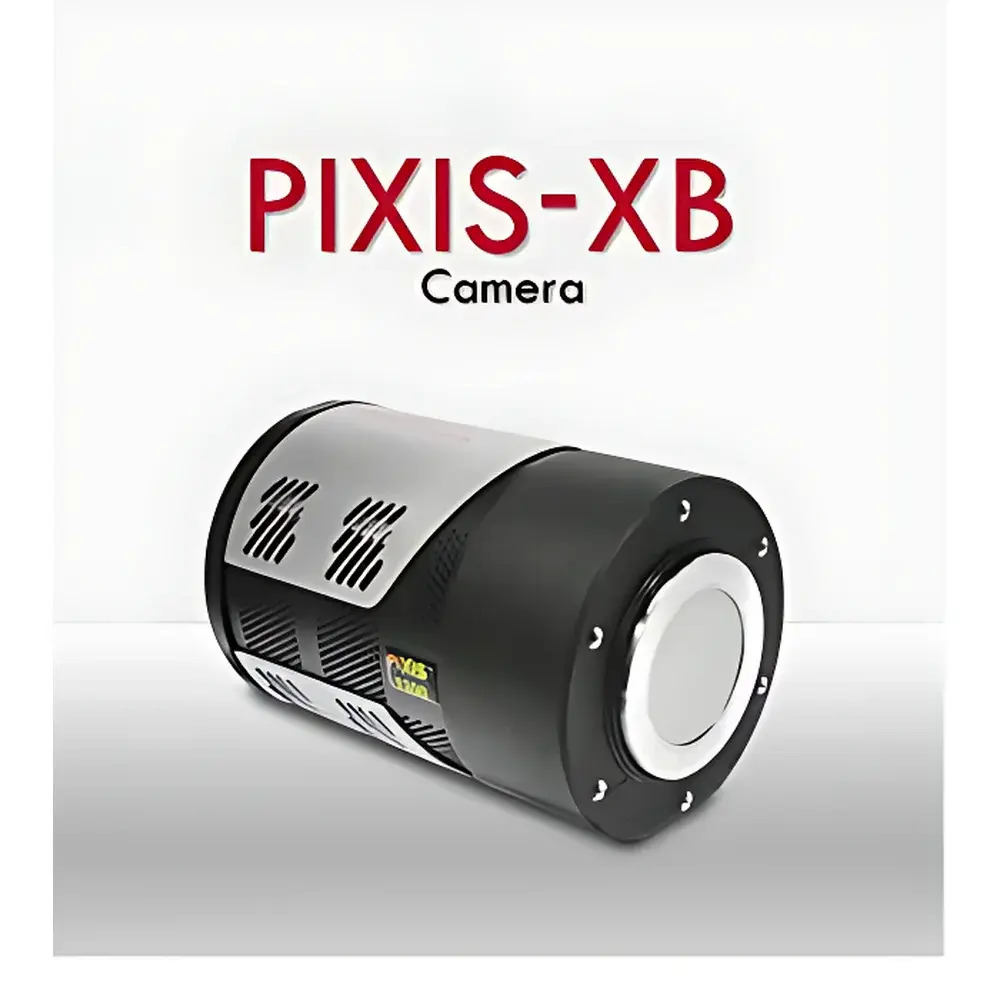
Princeton Instruments PIXIS-XB Direct-Detection X-Ray Camera
| Brand | Princeton Instruments / Teledyne Princeton Instruments |
|---|---|
| Origin | USA |
| Manufacturer Type | Authorized Distributor |
| Product Origin | Imported |
| Model Variants | 400BR, 1024BR, 1300R/BR |
| Pixel Size | 13 × 13 µm, 20 × 20 µm |
| Operating Temperature Range | –70 °C to –90 °C |
| Energy Detection Range | ~3 keV to ~20 keV |
| Window Material | Beryllium (Be) vacuum window |
| Readout Architecture | Dual-output amplifier with selectable gain modes |
| ADC Resolution | 16-bit |
| Interface | High-speed USB 2.0 (up to 2 MHz readout rate) |
| Sensor Type | Deep-depletion back-illuminated CCD |
| Cooling Method | Thermoelectric (TE) cooling with vacuum-sealed package |
Overview
The Princeton Instruments PIXIS-XB is a scientific-grade, direct-detection X-ray imaging camera engineered for high-fidelity, low-flux X-ray applications in synchrotron, laboratory, and industrial settings. Unlike scintillator-coupled detectors, the PIXIS-XB employs a deep-depletion, back-illuminated CCD sensor that directly absorbs incident X-ray photons—enabling intrinsic spatial resolution limited only by pixel geometry and charge diffusion. This architecture delivers exceptional quantum efficiency across the soft-to-hard X-ray spectrum (~3 keV to ~20 keV), with peak absorption exceeding 75% in the 5–12 keV range. The sensor is hermetically sealed behind a thin beryllium entrance window, maintaining ultra-high vacuum compatibility while transmitting low-energy X-rays with minimal attenuation. Integrated thermoelectric cooling achieves stable operating temperatures from –70 °C to –90 °C, suppressing dark current to sub-0.001 e⁻/pixel/sec levels—critical for long-exposure coherent diffraction and photon-counting experiments. Designed for precision metrology and quantitative spectral analysis, the PIXIS-XB meets the physical and electronic requirements of ISO 14819 (X-ray instrumentation), ASTM E177 (standard practice for use of statistics in instrument calibration), and supports GLP/GMP-compliant data acquisition workflows.
Key Features
- Direct-detection deep-depletion back-illuminated CCD architecture for superior quantum efficiency and spatial fidelity
- Ultra-low-noise electronics with dual-output amplifiers and programmable gain modes—optimized for both high-speed alignment and low-noise quantitative acquisition
- Vacuum-compatible beryllium window (typically 8–12.5 µm thickness) enabling operation in UHV environments without maintenance or window replacement
- True 16-bit analog-to-digital conversion with up to 2 MHz pixel readout rate via high-bandwidth USB 2.0 interface—no frame grabber or proprietary hardware required
- Thermoelectric cooling system achieving stable sensor temperatures down to –90 °C; integrated thermal monitoring and automatic temperature stabilization
- Software-controlled flat-field correction, background subtraction, and pixel defect masking—applied in real time during acquisition
Sample Compatibility & Compliance
The PIXIS-XB supports a broad range of sample geometries and experimental configurations—including transmission, grazing-incidence, and reflection-mode X-ray imaging. Its modular mechanical design allows integration into custom beamlines, vacuum chambers, and OEM instrumentation platforms. The camera complies with CE marking requirements for electromagnetic compatibility (EMC Directive 2014/30/EU) and low-voltage safety (LVD Directive 2014/35/EU). All firmware and acquisition software adhere to FDA 21 CFR Part 11 principles for electronic records and signatures, including audit trail logging, user access control, and data integrity verification. Calibration certificates traceable to NIST standards are available upon request for ISO/IEC 17025-accredited laboratories.
Software & Data Management
The PIXIS-XB is fully supported by LightField®, Princeton Instruments’ 64-bit acquisition and analysis platform. LightField provides intuitive hardware configuration, real-time histogram visualization, multi-region-of-interest (ROI) analysis, and automated exposure optimization. It natively supports TIFF, HDF5, and FITS export formats—ensuring compatibility with third-party analysis tools such as PyFAI, GSAS-II, and CrystFEL. A comprehensive PICAM SDK (64-bit C/C++ and Python bindings) enables full programmatic control, including synchronization with external triggers, shutter timing, and metadata embedding. Seamless integration with LabVIEW, MATLAB, and EPICS IOC environments is validated through NI-DAQmx, MathWorks Instrument Control Toolbox, and Channel Access drivers—facilitating deployment in automated synchrotron end-stations and industrial QA/QC systems.
Applications
- Coherent X-ray diffraction imaging (CXDI) and ptychography for nanoscale structural reconstruction of crystalline and amorphous materials
- X-ray photon correlation spectroscopy (XPCS) requiring high dynamic range and single-photon sensitivity at low flux conditions
- Energy-dispersive X-ray spectroscopy (EDS) and wavelength-dispersive X-ray fluorescence (WDXRF) mapping
- X-ray interferometry and phase-contrast imaging using grating-based or propagation-based methods
- Time-resolved X-ray diffraction (TR-XRD) in pump-probe experiments with sub-millisecond temporal resolution
- Micro-CT preclinical imaging and industrial non-destructive testing (NDT) where geometric magnification and detector MTF are critical
FAQ
What X-ray energy ranges does the PIXIS-XB support?
The PIXIS-XB detects photons from approximately 3 keV to 20 keV, with optimal quantum efficiency between 5 keV and 12 keV depending on CCD thickness and beryllium window specification.
Is vacuum integration required for operation?
Yes—the beryllium window is designed for vacuum-sealed operation; the camera must be mounted on a vacuum flange (CF or KF standard) and operated under ≤10⁻⁵ Torr to prevent sensor degradation and ensure optimal low-energy response.
Can the PIXIS-XB perform photon counting?
While not a dedicated photon-counting detector, its ultra-low read noise (<3 e⁻ RMS) and high dynamic range enable threshold-based single-photon event identification in low-flux regimes when combined with appropriate post-processing.
How is calibration maintained across temperature and exposure variations?
LightField includes automated dark-frame and flat-field correction routines; users may store calibrated reference frames per temperature setpoint and exposure duration, ensuring reproducible radiometric accuracy across experimental sessions.
Does the system support synchronized multi-camera acquisition?
Yes—via TTL trigger input/output and programmable delay generators within LightField, enabling precise temporal alignment across multiple PIXIS-XB units or hybrid detector arrays.




