
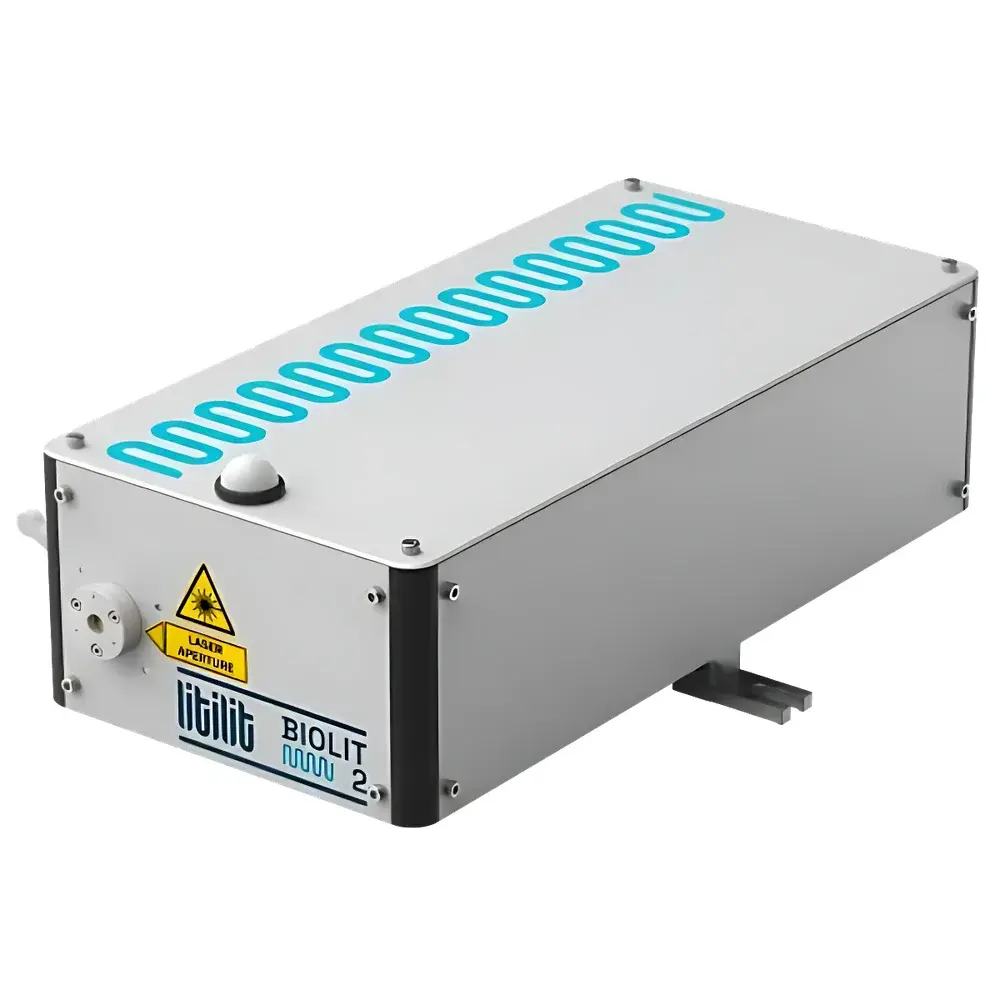
Litilit Biolit-2 Compact Air-Cooled Femtosecond Fiber Laser
| Key | Brand: Litilit |
|---|---|
| Model | Biolit-2 |
| Center Wavelength | 1050 ± 5 nm |
| Average Power | > 2 W |
| Pulse Duration | < 70 fs (typ. 55 fs) |
| Pulse Duration Stability | ±3 fs |
| Strehl Ratio | > 0.9 |
| Pre-chirp Tuning Range | −8000 to +500 fs² |
| Repetition Rate | 15/20/30/40 MHz (factory-set) |
| Analog Power Control | 1–100% |
| Beam Quality M² | < 1.2 (typ. 1.05) |
| Beam Roundness | > 0.9 (typ. 0.94) |
| Beam Diameter (1/e²) | 1.5 ± 0.3 mm |
| Beam Divergence (full angle) | < 1.5 mrad |
| Beam Pointing Stability (RMS) | < 20 μrad |
| Beam Pointing vs. Temperature | < 15 μrad/°C |
| Pulse Energy Stability (RMS) | < 1% |
| Power Stability (RMS) | < 1% |
| Warm-up Time | < 10 min |
| Cooling | Passive air-cooling (laser head) |
| Dimensions (L×W×H) | Laser Head: 313 × 152 × 107 mm³ |
| Control Unit | 449 × 370 × 140 mm³ |
| Cable Length | 3 ± 0.1 m |
| Input Voltage | 24 V DC (with integrated 100–240 V AC, 47–63 Hz power supply) |
| Operating Temp. | 18–30 °C |
| Storage/Transport Temp. | −20 to +70 °C |
| Harmonic Option | 0.4 W @ 525 nm (Biolit-2 SH variant) |
| Interfaces | USB, CAN |
| Patents | US10038297, JP6276471, EP3178137, CN106575849 |
Overview
The Litilit Biolit-2 is a compact, air-cooled femtosecond fiber laser engineered for demanding nonlinear optical applications in life sciences and precision photonics. Based on Litilit’s patented pulse generation architecture, the Biolit-2 delivers transform-limited, carrier-envelope-phase-stable pulses with exceptional temporal fidelity—enabling high-fidelity multiphoton excitation without spectral broadening or temporal distortion. Its core operating principle leverages mode-locked all-fiber oscillator technology combined with intracavity dispersion management and proprietary nonlinear pulse shaping, resulting in intrinsically clean pulse profiles (Strehl ratio > 0.9) and sub-70 fs pulse durations (typically 55 fs at 1050 nm). Designed for integration into commercial and custom-built multiphoton microscopes, OPO pump systems, and ultrafast biophotonic platforms, the Biolit-2 operates at industrial-grade reliability while maintaining laboratory-level performance metrics—including RMS power stability < 1%, beam pointing drift < 20 μrad, and thermal insensitivity (<15 μrad/°C).
Key Features
- Transform-limited output with pulse duration 0.9, ensuring optimal peak intensity and minimal temporal chirp
- Integrated, tunable pre-chirp compensation (−8000 to +500 fs²), equivalent to up to 80 mm of SF10 glass—enabling precise dispersion matching for downstream optics and microscope objectives
- Factory-configurable repetition rates (15 / 20 / 30 / 40 MHz); optional fine-tuning down to 1 MHz via integer division of base rate (RR = RR₀/N)
- M² 0.9 (typ. 0.94), supporting diffraction-limited focusing and uniform excitation across wide-field scanning systems
- Passively cooled laser head (no fans or water lines) and actively cooled control unit—optimized for vibration-sensitive environments such as electrophysiology rigs and live-tissue imaging setups
- Full analog, USB, and CAN bus control interfaces for seamless integration into automated workflows compliant with GLP/GMP and FDA 21 CFR Part 11 requirements
- Zero-maintenance, turnkey operation with <10-minute warm-up time and continuous 8-hour stability validated under ±1 °C ambient temperature control
Sample Compatibility & Compliance
The Biolit-2 is designed for direct coupling into high-NA microscope objectives, hollow-core photonic crystal fibers, and optical parametric amplifier (OPA) stages without requiring external pulse compressors or adaptive optics. Its 1050 nm fundamental output is optimized for deep-tissue penetration and reduced scattering in biological specimens, while the optional second-harmonic generation (SHG) module delivers 525 nm output (0.4 W) for dual-wavelength excitation schemes. All optical specifications—including beam divergence (<1.5 mrad), pointing stability (<20 μrad RMS), and spectral bandwidth (transform-limited)—are verified per ISO 11146-1:2019 (laser beam parameters) and IEC 60825-1:2014 (laser safety). The system meets CE marking requirements for Class 1M laser products and supports audit-ready electronic log files with timestamped parameter tracking for regulated research environments.
Software & Data Management
Litilit provides a native Windows-based GUI with real-time monitoring of pulse energy, repetition rate, output power, and internal temperature sensors. All control registers—including analog modulation input scaling, CAN message mapping, and USB command protocol—are fully documented in the SDK (C/C++, Python bindings included). Configuration files are saved in XML format with digital signatures to ensure traceability. For compliance-critical applications, the system supports 21 CFR Part 11–compliant user access controls, electronic signatures, and immutable audit trails when deployed with validated third-party LIMS or ELN platforms. Firmware updates are delivered via signed binary packages with SHA-256 verification and rollback capability.
Applications
- Multiphoton fluorescence microscopy (MPM) for in vivo neural imaging, calcium dynamics, and metabolic redox mapping
- Second- and third-harmonic generation (SHG/THG) imaging of collagen, myosin, and lipid membranes in unstained tissue
- Optogenetic stimulation using precise temporal gating of two-photon absorption
- Precision ophthalmic diagnostics and therapeutic ablation (e.g., corneal lenticule cutting)
- Pump source for synchronously pumped OPOs and ultrafast spectroscopy setups
- Two-photon polymerization (2PP) for microfabrication of biocompatible scaffolds and photonic crystals
FAQ
Is the Biolit-2 compatible with standard Ti:sapphire-based microscope scan engines?
Yes—the 1050 nm fundamental output and M² < 1.2 beam profile enable direct coupling into galvo-resonant scanners and acousto-optic deflectors without beam reshaping optics.
Can pulse duration be verified in-house without autocorrelation equipment?
Litilit supplies factory-measured FROG or SPIDER traces upon request; users may also perform interferometric autocorrelation using standard nonlinear crystals (e.g., BBO) and balanced photodiodes.
What is the maximum external dispersion the Biolit-2 can compensate for?
Standard pre-compensation covers −8000 to +500 fs²; custom configurations up to ±30,000 fs² are available upon consultation with Litilit engineering.
Does the SHG option affect the IR output power or stability?
No—the Biolit-2 SH variant maintains identical IR output specifications (power, noise, pointing) while adding a collinear 525 nm beam; both outputs are simultaneously available.
How is long-term calibration maintained without service intervention?
The all-fiber monolithic cavity design eliminates alignment drift; factory calibration data (pulse duration, spectrum, pointing) is embedded in firmware and accessible via USB query commands for periodic verification.



