
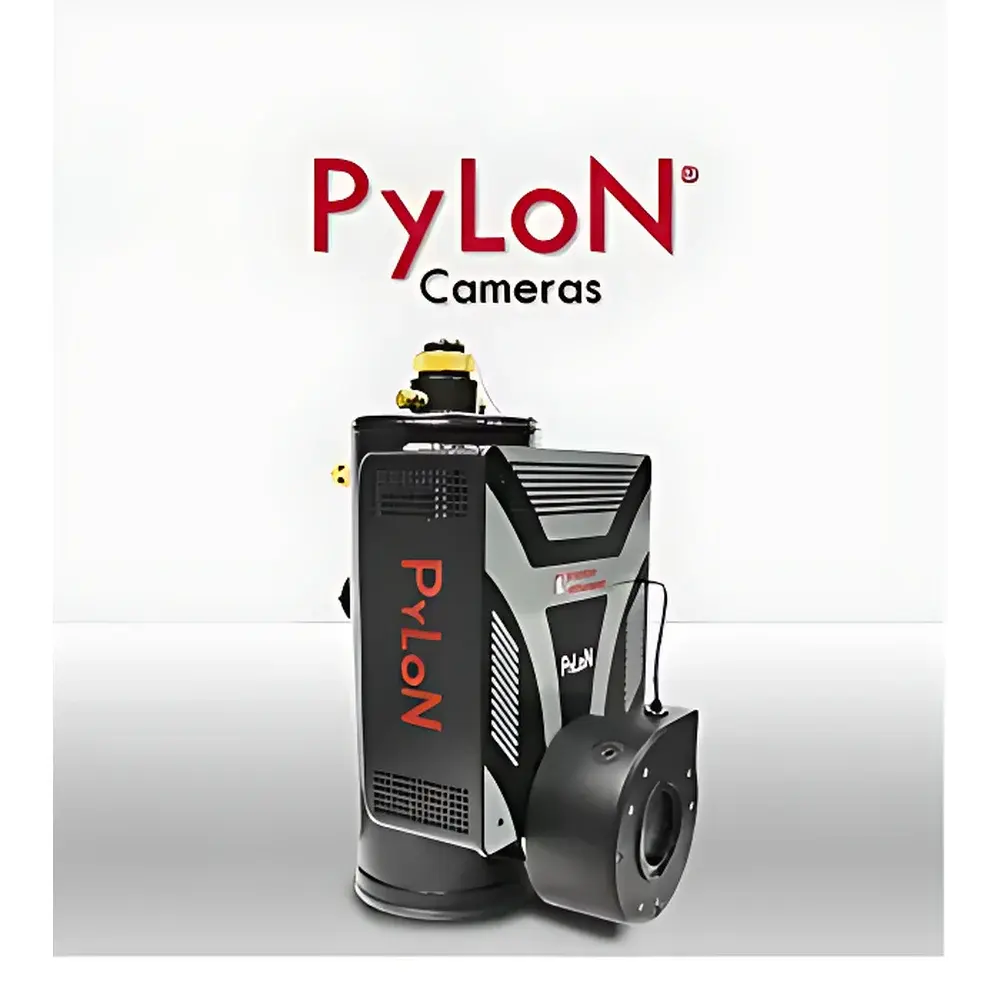
Teledyne Princeton Instruments PyLoN Imaging and Spectroscopic CCD Camera Series
| Brand | Teledyne Princeton Instruments |
|---|---|
| Origin | USA |
| Model Range | PyLoN 100B/BR, 400B/BR, 2KB, 2KBUV, 2KF, 256E/BR |
| Pixel Size | 20 × 20 µm, 13.5 × 13.5 µm, 26 × 26 µm |
| Cooling | Liquid Nitrogen to –120 °C |
| Dark Current | ≤1 e⁻/pixel/hour |
| Spectral Response | 200–1100 nm |
| Readout Speed | 50 kHz – 4 MHz |
| Interface | Gigabit Ethernet |
| Software | LightField (64-bit) |
| QE Peak | Up to 98% (eXcelon-enhanced deep-depletion back-illuminated) |
Overview
The Teledyne Princeton Instruments PyLoN series represents a class of scientific-grade, liquid nitrogen–cooled CCD cameras engineered for ultra-low-noise, high-dynamic-range imaging and spectroscopy across demanding research domains. Based on charge-coupled device (CCD) architecture with selectable front-illuminated (F/I), back-illuminated (B/I), and deep-depletion back-illuminated (B/I DD) sensor configurations, the PyLoN platform supports both spatial imaging and spectral acquisition with rigorous photometric fidelity. Its core measurement principle relies on photon-to-electron conversion in silicon-based photodiodes, followed by low-noise charge transfer and digitization under cryogenic stabilization. The system achieves sub-electron-per-pixel-per-hour dark current through sustained –120 °C cooling—enabling integration times from seconds to multiple hours without thermal signal degradation. This performance envelope makes PyLoN particularly suited for applications requiring extreme sensitivity in low-photon-flux regimes, including tip-enhanced Raman spectroscopy (TERS), astronomical photometry, time-resolved luminescence, and X-ray fluorescence mapping.
Key Features
- Liquid nitrogen cooling to –120 °C with single-fill daily operation and customizable Dewar geometry for integration into optical tables or vacuum chambers
- Ultra-low dark current: ≤1 e⁻/pixel/hour—critical for multi-minute to multi-hour integrations
- Spectral response spanning 200–1100 nm, with optional UV-enhancement coatings (Unichrome/Lumogen) or eXcelon anti-fringing technology for >95% peak quantum efficiency (QE) and minimized etaloning in NIR
- Dual-amplifier readout architecture: high-sensitivity mode (sub-3 e⁻ read noise at ≤1 MHz) and high-dynamic-range mode (extended full-well capacity)
- Numerical double sampling and bias voltage stabilization for enhanced linearity, reduced fixed-pattern noise, and stable baseline over extended acquisitions
- Gigabit Ethernet interface enabling direct connection to standard PCs without frame grabbers; supports true 16-bit data transmission synchronized with 2/5/10 MHz pixel clock options
- Flexible readout speeds from 50 kHz (optimized for lowest noise) to 4 MHz (enabling >1,000 fps spectral frame rates)
Sample Compatibility & Compliance
PyLoN cameras are compatible with a broad range of optical configurations—including monochromators, spectrographs, microscopes, and telescope focal planes—via standard C-mount or optional adapter interfaces. Sensor variants accommodate diverse experimental geometries: the 1340 × 100 array (100-series) suits narrow-line spectroscopy; the 2048 × 512 format (2K-series) balances resolution and speed for broadband spectral imaging; and the 1024 × 253 open-electrode design (256E) enables high-energy X-ray detection. All models comply with international standards for scientific instrumentation, including ISO/IEC 17025 traceable calibration protocols. LightField software supports audit-trail logging and user-access controls aligned with GLP/GMP and FDA 21 CFR Part 11 requirements for regulated environments. Hardware-level shutter synchronization and external trigger inputs ensure precise temporal alignment in pump-probe or time-gated experiments.
Software & Data Management
LightField—a native 64-bit acquisition and analysis platform—provides intuitive instrument control, real-time spectral fitting, and quantitative image processing. Its embedded mathematical engine supports on-the-fly background subtraction, spectral deconvolution, intensity normalization, and multi-channel ratio imaging. The PICAM SDK (64-bit) enables programmatic access via Python, MATLAB, LabVIEW, and EPICS, facilitating integration into automated synchrotron beamlines or industrial QC workflows. IntelliCal automates wavelength and intensity calibration using reference lamps or known emission lines, reducing setup time and operator variability. All raw data is saved in vendor-neutral HDF5 or TIFF formats with embedded metadata (exposure time, temperature, gain, binning), ensuring long-term reproducibility and FAIR (Findable, Accessible, Interoperable, Reusable) data principles.
Applications
- Tip-Enhanced Raman Spectroscopy (TERS): Sub-diffraction-limited chemical mapping enabled by ultra-low-noise, long-exposure capability and high spatial resolution
- Astronomical Imaging: Steady-state deep-sky observation and time-resolved photometry across visible/NIR bands with minimal dark current contribution
- Photoluminescence & Phosphorescence Studies: Quantitative decay kinetics analysis under pulsed excitation with precise gating and accumulation
- Surface-Enhanced Raman Spectroscopy (SERS) & Coherent Anti-Stokes Raman Spectroscopy (CARS): High-fidelity spectral acquisition in low-signal nonlinear modalities
- X-ray Fluorescence (XRF) & Soft X-ray Spectroscopy: Optimized open-electrode and deep-depletion variants for efficient soft X-ray photon detection
- Stimulated Raman Scattering (SRS) Microscopy: Synchronized acquisition of Stokes and pump beams with nanosecond timing precision
FAQ
What cooling method does the PyLoN series use, and how often must liquid nitrogen be refilled?
PyLoN cameras utilize passive liquid nitrogen cooling with integrated Dewars designed for ≥24-hour hold time under typical lab conditions—requiring refilling approximately once per day.
Can PyLoN cameras be operated in vacuum environments?
Yes—select models support vacuum-compatible Dewar housings and feedthroughs for integration into UHV chambers or space-qualified optical benches.
Is LightField software compliant with regulatory data integrity standards?
Yes—LightField includes electronic signatures, audit trails, and role-based permissions aligned with FDA 21 CFR Part 11 and ISO 13485 requirements for validated laboratory systems.
How does eXcelon technology improve near-infrared performance?
eXcelon employs an optimized anti-reflection coating and substrate treatment to suppress Fabry–Pérot interference fringes in back-illuminated sensors—enhancing QE uniformity and spectral accuracy above 700 nm.
Which PyLoN model is recommended for UV-sensitive applications such as ozone monitoring or fluorescence excitation at 254 nm?
The PyLoN 2KBUV variant features UV-optimized phosphor coating and delivers up to 67% QE at 254 nm, making it ideal for deep-UV spectral work where conventional silicon QE drops below 10%.




