
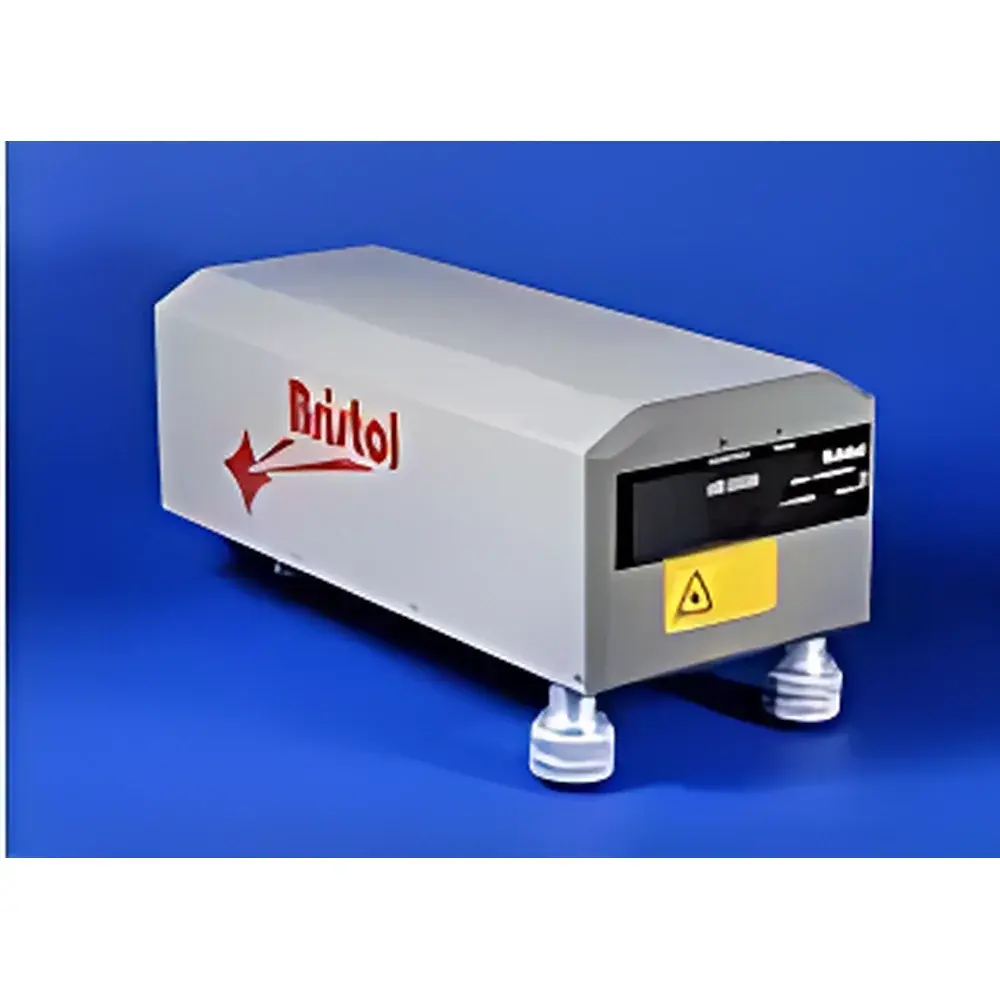
Bristol Instruments 821-B Pulsed Laser Wavelength Meter
| Brand | Bristol |
|---|---|
| Origin | USA |
| Model | 821-B |
| Wavelength Range | 350–1700 nm (VIS: 350–1100 nm |
| NIR | 630–1700 nm) |
| Absolute Accuracy | ±0.02 cm⁻¹ (±0.001 nm @ 700 nm |
| Repeatability | ±0.002 cm⁻¹ (±0.0001 nm @ 700 nm |
| Calibration Source | Integrated HeNe laser |
| Measurement Rate | Up to 200 Hz |
| Input Interface | Pre-aligned FC/PC fiber port (free-space coupling optional) |
| Minimum Pulse Energy | 15 µJ @ 350 nm, 1 µJ @ 700 nm, 100 µJ @ 1100–1700 nm |
| Display Resolution | 8 digits |
| Units | nm, cm⁻¹ (vacuum or air), GHz |
| Dimensions (H×W×L) | 190 × 165 × 381 mm |
Overview
The Bristol Instruments 821-B Pulsed Laser Wavelength Meter is a high-precision, compact interferometric instrument engineered for absolute wavelength measurement of both pulsed and continuous-wave (CW) lasers across the visible and near-infrared spectral regions. Based on a proprietary Fizeau interferometer architecture—distinct from conventional Michelson or grating-based designs—the 821-B delivers traceable, vacuum- or air-referenced wavelength values without reliance on external calibration references during routine operation. Its core measurement principle exploits the interference fringe pattern generated by splitting and recombining collimated laser light within a thermally stabilized, monolithic optical cavity. This design inherently suppresses sensitivity to vibration and thermal drift while enabling direct determination of absolute wavenumber (cm⁻¹) with metrological confidence. The instrument is widely deployed in laser development laboratories, quantum optics facilities, spectroscopy R&D, and OPO (optical parametric oscillator) characterization workflows where sub-picometer wavelength stability and shot-to-shot reproducibility are critical for experimental validity.
Key Features
- Fizeau interferometer-based architecture for absolute wavelength measurement without periodic recalibration against external standards
- Integrated, temperature-stabilized HeNe laser serving as an internal wavelength reference for autonomous, real-time calibration
- Simultaneous support for pulsed (ns–ms pulse width) and CW laser sources with asynchronous pulse detection and auto-triggering at up to 200 Hz measurement rate
- Dual-band optical input path optimized for VIS (350–1100 nm) and NIR (630–1700 nm), with pre-aligned FC/PC fiber interface as standard; free-space coupling option available for high-energy or non-fiber-coupled sources
- Eight-digit display with selectable units: nanometers (nm), wavenumbers (cm⁻¹, configurable for vacuum or atmospheric conditions), and optical frequency (GHz)
- USB 2.0 high-speed interface for seamless integration into automated test benches, LabVIEW environments, and custom Python/Matlab control scripts
- Compact benchtop form factor (190 × 165 × 381 mm) designed for space-constrained optical tables and OEM integration
Sample Compatibility & Compliance
The 821-B accommodates a broad range of laser sources including Q-switched Nd:YAG harmonics, Ti:sapphire oscillators, diode lasers, fiber lasers, and tunable OPO outputs. It meets the optical power and pulse energy thresholds typical of laboratory-grade pulsed systems, with minimum detectable energies ranging from 1 µJ at 700 nm to 100 µJ at 1700 nm. While not certified as a primary standard, its performance aligns with requirements for ISO/IEC 17025-compliant calibration labs when used as a transfer standard under documented environmental controls (temperature stability ±0.5 °C, low-vibration mounting). The device supports audit-ready data logging compatible with GLP/GMP documentation practices, and its firmware architecture permits timestamped, user-annotated measurement records suitable for regulatory submissions.
Software & Data Management
Bristol Instruments provides the Wavelength Meter Control Software (WMCS), a Windows-native application supporting real-time spectrum visualization, statistical analysis (mean, std dev, min/max over user-defined acquisition windows), and batch export to CSV or Excel formats. The SDK includes C/C++, .NET, and Python APIs with full command-line support for integration into automated alignment routines, closed-loop wavelength stabilization systems, or laser qualification protocols. All measurements include embedded metadata: timestamp (UTC), input energy estimate, signal-to-noise ratio, and calibration status flag. Optional firmware updates maintain compatibility with evolving USB driver standards and enhance noise rejection algorithms for low-SNR pulses.
Applications
- Characterization of ultrafast and nanosecond-pulsed laser systems in academic and industrial photonics labs
- Wavelength validation and drift monitoring of tunable OPOs and dye lasers in nonlinear optics experiments
- QC testing of semiconductor laser diodes and VCSEL arrays in manufacturing environments
- Supporting NIST-traceable wavelength verification in metrology institutes and national labs
- Integration into automated laser-based analytical platforms such as LIBS (Laser-Induced Breakdown Spectroscopy) and LIDAR system calibration
- Education and training in advanced optical instrumentation, where hands-on interferometric wavelength metrology principles are demonstrated
FAQ
Does the 821-B require external calibration to maintain specified accuracy?
No. The integrated HeNe laser serves as a permanent, factory-aligned reference source. Automatic calibration occurs at power-up and optionally at user-defined intervals, ensuring long-term stability without dependency on external standards.
Can the 821-B measure femtosecond laser pulses?
It is optimized for pulses ≥1 ns duration. Sub-nanosecond pulses may be measured if sufficiently energetic and spectrally narrow; however, temporal coherence limitations apply—consult technical specifications for coherence-length-dependent resolution limits.
Is vacuum-wavelength reporting traceable to NIST?
Yes. The internal HeNe reference is calibrated against NIST-traceable standards during manufacturing. Vacuum-mode calculations use the standard Edlén equation with updated coefficients per ISO 20483:2017.
What software licenses or annual fees are associated with the 821-B?
The WMCS application and SDK are provided royalty-free with hardware purchase. No subscription, activation keys, or time-limited licenses are required.
How is thermal drift managed in the interferometer cavity?
The Fizeau cavity is fabricated from low-expansion ULE glass and housed in a passive thermal enclosure. Internal temperature is monitored continuously, and compensation algorithms adjust phase interpretation in real time to maintain ±0.002 cm⁻¹ repeatability over 8-hour operational periods.
Related Products



