
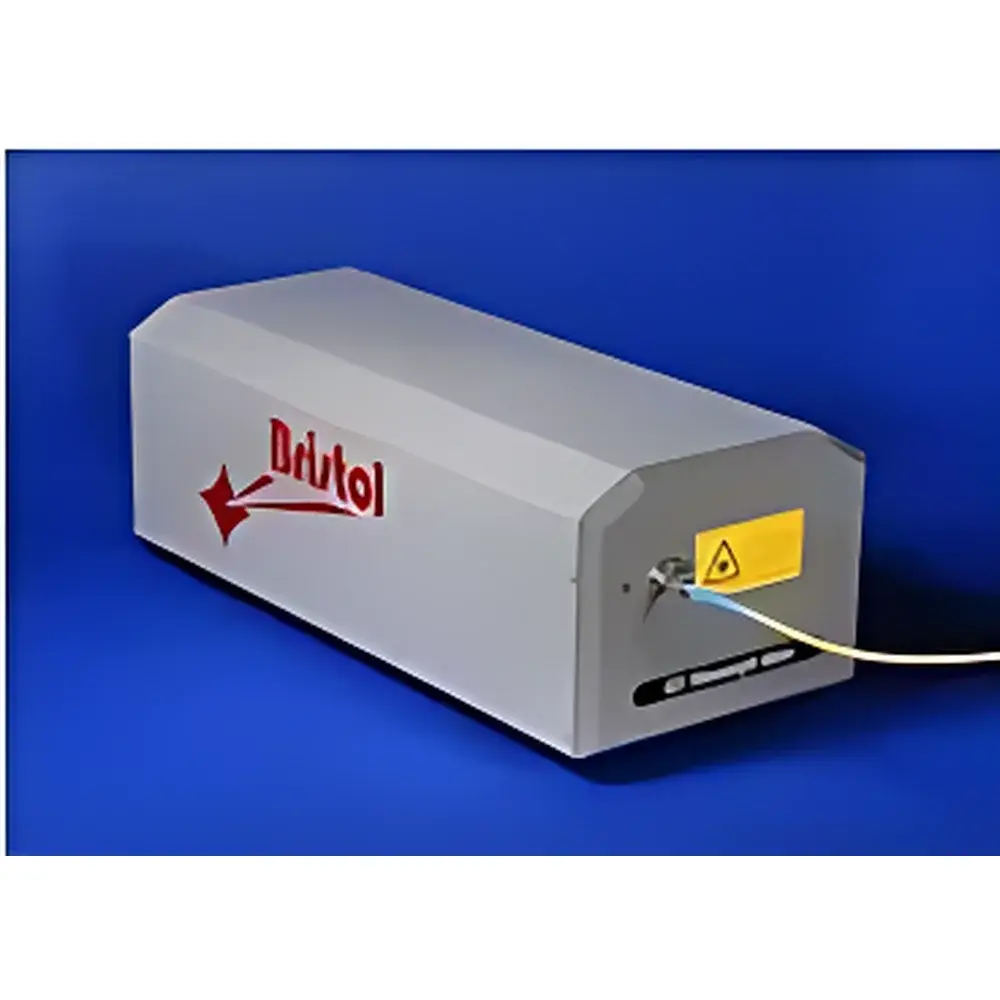
Bristol Instruments 621 Series High-Precision Laser Wavelength Meter
| Brand | Bristol |
|---|---|
| Origin | USA |
| Model | 621 |
| Wavelength Range | 350 nm – 11 µm (configurable by variant) |
| Absolute Accuracy | ±0.2 ppm (VIS/NIR), ±0.75 ppm (IR/MIR/XIR) |
| Repeatability | ±0.03 ppm (VIS/NIR), ±0.06–±0.1 ppm (IR–XIR) |
| Calibration Source | Internal Stabilized HeNe Laser |
| Minimum Input Power | 5–65 µW (wavelength-dependent) |
| Interface | High-Speed USB 2.0 |
| Display Resolution | 9 digits (621A), 8 digits (621B) |
| Units | nm, cm⁻¹ (vacuum/atmospheric), GHz |
| Input Options | FC/PC fiber (VIS/NIR), 2 mm collimated beam with alignment red pilot (IR+) |
Overview
The Bristol Instruments 621 Series Laser Wavelength Meter is an interferometric precision instrument engineered for absolute wavelength measurement of continuous-wave (CW) and pulsed lasers across ultraviolet, visible, near-infrared (NIR), mid-infrared (MIR), and extended infrared (XIR) spectral regions. Utilizing a thermally stabilized, high-finesse Fabry–Pérot interferometer coupled with a proprietary phase-shifting detection algorithm, the system achieves traceable absolute accuracy without reliance on external reference lasers during routine operation. Its core architecture integrates a built-in, actively stabilized HeNe laser as a permanent wavelength standard—enabling continuous in-situ calibration and eliminating drift-induced uncertainty over time. Designed for laboratory metrology, laser development, and optical frequency standards validation, the 621 delivers real-time, high-reproducibility measurements at up to 10 Hz acquisition rate, supporting rigorous experimental protocols requiring ISO/IEC 17025-compliant traceability.
Key Features
- Traceable absolute wavelength accuracy of ±0.2 ppm (e.g., ±0.0002 nm at 1000 nm) for VIS/NIR variants (621A); ±0.75 ppm for IR/MIR/XIR configurations (621B)
- Simultaneous wavelength and optical power measurement—power accuracy ±15% across calibrated range
- Multi-band spectral coverage: configurable modules support 350–1100 nm (VIS), 520–1700 nm (NIR), 1–5 µm (IR), 4–11 µm (MIR), and 2–12 µm (XIR)
- Low-power operation: minimum input as low as 5 µW @ 650 nm or 1100 nm; 10 µW @ 400 nm; 30 µW @ 1100 nm; 15 µW @ 1700 nm
- High-speed USB 2.0 interface with vendor-provided SDK for LabVIEW, Python, MATLAB, and C/C++ integration
- Real-time display with 9-digit resolution (621A) or 8-digit resolution (621B); selectable units: nm, cm⁻¹ (vacuum or atmospheric), GHz
- Thermally compensated optical path and rigid monolithic interferometer housing ensure long-term stability under ambient lab conditions
Sample Compatibility & Compliance
The 621 Series accommodates both free-space and fiber-coupled inputs. VIS/NIR models accept pre-aligned FC/PC fiber connectors or optional free-space coupling via adjustable kinematic mounts; IR+ variants utilize a 2 mm aperture collimated beam path with integrated 635 nm red alignment guide. The system complies with general requirements for optical metrology instrumentation per ANSI Z540.3 and supports documentation workflows aligned with GLP and GMP environments. While not FDA 21 CFR Part 11–certified out-of-the-box, its deterministic data logging, timestamped measurement records, and audit-ready output files enable straightforward validation for regulated QC laboratories. All calibration constants are stored internally and digitally signed to prevent unauthorized modification.
Software & Data Management
Bristol’s Wavelength Meter Software (v5.x) provides intuitive GUI control, real-time plotting, statistical analysis (mean, std dev, min/max over user-defined intervals), and automated report generation in PDF or CSV format. The SDK enables full remote control—including trigger synchronization, multi-channel averaging, and closed-loop feedback to tunable laser controllers. Measurement data includes embedded metadata: timestamp (UTC), input power, signal-to-noise ratio, interferometer status flags, and calibration epoch. Raw interferogram export is supported for advanced post-processing. Software logs retain full audit trail history for all parameter changes and calibration events—critical for ISO 17025 accreditation and internal quality audits.
Applications
- Calibration and verification of tunable diode lasers, Ti:sapphire oscillators, and fiber lasers in R&D labs
- Wavelength stabilization feedback for external cavity diode lasers (ECDLs) and DFB/DBR sources
- Characterization of narrow-linewidth lasers used in atomic physics (e.g., Rb, Cs cooling transitions) and optical clocks
- Validation of grating-based spectrometers and Fourier-transform infrared (FTIR) systems
- Monitoring wavelength drift in semiconductor laser modules under thermal or current stress testing
- Supporting NIST-traceable measurements in national metrology institutes and defense-related electro-optical test facilities
FAQ
Does the 621 require periodic recalibration by the manufacturer?
No—its internal stabilized HeNe reference laser provides continuous self-calibration. Annual verification against a primary standard is recommended for ISO 17025 compliance but not mandatory for routine operation.
Can the 621 measure pulsed lasers?
Yes—models configured for pulsed operation support single-shot and burst-mode acquisition with adjustable gate timing synchronized to external TTL triggers.
Is vacuum-wavelength or air-wavelength output selectable?
Yes—the software allows real-time conversion between vacuum and atmospheric cm⁻¹ or nm units using standard Edlén equation parameters.
What is the typical warm-up time to achieve specified accuracy?
Less than 30 minutes from cold start; thermal equilibrium is indicated by system status LED and software stability flag.
How is traceability to SI units maintained?
The internal HeNe laser is referenced to the iodine-stabilized 633 nm standard, which is itself linked to the cesium hyperfine transition via the speed of light definition—ensuring direct SI traceability per BIPM guidelines.



