
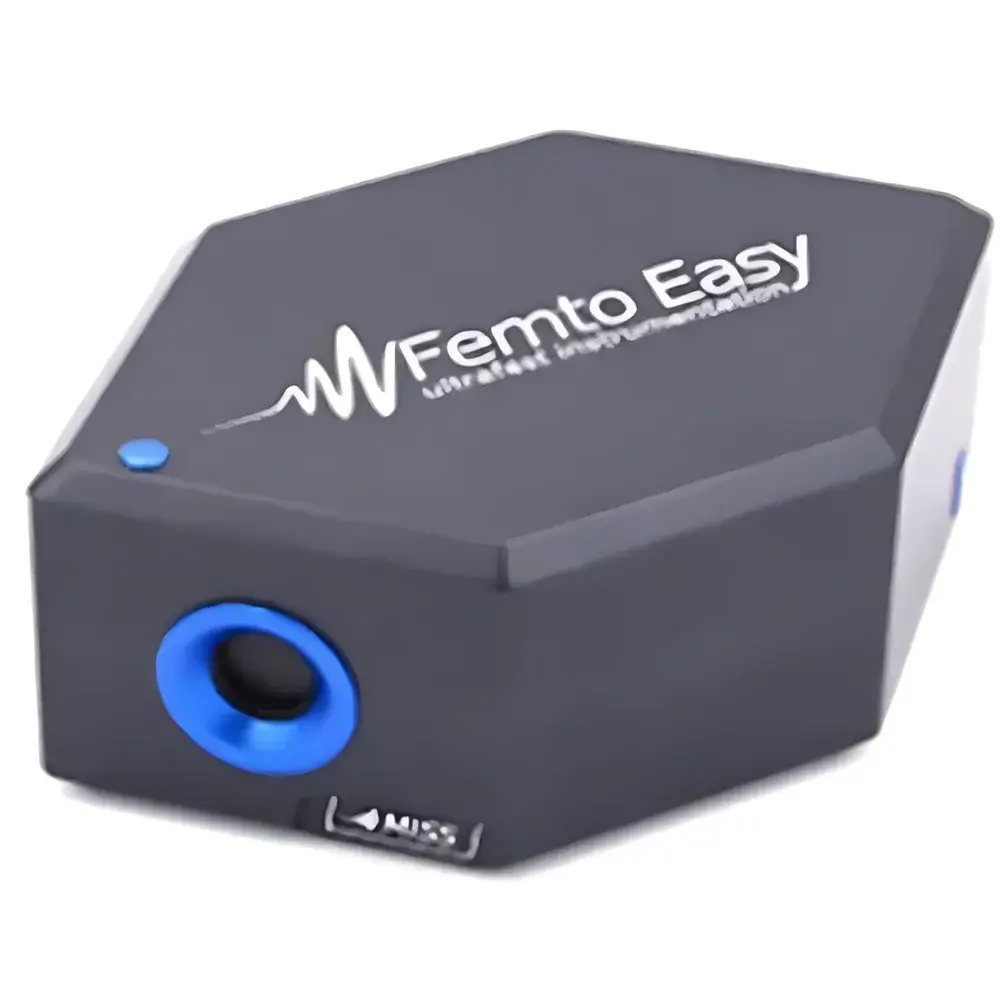
Femto Easy MISS Series 2D Imaging Spectrometer
| Brand | FEMTOEASY |
|---|---|
| Origin | France |
| Model Variants | SWIR 320, SWIR 640, SWIR 1280, VSWIR 656/L, VSWIR 1296/L, UV-VIS, Yb, Ti:Sa, IR-L, Ti:Sa-L, Broadband-L |
| Spectral Range | 240–1700 nm |
| Detector Types | InGaAs (SWIR), CMOS (UV-VIS-IR) |
| Resolution Options | 0.08–20 MPx |
| Spectral Sampling | 0.11–1.7 nm/pixel |
| Spectral Resolution | <0.35–3.5 nm (FWHM) |
| Spatial Resolution | 3.6–25 µm |
| Input Beam Diameter | 3.3–12.5 mm |
| Exposure Time | 0.01–10,000 ms |
| Interface | USB 3.1 |
| Shutter Type | Global (InGaAs & most CMOS) / Rolling (Broadband-L CMOS) |
| Dimensions | 102×101×52 mm to 117×102×52 mm |
Overview
The Femto Easy MISS (Multi-Imaging Spectral Sensor) Series is a line of compact, high-fidelity 2D imaging spectrometers engineered for spatially resolved spectral characterization of ultrafast and broadband laser sources. Unlike conventional 1D scanning or dispersive spectrometers, the MISS platform captures a full two-dimensional intensity map in a single exposure: one axis encodes spatial position across the beam profile (e.g., horizontal or vertical cross-section), while the orthogonal axis encodes wavelength (or frequency). This architecture leverages imaging spectroscopy principles—specifically, slitless, real-time, wide-field spectral dispersion coupled with pixel-registered detection—to quantify spatial-spectral coupling phenomena such as spatial chirp, beam-dependent spectral narrowing, gain narrowing in amplifiers, and non-uniform spectral phase across transverse modes. Designed for integration into ultrafast laser chains—including oscillator outputs, stretcher-compressor paths, amplifier stages, and post-compression diagnostics—the MISS series operates across an extended spectral range from deep ultraviolet (240 nm) to short-wave infrared (1700 nm), supporting femtosecond-to-picosecond pulse regimes without temporal gating.
Key Features
- True 2D spatial-spectral acquisition in a single shot—no scanning, no moving parts, no trade-off between speed and fidelity
- Modular model family covering application-specific bands: UV-VIS (240–800 nm), VIS-NIR (545–1100 nm), SWIR (900–1700 nm), and extended broadband variants up to 20 MPx resolution
- High spatial resolution down to 3.6 µm (Broadband-L model) and spectral resolution as fine as <0.35 nm (Ti:Sa-L), calibrated per ISO 14134 and traceable to NIST-traceable reference sources
- Compact, rigid aluminum housing (102 × 101 × 52 mm typical) with kinematic mounting options—designed for direct insertion into free-space beam paths at any orientation (horizontal, vertical, or oblique)
- Global shutter operation on all InGaAs and standard CMOS variants ensures temporal fidelity for pulsed measurements; rolling shutter enabled only where required for ultra-high-resolution broadband capture
- USB 3.1 Gen 1 interface with deterministic latency (<1.2 ms frame-to-host transfer) and native support for hardware-triggered acquisition synchronized to laser repetition rate
Sample Compatibility & Compliance
The MISS spectrometer accepts both free-space collimated beams (diameters 3.3–12.5 mm, depending on model) and fiber-coupled inputs via optional SMA-905 or FC/PC adapters. It is compatible with CW, quasi-CW, and pulsed sources—including Ti:sapphire, Yb-doped fiber, optical parametric amplifiers (OPAs), supercontinuum generators, and synchrotron-derived broadband pulses. All models comply with CE marking requirements under Directive 2014/30/EU (EMC) and 2014/35/EU (LVD). Firmware and acquisition software adhere to IEC 62304 Class B for medical-grade software lifecycle management and support audit-ready logging for GLP/GMP environments. Data export formats include HDF5 (with embedded metadata per NeXus standard), TIFF (16-bit linear), and CSV—enabling traceability per FDA 21 CFR Part 11 when used with validated configurations.
Software & Data Management
The proprietary MISS Control Suite (v4.2+) provides real-time visualization, spectral centroid tracking, spatial chirp vector quantification (dx/dλ), and custom ROI-based spectral slicing. It supports batch processing of time-series datasets (e.g., pump-probe delay scans or thermal drift monitoring) and exports calibrated spectra with uncertainty propagation per GUM (JCGM 100:2008). Integration APIs (Python SDK, MATLAB toolbox, LabVIEW VI library) enable automated control within larger experimental frameworks. All raw frames retain full bit-depth (12-bit), dark-current corrected, and flat-field normalized by default. Metadata—including exposure time, temperature, detector gain, and calibration timestamp—is embedded in every saved file using EXIF-compatible tags and extended FITS headers.
Applications
- Diagnosis and correction of spatial chirp in grating- or prism-based compressors (e.g., quantifying residual dx/dλ > 0.1 µm/nm)
- In-situ spectral homogeneity assessment across multi-stage amplifier chains (e.g., regenerative + multipass + post-compression)
- Characterization of supercontinuum spatial coherence and spectral uniformity in photonic crystal fibers
- Beam quality validation for industrial ultrafast lasers (ISO 11146-1/-2 compliant M² and spectral divergence mapping)
- Time-resolved spectral evolution in nonlinear frequency conversion processes (e.g., SHG, DFG, OPAs)
- Validation of pulse shaper fidelity in 4f geometry, including spectral phase error mapping across spatial coordinates
FAQ
What distinguishes a 2D imaging spectrometer from a traditional monochromator-based spectrometer?
A 2D imaging spectrometer captures wavelength and transverse spatial position simultaneously in one exposure, preserving correlations between spectrum and beam geometry—whereas monochromators scan sequentially and inherently average over spatial dimensions.
Can the MISS be used with amplified femtosecond pulses above 1 µJ/pulse?
Yes—when operated with appropriate neutral density attenuation and verified detector saturation thresholds (provided in model-specific datasheets), all MISS variants support peak intensities up to 10 GW/cm² for sub-100 fs pulses.
Is spectral calibration performed at the factory, and is recalibration required?
Each unit ships with NIST-traceable wavelength calibration (Hg/Ar lamp lines ±0.05 nm uncertainty) and spatial pixel mapping; field recalibration is optional and supported via the included calibration target kit and software wizard.
Does the system support synchronization with external triggers, such as laser sync outputs or delay generators?
Yes—hardware trigger input (TTL, 5 V, ≤10 ns jitter) enables precise frame alignment with laser pulses, pump-probe delays, or mechanical chopper signals.
Are software updates and firmware patches provided post-purchase?
Femto Easy offers lifetime software maintenance for registered instruments, including feature updates, bug fixes, and compatibility patches for new OS versions—delivered via secure HTTPS portal with SHA-256 signature verification.
Related Products






