
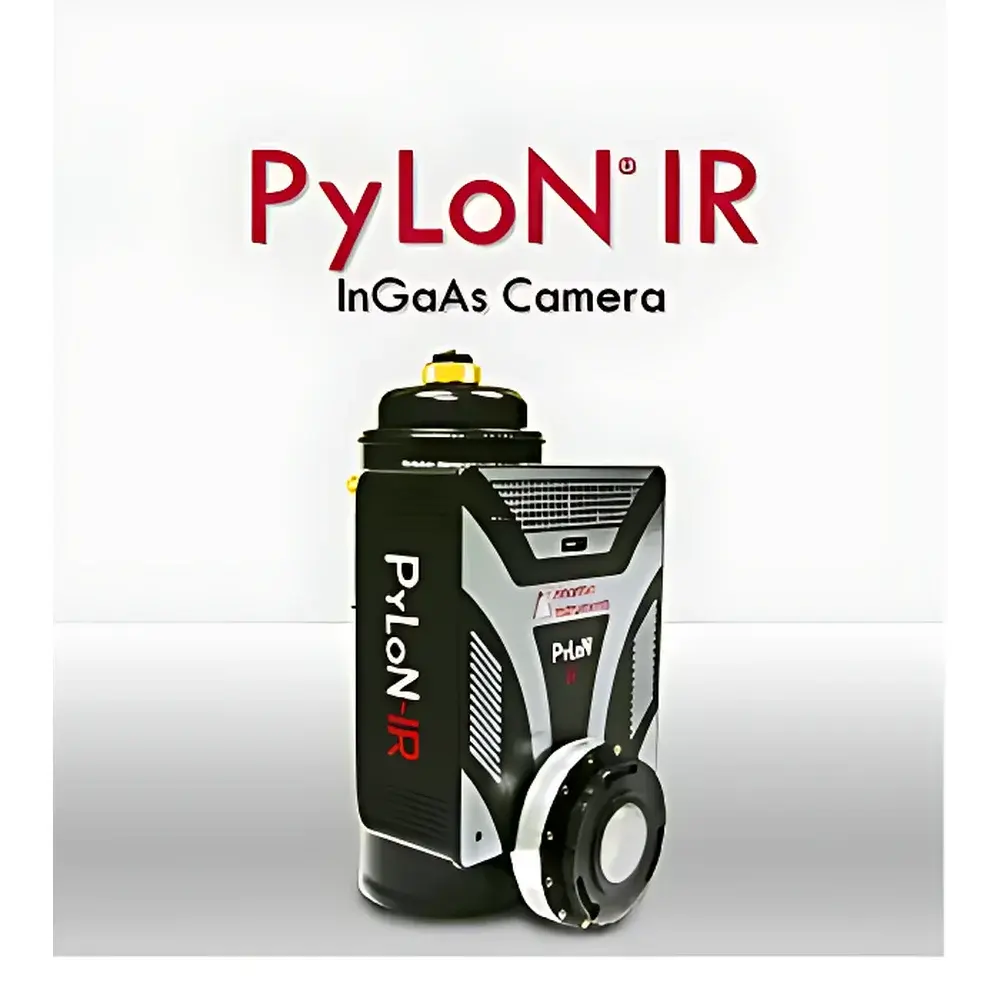
Teledyne Princeton Instruments PyLoN-IR Linear InGaAs Spectral Camera
| Brand | Teledyne Princeton Instruments |
|---|---|
| Origin | USA |
| Model | 1024-1.7, 1024-2.2 |
| Pixel Size | 25 µm (W) × 500 µm (H), 25 µm (W) × 250 µm (H) |
| Spectral Range | 800–1700 nm (1024-1.7), 1000–2200 nm (1024-2.2) |
| Digitization | 16-bit ADC |
| Max Acquisition Rate | 6600 spectra/sec |
| Cooling | Liquid nitrogen (77 K) |
| QE Peak | 88% (1024-1.7), 70% (1024-2.2) |
| Dark Current | <0.1 e⁻/pixel/sec @ 77 K |
| Read Noise | <15 e⁻ RMS (typ.) |
Overview
The Teledyne Princeton Instruments PyLoN-IR Linear InGaAs Spectral Camera is a high-performance, liquid nitrogen–cooled line-scan detector engineered for quantitative spectroscopic applications in the near-infrared (NIR) and short-wave infrared (SWIR) spectral regions. Unlike conventional thermoelectrically cooled InGaAs arrays, the PyLoN-IR employs a hermetically sealed, vacuum-jacketed architecture with direct liquid nitrogen cooling to stabilize the sensor at 77 K—enabling ultra-low dark current (<0.1 e⁻/pixel/sec), exceptional signal-to-noise ratio (SNR), and long-term measurement stability. Its core sensing element is a monolithic linear InGaAs photodiode array (1024 × 1 pixels), optimized for high quantum efficiency across two complementary spectral bands: 800–1700 nm (model 1024-1.7) and 1000–2200 nm (model 1024-2.2). The camera operates without an external controller, integrating all timing, biasing, and digitization circuitry onboard—a design that minimizes electromagnetic interference and ensures deterministic synchronization with pulsed lasers or scanning monochromators.
Key Features
- Liquid nitrogen cooling (77 K) for sub-nA dark current and thermal stability over extended acquisitions
- Hermetic metal-sealed vacuum housing extending operational lifetime beyond 10 years without maintenance
- 16-bit analog-to-digital conversion with 70 dB dynamic range
- Ultra-high spectral acquisition rate up to 6600 full-line spectra per second—optimized for real-time process monitoring and rapid scanning applications
- Two standard configurations: 1024-1.7 (25 µm × 500 µm pixels, 88% peak QE at ~1550 nm) and 1024-2.2 (25 µm × 250 µm pixels, 70% peak QE at ~2000 nm)
- Onboard programmable timing engine supporting complex trigger modes (external TTL, internal clock, gated integration)
- Full compatibility with LightField 64 software for hardware-level control, real-time visualization, and automated calibration workflows
Sample Compatibility & Compliance
The PyLoN-IR is designed for integration into benchtop and industrial spectrometers—including Czerny–Turner, Echelle, and Fourier-transform NIR platforms—as well as fiber-coupled Raman, photoluminescence, and laser-induced breakdown spectroscopy (LIBS) systems. Its linear geometry supports high optical throughput in slit-based configurations while maintaining spatial fidelity across the full 1024-pixel aperture. The detector meets key requirements for regulated analytical environments: raw data integrity is preserved through non-volatile memory logging of acquisition parameters (exposure time, gain, temperature, timestamp); LightField 64 supports audit-trail generation and user-access controls compliant with FDA 21 CFR Part 11 for GLP/GMP laboratories. While not certified as medical device hardware, its performance aligns with ASTM E131 (Standard Terminology Relating to Molecular Spectroscopy) and ISO 17025–accredited calibration practices when used with NIST-traceable reference sources.
Software & Data Management
Control and analysis are fully enabled via LightField 64—a modular, Windows-based application developed exclusively for Teledyne Princeton Instruments detectors. LightField provides synchronized multi-device orchestration (e.g., simultaneous shutter, grating, and detector control), real-time spectral preview with auto-scaling and baseline correction, and batch processing for large hyperspectral datasets. The integrated IntelliCal wavelength calibration system uses dual-lamp (Hg/Ar or Ne) references to achieve ±0.05 nm absolute accuracy across the full spectral range—with spatial nonlinearity compensation applied per pixel. All acquired spectra are saved in HDF5 format, preserving metadata (sensor temperature, integration time, firmware version) for traceability. Export options include CSV, MATLAB .mat, and vendor-neutral SPE file formats compatible with third-party chemometric tools (e.g., MATLAB Statistics Toolbox, Python SciPy, Unscrambler).
Applications
- Tip-Enhanced Raman Spectroscopy (TERS): High-sensitivity detection of nanoscale vibrational signatures with diffraction-limited spatial resolution in the 1–2.2 µm window
- Photoluminescence & Quantum Dot Characterization: Quantitative decay kinetics and spectral line-shape analysis of colloidal and epitaxial semiconductors under CW or pulsed excitation
- Surface-Enhanced Raman Spectroscopy (SERS): Low-noise capture of weak plasmon-coupled signals from Au/Ag nanostructures in aqueous or solid-phase matrices
- Coherent Anti-Stokes Raman Scattering (CARS): Synchronized detection of narrowband anti-Stokes signals requiring precise temporal gating and high dynamic range
- Resonance Raman & Stimulated Raman Scattering (SRS): Discrimination of electronic resonance conditions and amplification of weak vibrational transitions in biological tissues and polymers
- Industrial Process Monitoring: Real-time NIR/SWIR absorption spectroscopy for pharmaceutical blend uniformity, polymer composition, or agricultural moisture analysis
FAQ
What cooling method does the PyLoN-IR use, and why is it critical for low-noise operation?
The PyLoN-IR uses direct liquid nitrogen cooling to maintain the InGaAs sensor at 77 K. This reduces thermally generated dark current by more than three orders of magnitude compared to thermoelectric cooling, enabling integration times exceeding 10 seconds without saturation—essential for detecting weak luminescent or Raman signals.
Can the PyLoN-IR be operated without LightField software?
Yes—the camera supports ASCII-based serial command protocol (RS-232) and SDK libraries for C/C++, Python, and LabVIEW, allowing custom integration into OEM instruments or automated test benches.
How does the 1024-2.2 model achieve sensitivity beyond 1.7 µm despite lower peak QE?
The 1024-2.2 uses a modified InGaAs composition with extended cutoff wavelength, trading peak quantum efficiency for broader spectral response. Its smaller pixel height (250 µm vs. 500 µm) also improves charge collection efficiency at longer wavelengths where carrier diffusion length increases.
Is vacuum re-filling required during the product lifecycle?
No—the metal-sealed vacuum enclosure is permanently evacuated and baked during manufacturing; no serviceable vacuum ports or getter materials are present, eliminating routine maintenance.
Does the PyLoN-IR support hardware binning or region-of-interest (ROI) readout?
No—it is a true linear array with fixed 1024-pixel readout; however, software ROI selection and on-the-fly averaging are supported in LightField to optimize frame rate and SNR for specific spectral windows.




