
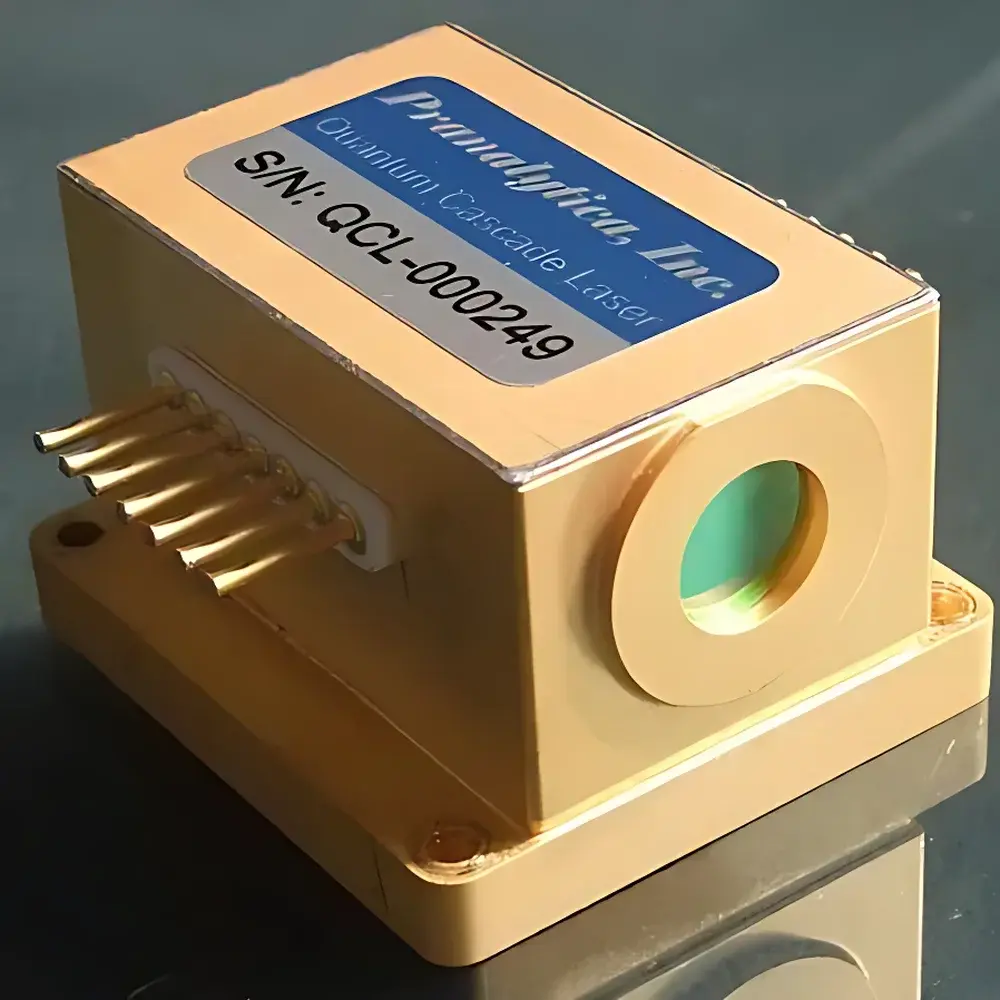
Pranalytica 1101-XX-CW-YYYY-BF OEM High-Power Continuous-Wave Quantum Cascade Laser
| Brand | Pranalytica |
|---|---|
| Origin | USA |
| Manufacturer Type | Authorized Distributor |
| Product Category | Imported Optical Instrument |
| Model | 1101-XX-CW-YYYY-BF |
| Output Wavelength Range | 3.8–12+ µm |
| Max CW Output Power | Up to 3.5 W @ 4.6 µm (OEM module, T<35°C) |
| Package | Butterfly with Integrated TEC, Thermistor, and Collimating Optics |
| Operating Temperature | Ambient <35°C (Module Baseplate), QCL Junction Temp Controlled to ≤45°C via TEC Feedback |
| Cooling Requirement | Active thermal management required (no external water cooling needed) |
| Compliance | Meets MIL-STD-810G for shock/vibration |
Overview
The Pranalytica 1101-XX-CW-YYYY-BF is an OEM-grade, high-power continuous-wave (CW) quantum cascade laser (QCL) engineered for integration into mid-infrared (MIR) spectroscopic, sensing, and countermeasure systems. Unlike conventional interband semiconductor lasers, the QCL operates on intersubband electron transitions within a repeated cascade of precisely engineered quantum wells—typically exceeding 500 periods—enabling single-electron injection to generate multiple photons per carrier. This unipolar architecture supports emission across two primary atmospheric transmission windows (3–5 µm and 8–12 µm), with demonstrated CW operation from 3.8 µm to beyond 12 µm. The 1101 series leverages Pranalytica’s patented waveguide design and intracavity high-reflectivity dielectric coatings to achieve unprecedented wall-plug efficiency and thermal stability at room temperature—eliminating reliance on cryogenic or liquid-cooling infrastructure while sustaining multi-watt optical output.
Key Features
- Industry-leading CW output power: up to 3.5 W at 4.6 µm and 2.5 W at 4.0 µm under controlled baseplate temperature (<35°C)
- OEM-optimized butterfly package integrating high-power QCL chip, thermoelectric cooler (TEC), NTC thermistor, and collimating optics in a hermetically sealed housing
- No external water cooling required—enabled by proprietary epitaxial structure and thermal management design
- Integrated temperature feedback loop: thermistor signal drives closed-loop TEC control to maintain junction temperature ≤45°C; automatic laser shutdown triggered above threshold
- Scalable power variants: 0.5 W to 3.5 W CW models (1101-XX-CW-500-BF through 1101-XX-CW-3500-BF), all compliant with MIL-STD-810G mechanical robustness specifications
- Available in fixed-wavelength and externally tunable configurations (e.g., Littrow- or Littman-type external cavity integration)
- RoHS-compliant materials and lead-free soldering processes aligned with industrial manufacturing standards
Sample Compatibility & Compliance
The 1101-XX-CW-YYYY-BF is designed for direct integration into gas-phase analytical platforms where spectral fidelity, long-term power stability, and environmental resilience are critical. Its MIR emission range overlaps fundamental vibrational absorption bands of key analytes—including CO, CO₂, NOₓ, CH₄, NH₃, H₂S, HF, and volatile organic compounds (VOCs)—enabling quantitative detection at sub-ppb levels using direct absorption or photoacoustic spectroscopy. The module complies with IEC 61000-6-3 (EMI emissions) and IEC 61000-6-2 (immunity), supports GLP/GMP-aligned system validation protocols, and meets mechanical stress requirements per MIL-STD-810G Method 516.6 (shock) and Method 514.6 (vibration). While not FDA-cleared as a medical device, its performance parameters align with ASTM E1421 and ISO 13485–compatible subsystem qualification frameworks for diagnostic instrument development.
Software & Data Management
As an OEM component, the 1101-XX-CW-YYYY-BF does not include embedded firmware or user-facing software. However, it is fully compatible with industry-standard current and temperature controllers featuring analog/digital I/O (0–5 V or 0–10 V modulation input), RS-232/RS-485, or USB-CDC interfaces. Pranalytica provides detailed electrical interface specifications, pinout diagrams, and thermal derating curves to support custom driver development. For traceable calibration and audit readiness, integration partners may implement timestamped telemetry logging of drive current, TEC voltage/current, and thermistor resistance—enabling full 21 CFR Part 11–compliant audit trails when deployed in regulated environments (e.g., pharmaceutical process monitoring or emissions compliance reporting).
Applications
- Defense & Security: Infrared countermeasures (IRCM), long-range standoff chemical threat detection, container inspection, and directed infrared counter-drone systems
- Medical Diagnostics: Real-time breath analysis for ammonia (liver/kidney function), acetone (diabetes monitoring), isoprene (cardiac stress), and sevoflurane (anesthetic delivery control)
- Environmental Monitoring: Mobile and stationary air quality networks, stack emission monitoring (EPA Method 320–compatible), marine vessel exhaust profiling, and agricultural methane flux quantification
- Industrial Process Control: In-situ natural gas composition analysis, leak detection in petrochemical facilities, fermentation headspace monitoring, and solvent vapor tracking in cleanrooms
- Semiconductor Manufacturing: Ultra-high-purity process gas verification (e.g., NF₃, SiH₄, BCl₃), chamber cleanliness assessment, and real-time etch endpoint detection
FAQ
What is the maximum allowable baseplate temperature for stable CW operation?
The module requires sustained baseplate temperature below 35°C. Exceeding this limit reduces output power and accelerates degradation; active thermal management (e.g., forced-air heat sinking or conductive cold plate) is mandatory.
Does the laser require a dedicated driver or can it operate with standard current sources?
A precision bipolar current source with low-noise (<100 nA RMS) and fast transient response (<10 µs rise time) is required. Pranalytica supplies recommended driver specifications but does not supply drivers as part of the OEM module.
Is wavelength tuning supported natively in the butterfly package?
No—tuning capability requires external cavity integration (e.g., diffraction grating + motorized stage). Fixed-wavelength modules are optimized for maximum power and reliability.
How is laser lifetime defined for OEM applications?
Mean time to failure (MTTF) exceeds 10,000 hours under specified thermal and electrical operating conditions. Lifetime is highly dependent on junction temperature control; operation above 45°C significantly reduces operational longevity.
Can multiple 1101 modules be combined for multi-wavelength output?
Yes—spatial or polarization multiplexing of discrete-wavelength modules enables broadband MIR illumination without moving parts, supporting multicomponent gas analysis and hyperspectral imaging subsystems.




