
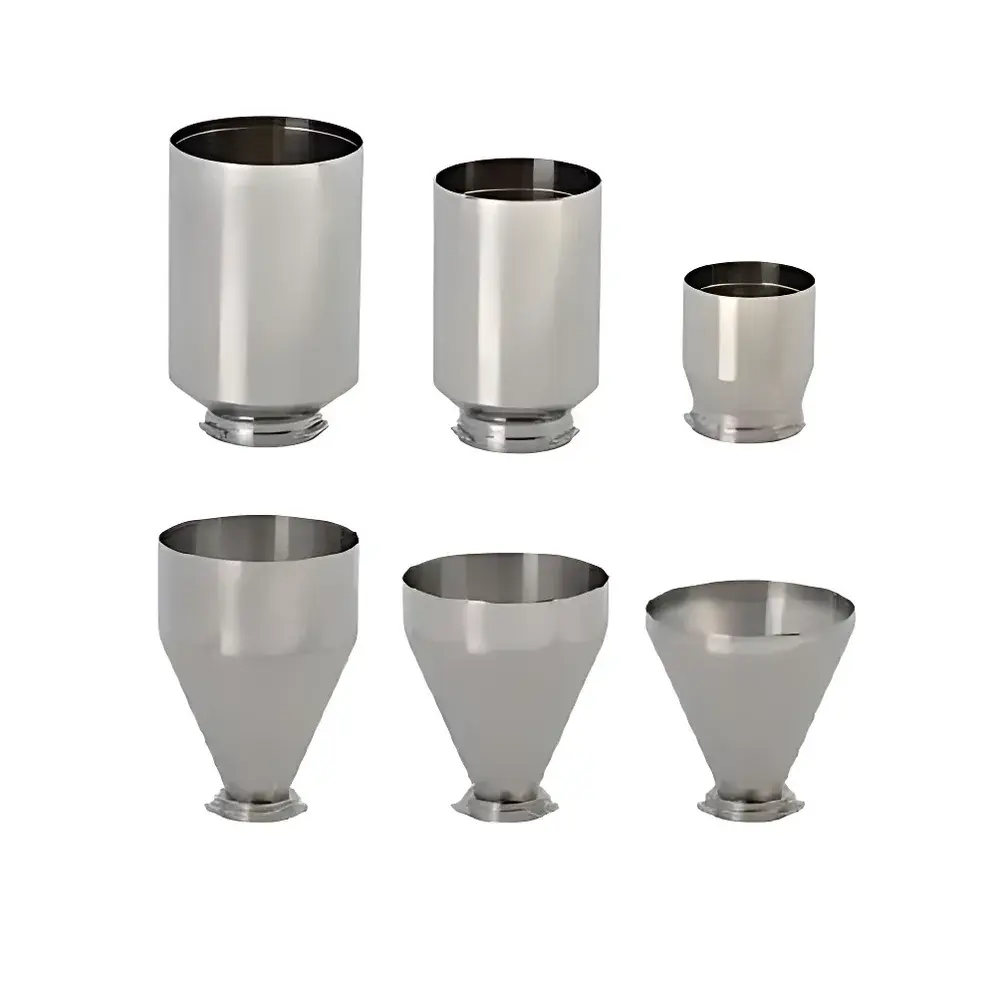
ROCKER Stainless Steel Filter Funnel Cup
| Brand | ROCKER |
|---|---|
| Origin | Taiwan |
| Material | ASTM-A276 Type 316 Stainless Steel |
| Sterilization Compatibility | Autoclave (121°C, 20 min), Dry Heat (180°C), Flame |
| Capacity Options | 100 mL (Straight-wall), 300 mL (Straight-wall), 500 mL (Straight-wall), 500 mL (Conical), 750 mL (Conical), 1000 mL (Conical) |
| Warranty | 24 months parts coverage |
| Regulatory Compliance | Designed for GLP-compliant laboratories |
| Model Designation | 167103-61, 167103-63, 167103-65, 167102-50, 167102-75, 167102-99 |
Overview
The ROCKER Stainless Steel Filter Funnel Cup is a precision-engineered filtration component designed for high-integrity liquid handling in regulated life science and bioprocessing environments. Constructed entirely from ASTM-A276 Type 316 stainless steel, this funnel cup integrates seamlessly into vacuum-assisted or pressure-driven filtration systems—serving as the primary receptacle for membrane-based microfiltration (MF) and ultrafiltration (UF) workflows. Its operational principle relies on gravity-, vacuum-, or positive-pressure–driven flow across sterile-grade membranes (e.g., PVDF, PES, or nylon), enabling quantitative recovery of cells, particulates, or biomolecules while maintaining structural integrity under repeated thermal and chemical stress. Unlike polymer-based alternatives, the all-metal construction eliminates extractables, leachables, and dimensional drift during sterilization cycles—making it suitable for upstream biomanufacturing, QC microbiology, and analytical sample preparation where material compatibility and batch-to-batch reproducibility are critical.
Key Features
- Patented twist-lock coupling mechanism (Taiwan Patent No. M381450): Enables tool-free, leak-tight assembly with <1.5 N·m torque requirement—verified per ISO 8536-4 for fluid pathway integrity under vacuum up to −95 kPa.
- Full-body ASTM-A276 Type 316 stainless steel: Superior resistance to chloride-induced pitting and crevice corrosion; validated for >500 autoclave cycles at 121°C/20 min without surface passivation loss (per ASTM A967).
- Dual geometry options: Straight-wall variants (100–500 mL) optimized for volumetric accuracy and sedimentation studies; conical variants (500–1000 mL) engineered for efficient slurry collection and minimal residual volume (<0.3 mL at 1000 mL scale).
- Electropolished interior finish (Ra ≤ 0.4 µm): Reduces protein adsorption and biofilm nucleation; compliant with ASME BPE-2022 surface roughness requirements for single-use and multi-use bioprocess components.
- Integrated O-ring groove design: Accommodates FDA-listed silicone or EPDM gaskets (not included); ensures repeatable sealing performance across temperature ranges from −20°C to +180°C.
Sample Compatibility & Compliance
The ROCKER Stainless Steel Filter Funnel Cup supports aqueous, organic, and mildly acidic/basic solutions (pH 2–12) when paired with chemically compatible filter membranes. It is routinely deployed in USP sterility testing, ISO 8573-7 compressed air particulate analysis, and ASTM D4189-22 suspended solids quantification. The device conforms to ISO 9001:2015 quality management system requirements at the point of manufacture in Taiwan. While not individually certified to ISO 13485, its material traceability, heat lot documentation, and surface finish verification support integration into GMP-compliant purification trains and GLP audit trails. All models are compatible with standard 47 mm and 90 mm diameter membrane filters and interface with common filtration manifolds (e.g., Millipore® Steriflip®, Sartorius® Minisart® NML).
Software & Data Management
As a passive hardware component, the funnel cup does not incorporate embedded electronics or firmware. However, its mechanical consistency enables full traceability within digital lab infrastructure: capacity variants are uniquely encoded in model numbers (e.g., 167103-65 = 500 mL straight-wall), supporting automated inventory reconciliation via LIMS or ELN systems. Batch-specific material certifications (EN 10204 3.1) and electropolishing validation reports can be supplied upon order—facilitating 21 CFR Part 11–aligned record retention when linked to electronic batch records. Calibration of associated vacuum manifolds or pressure transducers remains the responsibility of the end-user per ISO/IEC 17025 guidelines.
Applications
- Microbiological analysis: Membrane filtration of water, pharmaceuticals, and cosmetics per APHA Standard Methods 9222B and EU Pharmacopoeia 2.6.28.
- Cell harvesting and washing: Recovery of mammalian, bacterial, or yeast cultures prior to lysis or cryopreservation—minimizing shear stress and metal ion leaching.
- Environmental monitoring: Filtration of wastewater, seawater, and air sampling impingers for subsequent ICP-MS or SEM-EDS analysis.
- Biopharmaceutical process development: Clarification of clarified lysates or harvest streams in bench-scale UF/DF experiments.
- Quality control laboratories: Reusable alternative to disposable polypropylene funnels in high-volume QC testing, reducing plastic waste and long-term cost-of-ownership.
FAQ
Is the funnel cup compatible with aggressive solvents such as acetone or chloroform?
Yes—when used with solvent-resistant membranes (e.g., PTFE or PVDF) and appropriate gasket materials (e.g., fluorosilicone), the Type 316 stainless steel body exhibits no degradation in contact with Class II and III organic solvents per ASTM D543.
Can the funnel cup be used under positive pressure?
It is rated for continuous operation at ≤100 kPa(g) when assembled with certified gaskets and mounted on pressure-rated filtration housings; static pressure testing data available upon request.
Does ROCKER provide cleaning validation protocols?
Standard operating procedures for alkaline detergent wash, nitric acid passivation, and rinse water conductivity testing are included in the technical documentation package.
Are replacement O-rings available as spare parts?
Yes—silicone (70 Shore A) and EPDM (75 Shore A) gaskets are stocked under part numbers OR-316-SIL-47 and OR-316-EPDM-47 for 47 mm configurations.
What is the maximum recommended operating temperature during dry-heat sterilization?
180°C for 60 minutes, consistent with ISO 17665-1 Annex C for depyrogenation validation of stainless steel components.
Related Products



