
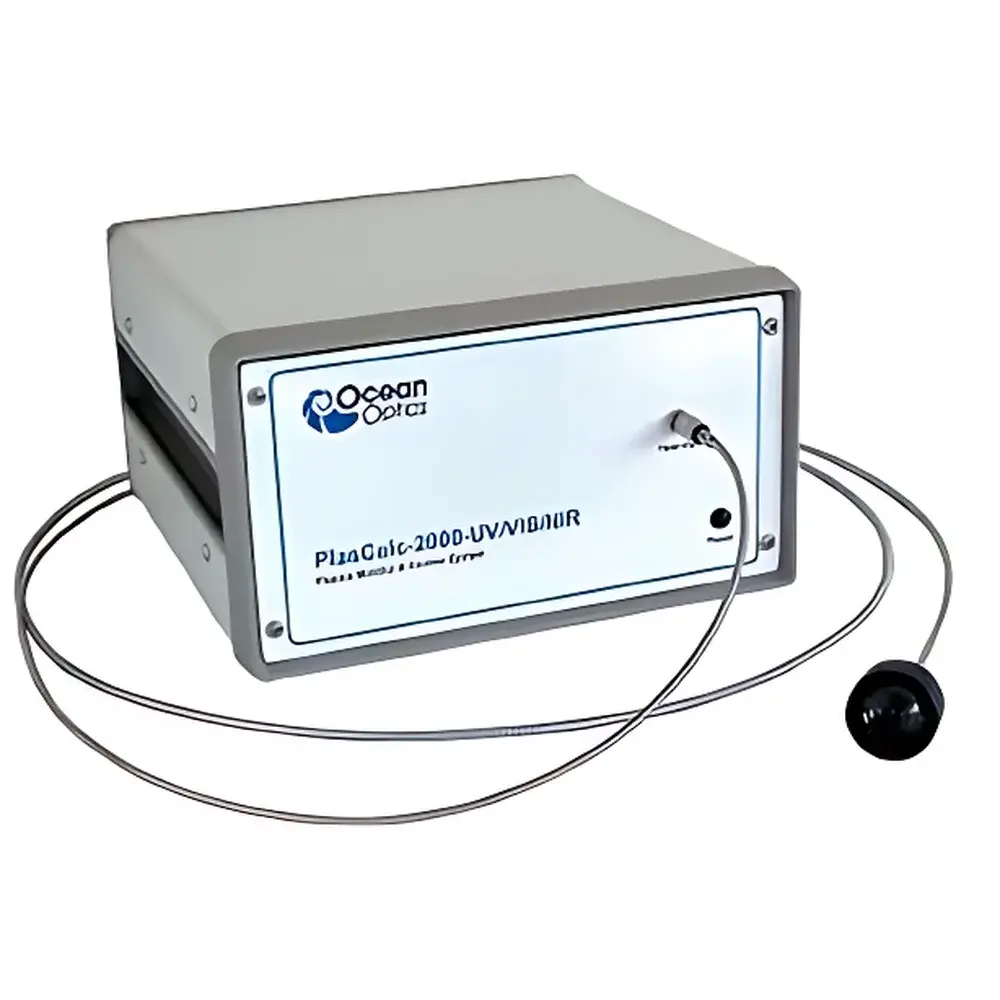
Ocean Optics PlasCalc Plasma Monitoring System
| Brand | Ocean Optics |
|---|---|
| Origin | USA |
| Model | PlasCalc |
| Spectral Range | 200–1100 nm |
| Optical Resolution | 1.0 nm (FWHM) |
| A/D Conversion | 14-bit |
| Digital I/O | 8 × TTL |
| Analog Outputs | 4 × [0–10 V] |
| Interface | USB 1.1 |
| Power Supply | 12 VDC @ 1.25 A |
| Measurement Speed | ≤3 ms per spectrum |
| Ion Detection Capability | Multi-ion (indirect via spectral emission analysis) |
Overview
The Ocean Optics PlasCalc Plasma Monitoring System is a high-speed, fiber-optic-based spectrometric platform engineered for real-time optical emission spectroscopy (OES) of low-temperature plasma processes. Unlike conventional ion-selective electrode or mass-spectrometry-based approaches, the PlasCalc operates on the principle of passive spectral decomposition: it captures and quantifies characteristic atomic and molecular emission lines across the deep UV to near-infrared range (200–1100 nm), enabling indirect but highly specific identification and relative quantification of reactive species—including Ar⁺, O, N₂⁺, F*, Cl*, Si*, and metal sputter emissions—within plasma chambers. Designed for integration into semiconductor fabrication lines, thin-film coating systems, and plasma-enhanced chemical vapor deposition (PECVD) tools, the system delivers sub-3-millisecond spectral acquisition with 1.0 nm full-width-at-half-maximum (FWHM) optical resolution—sufficient to resolve key diagnostic lines such as the 777.4 nm O I triplet, 640.2 nm Ar II line, or 519.8 nm Cu I transition. Its compact OEM-grade architecture supports in situ installation with minimal footprint and no vacuum interface requirements.
Key Features
- Real-time spectral acquisition at ≤3 ms per full 200–1100 nm scan—enabling closed-loop process feedback at production-relevant timescales
- High-fidelity optical resolution of 1.0 nm (FWHM) maintained across the entire spectral range, calibrated traceably to NIST-traceable emission standards
- Integrated 14-bit analog-to-digital conversion with 4 programmable analog outputs (0–10 V) for direct interfacing with PLCs, RF generators, or gas flow controllers
- Eight TTL-level digital I/O lines supporting external trigger synchronization, shutter control, and alarm signaling compliant with SEMI E10 and E19 standards
- USB 1.1 interface with deterministic latency—compatible with Windows-based host systems running under industrial RTOS environments (e.g., NI VeriStand, MATLAB Real-Time Workshop)
- Ruggedized aluminum housing rated IP52 for operation in cleanroom Class 1000 environments; operating temperature range: 10–40 °C, non-condensing
Sample Compatibility & Compliance
The PlasCalc does not require physical sample introduction or consumables; it interfaces optically via SMA905 fiber coupling to plasma viewports (quartz or MgF₂ windows). It is compatible with capacitively coupled plasma (CCP), inductively coupled plasma (ICP), microwave plasma, and dielectric barrier discharge (DBD) sources. The system complies with IEC 61326-1 (EMC for laboratory equipment) and meets essential requirements of the EU Machinery Directive 2006/42/EC when integrated into automated tool platforms. While not a certified medical or environmental compliance instrument per se, its spectral data output supports adherence to ISO 14644-1 (cleanroom monitoring), ASTM F2627 (plasma process validation), and SEMI F20 (plasma etch endpoint detection) protocols. Data integrity features—including timestamped spectra, hardware-enforced acquisition logs, and optional audit trail configuration—align with GLP and GMP documentation expectations for regulated manufacturing.
Software & Data Management
The PlasCalc ships with PlasCalc Control Suite v4.x—a modular, scriptable application built on .NET Framework with native support for Python (via COM interop) and LabVIEW (NI-VISA drivers). The embedded Recipe Editor enables drag-and-drop construction of multistep measurement sequences: users define wavelength regions of interest (ROIs), baseline correction methods (e.g., asymmetric least squares), peak integration algorithms (Gaussian deconvolution, centroid tracking), and threshold-triggered actions (e.g., “if Si 251.6 nm intensity drops >15% over 5 s, assert DIO#3 low”). All recipes are stored in encrypted XML format with SHA-256 checksums. Raw spectral data is saved in HDF5 format (HDF Group specification 1.12+), ensuring long-term readability and compatibility with third-party analysis tools such as Igor Pro, OriginLab, or Python’s h5py ecosystem. Optional FDA 21 CFR Part 11 compliance package includes electronic signature enforcement, role-based access control, and immutable audit trails for all method modifications and data exports.
Applications
- Endpoint detection in plasma etching of SiO₂, Si₃N₄, and photoresist layers using time-resolved intensity tracking of CO, CN, or SiCl emission bands
- Real-time chamber conditioning monitoring via O/H/N emission ratio trends during plasma cleaning cycles
- RF power and pressure optimization in PECVD of a-Si:H or SiNx films through correlation of NH₂* (336 nm) and SiH* (395 nm) band intensities
- Anomaly detection in plasma source degradation—e.g., tungsten sputtering from electrodes signaled by W I lines at 400.9 nm and 429.5 nm
- Multi-point spatial mapping of plasma uniformity using fiber bundle arrays coupled to a single PlasCalc unit
- Qualitative contamination screening in vacuum systems via detection of hydrocarbon C₂ Swan bands (516 nm) or water OH rotational lines (725–740 nm)
FAQ
Does the PlasCalc directly measure ion concentration in ppm or ppb units?
No. It measures relative photon fluxes of atomic/molecular emission lines. Quantitative ion density calibration requires separate Langmuir probe or actinometry validation under identical plasma conditions.
Can the PlasCalc operate in ultra-high vacuum (UHV) environments?
No—the spectrometer itself remains external; only the fiber-optic cable and viewport are UHV-compatible. Vacuum feedthroughs and window transmission must be validated separately.
Is firmware update supported in the field?
Yes—via signed binary packages delivered through Ocean Insight’s secure customer portal; updates preserve existing calibration coefficients and recipe libraries.
What is the typical calibration interval for factory spectral calibration?
Ocean Optics recommends annual recalibration against Hg/Ar/Ne lamp standards; drift tolerance is specified as ±0.2 nm over 12 months at constant ambient temperature.
Can multiple PlasCalc units be synchronized for distributed plasma monitoring?
Yes—using external TTL trigger distribution and software-managed time-stamp alignment within ±10 µs jitter across up to 16 units on a shared USB hub or Ethernet gateway (with optional USB-to-Ethernet bridge module).







