
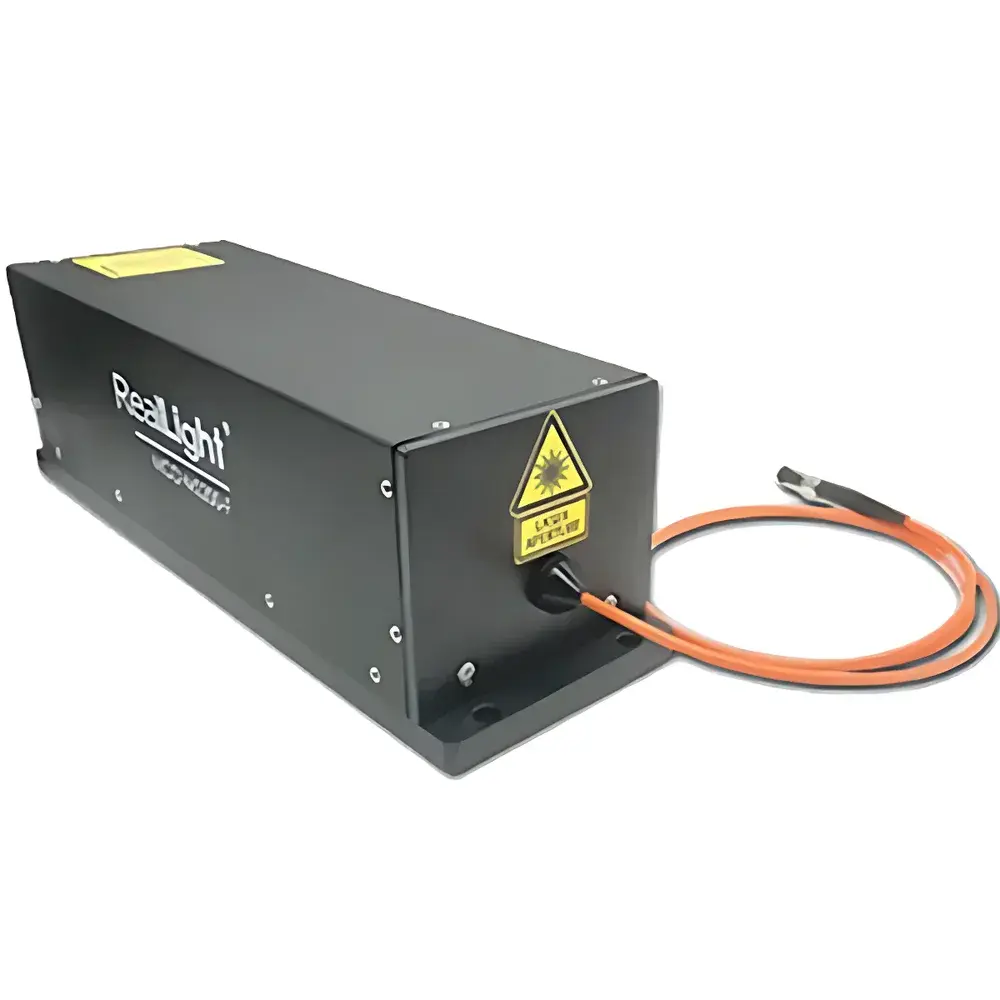
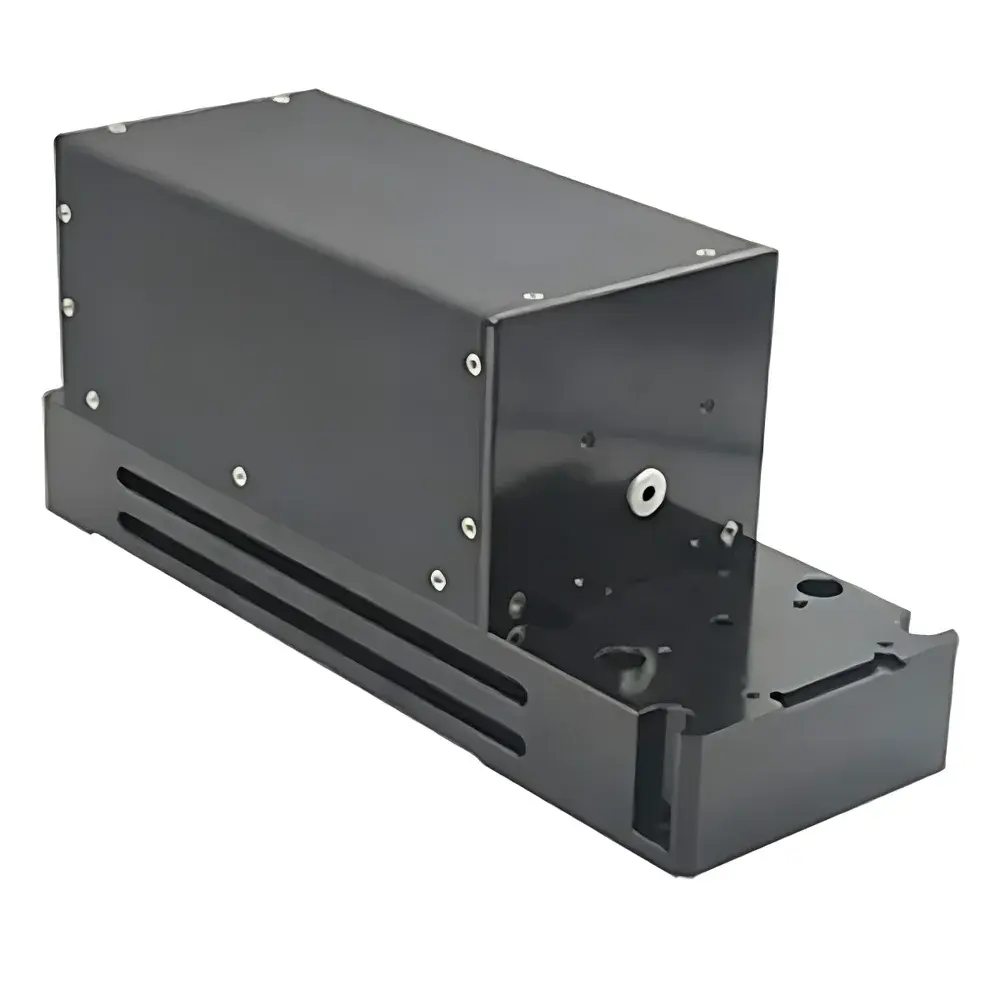
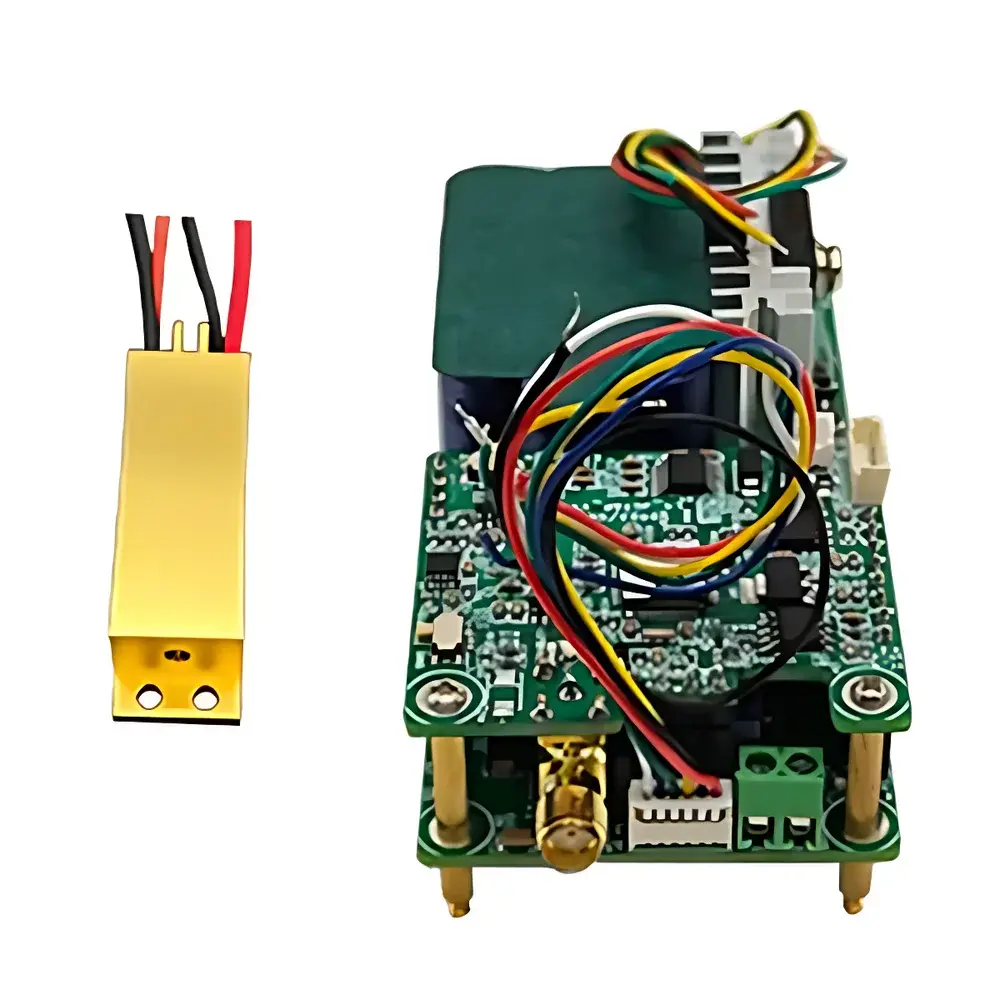
RealLight MCM & MCO Series High-Energy Tunable Microchip Lasers
| Brand | RealLight |
|---|---|
| Origin | Beijing, China |
| Model(s) | MCM, MCO |
| Output Configuration | Free-space (MCO) or Fiber-coupled (MCO-F) |
| Wavelength Range | 266–1064 nm |
| Repetition Rate | 10–200 Hz |
| Pulse Energy | >10 mJ (MCM @ 1064 nm) |
| Pulse Width | <3 ns (MCM) |
| Laser Type | Diode-pumped solid-state (DPSS) microchip laser |
| Cooling | Conductive / Forced-air (model-dependent) |
| Compliance | CE-marked per EN 60825-1:2014 (Class 4 laser product) |
| Control Interface | RS232 / USB / Analog TTL sync |
Overview
The RealLight MCM and MCO series are compact, diode-pumped solid-state (DPSS) microchip lasers engineered for high pulse energy, narrow linewidth, and excellent beam quality in a monolithic cavity architecture. Based on Nd:YAG or Nd:YVO₄ gain media with intracavity harmonic generation, these lasers operate across fundamental (1064 nm) and harmonic wavelengths (532 nm, 355 nm, 266 nm), delivering stable Q-switched output with sub-nanosecond to few-nanosecond pulse durations. The MCM variant is optimized for maximum single-pulse energy (>10 mJ at 1064 nm, 10 Hz), while the MCO platform provides continuous, software-controlled energy tuning across its full wavelength range—enabling precise irradiance calibration without mechanical attenuation. Both models feature hermetically sealed microchip resonators, minimizing sensitivity to thermal drift and mechanical vibration—critical for integration into OEM systems, field-deployable instrumentation, and laboratory-grade analytical platforms.
Key Features
- Monolithic DPSS design ensures long-term alignment stability and low maintenance requirements
- MCM: Fixed-wavelength, high-energy configuration ideal for LIBS, laser ablation, and plasma generation
- MCO: Continuously tunable pulse energy (via intra-cavity variable reflectivity or pump current modulation) across 266–1064 nm; supports both free-space and fiber-coupled (MCO-F) output variants
- Pulse-to-pulse energy stability <±3% RMS (typical, over 8 hours, temperature-stabilized environment)
- Beam divergence <2 mrad (full angle, TEM₀₀ dominant mode); M² <1.3 measured via scanning slit profiler
- Integrated digital control interface (RS232/USB) with programmable trigger delay, burst mode, and external TTL synchronization
- Compliant with IEC 60825-1:2014 Class 4 laser safety requirements; includes interlock circuitry and emission indicator
Sample Compatibility & Compliance
The MCM/MCO series is compatible with standard optical tables, kinematic mounts, and commercial spectrometers, mass analyzers, and time-resolved detection systems. Its short pulse width and high peak power enable efficient nonlinear excitation in UV–NIR spectral regions—making it suitable for demanding applications requiring minimal thermal load and precise spatiotemporal confinement. All units undergo factory calibration traceable to NIST-traceable radiometric standards. Device firmware and operational logs support audit-ready documentation for GLP/GMP environments. While not FDA-cleared as a medical device, the system meets essential requirements for Class IV laser use in ISO 13485-aligned manufacturing facilities and research labs operating under 21 CFR Part 11-compliant data governance frameworks.
Software & Data Management
RealLight provides the RL-LaserControl Suite—a cross-platform application (Windows/Linux) enabling remote parameter configuration, real-time pulse energy monitoring, and synchronized acquisition triggering. The software exports timestamped energy logs in CSV/JSON format, supports SCPI command set for integration with LabVIEW, Python (PyVISA), or MATLAB environments, and includes built-in routines for automated wavelength switching and energy ramping profiles. Firmware updates preserve user-defined calibration offsets and maintain backward compatibility with legacy control hardware. Audit trails record all parameter changes with user ID, timestamp, and IP address (when network-enabled)—fulfilling electronic record integrity requirements per ALCOA+ principles.
Applications
- Laser-Induced Breakdown Spectroscopy (LIBS): High pulse energy enables robust plasma generation on conductive/non-conductive samples with improved signal-to-background ratio
- Raman Spectroscopy: UV (266 nm) and visible (532 nm) configurations reduce fluorescence interference in biological and polymeric materials
- Laser Ablation ICP-MS: Sub-ns pulses minimize thermal diffusion, enhancing spatial resolution in depth profiling and elemental mapping
- Time-Resolved Photoluminescence (TRPL): <1 ns pulse width allows direct measurement of carrier recombination dynamics in semiconductors and perovskites
- Laser Radar (LIDAR) Development: High repetition rate (up to 200 Hz) and beam pointing stability support rangefinding and atmospheric backscatter characterization
- UV Microfabrication: 266 nm output enables high-resolution ablation of polymers, thin films, and photoresists without substrate damage
- Optical Pump-Probe Experiments: Synchronized dual-wavelength operation (e.g., 1064 nm pump + 266 nm probe) is supported via external delay generators
FAQ
What is the difference between the MCM and MCO models?
The MCM is a fixed-output, high-energy platform optimized for maximum pulse energy at discrete wavelengths (e.g., 1064 nm or 266 nm). The MCO offers continuously adjustable pulse energy across its entire tuning range and supports both free-space and fiber-coupled delivery.
Can the MCO be operated at multiple wavelengths simultaneously?
No—wavelength selection is discrete and requires manual or motorized filter/harmonic separator adjustment; simultaneous multi-wavelength output is not supported.
Is OEM integration supported?
Yes—RealLight provides mechanical drawings, electrical interface schematics, SDK documentation, and custom mounting flanges upon NDA. Units are designed for rack-mount or embedded chassis integration.
Does the system include beam diagnostics?
Beam profiling and energy metering require external accessories (e.g., pyroelectric sensor, CCD beam profiler); these are not bundled but are fully compatible with industry-standard interfaces.
What cooling method is required?
Standard configurations use conductive cooling via baseplate; high-repetition-rate or high-duty-cycle operation may require optional forced-air or thermoelectric cooling modules.





