
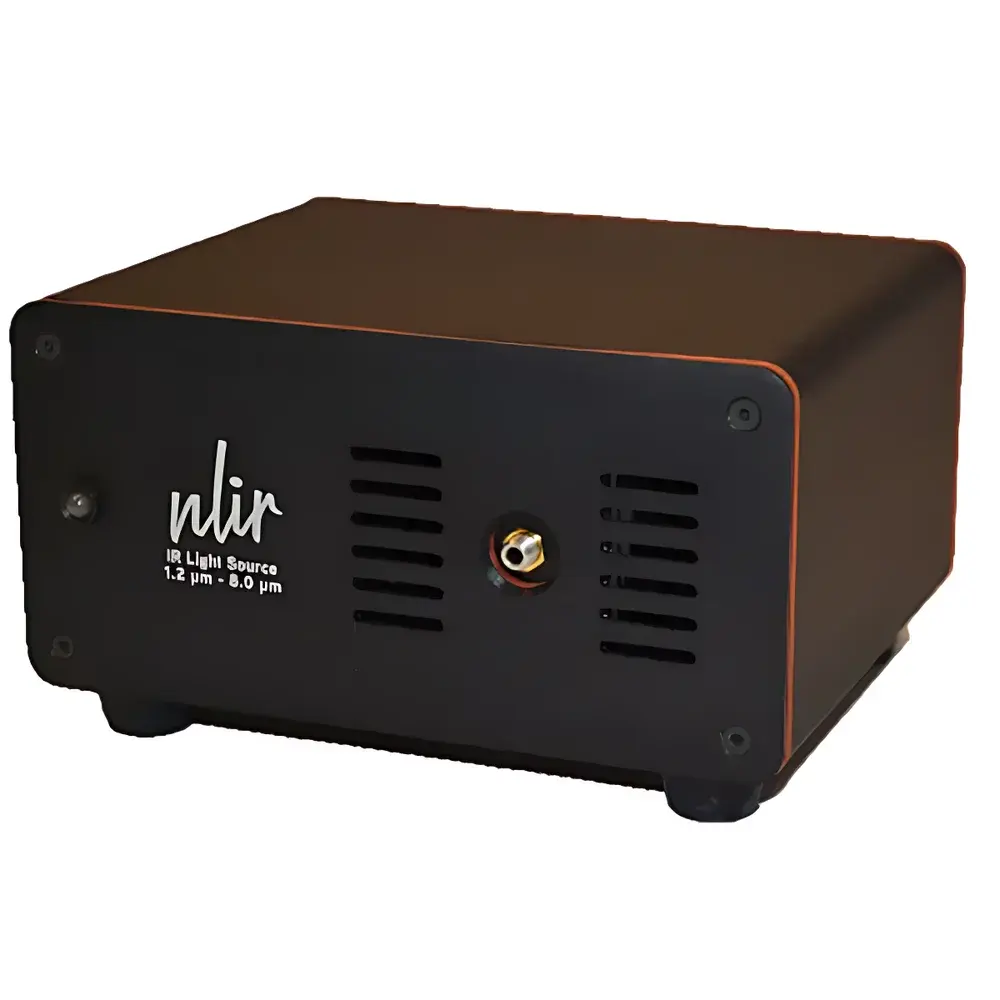
NLIR Fiber-Coupled Thermal Infrared Source
| Brand | NLIR |
|---|---|
| Origin | Denmark |
| Light Source Type | Mid-Infrared (MIR) Thermal Source |
| Wavelength Range | 1.2–8.0 µm |
| Output Power in ≥500 µm Fiber | >5 mW |
| Power Stability | ±0.5% (over time) |
| Lifetime | 5,000 hours |
| Cooling | Active Thermoelectric Cooling |
| Fiber Coupling | Standard FC/PC or SMA-compatible |
| Compliance | CE-marked, RoHS-compliant |
| Software Interface | None (standalone analog/digital control via TTL or 0–10 V input) |
Overview
The NLIR Fiber-Coupled Thermal Infrared Source is a compact, actively cooled broadband mid-infrared (MIR) emitter engineered for precision optical integration in laboratory and industrial spectroscopic systems. Unlike conventional blackbody or globar sources, this device leverages thermally stabilized resistive filament architecture optimized for spectral continuity across 1.2–8.0 µm — a range encompassing fundamental vibrational absorption bands of organic molecules, polymers, gases (e.g., CO, CO₂, CH₄, NOₓ), and semiconductor materials. Its core innovation lies not in spectral tunability, but in delivering high radiance, spatially confined MIR radiation directly into standard silica-based or fluoride fibers (≥500 µm core), eliminating free-space alignment complexity and enabling repeatable, vibration-insensitive illumination of remote or embedded samples. The source operates on the principle of incandescent thermal emission governed by Planck’s law, with spectral output calibrated against NIST-traceable reference standards. It is designed as a stable, low-maintenance excitation component — not a standalone spectrometer — intended for use with Fourier-transform infrared (FTIR), dispersive grating, or upconversion-based detection platforms.
Key Features
- Fiber-coupled output compatible with standard FC/PC or SMA connectors, supporting both step-index and low-OH silica fibers (up to 500 µm core diameter) and ZrF₄-based fluoride fibers for extended MIR transmission
- Active thermoelectric cooling ensures surface temperature remains below 45 °C during continuous operation, eliminating burn hazards and minimizing thermal drift in adjacent optical components
- Power stability better than ±0.5% over 8-hour continuous operation, verified under controlled ambient conditions (23 ±1 °C, <40% RH)
- Rated lifetime of 5,000 hours at nominal output power, validated per IEC 62040-2 accelerated life testing protocols
- Fast turn-on response: reaches 95% of nominal radiance within 3 seconds of power application, with no warm-up stabilization delay
- Analog (0–10 V) and digital (TTL) modulation inputs support external intensity control and synchronization with detector gating or scanning mechanisms
- CE-marked and RoHS-compliant; housed in an aluminum chassis with integrated heat-sink and EMI-shielded DC power interface (24 V DC, 2 A max)
Sample Compatibility & Compliance
The NLIR fiber-coupled infrared source is compatible with any measurement configuration requiring broadband MIR excitation delivered via fiber optic path — including reflection/transmission cells, gas flow cuvettes, attenuated total reflectance (ATR) probes, and microfluidic integration modules. It meets mechanical and electrical safety requirements per EN 61010-1 for laboratory equipment and conforms to electromagnetic compatibility standards EN 61326-1. While not intrinsically safe for hazardous environments, it may be deployed in Class 1 Div 2 areas when housed in appropriate enclosures. The source does not emit laser radiation and requires no laser safety classification (IEC 60825-1). For regulated applications (e.g., pharmaceutical process analytical technology or environmental emissions monitoring), its stability profile supports compliance with USP , ASTM E1421, and ISO 13485-aligned calibration traceability frameworks when paired with documented metrology procedures.
Software & Data Management
This is a hardware-level illumination module with no embedded firmware or proprietary software stack. Control is implemented externally via standard industrial interfaces: analog voltage input (0–10 V) for linear intensity scaling, and TTL-compatible digital input for on/off or pulse-width modulation (PWM) at frequencies up to 1 kHz. No drivers, SDKs, or cloud connectivity are provided. Integration into existing data acquisition environments (e.g., LabVIEW, Python with PyVISA, MATLAB Data Acquisition Toolbox) is achieved using common DAQ hardware (NI USB-6009, Keysight 34972A, or equivalent). Audit trails and calibration logs must be maintained externally in accordance with GLP/GMP requirements; the device itself provides no 21 CFR Part 11-compliant electronic record functionality.
Applications
- Real-time process monitoring of polymer extrusion, solvent drying, and chemical reaction kinetics via in-line fiber-optic MIR spectroscopy
- Calibration and performance validation of upconversion-based MIR detectors and NLIR’s own single-wavelength or spectral analyzers
- Reference illumination for optical coating characterization (e.g., measuring thin-film interference in IR antireflection stacks)
- Laser system diagnostics, including cavity loss measurement and mode profiling in quantum cascade laser (QCL) and interband cascade laser (ICL) setups
- Gas sensing probe development for environmental monitoring, where fiber-delivered broadband MIR enables multiplexed detection of overlapping rovibrational lines
- Material identification in recycling streams using portable or benchtop MIR spectral libraries
- Time-resolved spectroscopy of fast thermal events (e.g., combustion intermediates, plasma decay dynamics) leveraging sub-second radiance stability
FAQ
Is this source coherent or laser-based?
No. It is a thermal broadband emitter operating on incandescence; output is incoherent and unpolarized.
Can it be used with chalcogenide or silver halide fibers?
Yes, though coupling efficiency and transmission losses must be evaluated per fiber manufacturer specifications; NLIR recommends fluoride or low-OH silica for optimal 1.2–4.0 µm performance.
Does the source require vacuum or purge gas?
No. It operates reliably in ambient air; however, for measurements below 2.5 µm, purging with dry nitrogen is recommended to minimize atmospheric water vapor absorption.
What is the spectral radiance profile?
It follows a modified blackbody curve peaking near 3.5 µm at typical operating temperature (~1100 K filament); absolute radiance values are available in the calibration certificate shipped with each unit.
Is OEM integration supported?
Yes. Custom mechanical housings, fiber termination options (e.g., collimated output, angled polish), and control interface adaptations are available under NLIR’s OEM partnership program.




