
GRINTECH GT-M0-080-018-488 & GT-M0-080-0415-488 High-NA GRIN Lens Objective for Fluorescence Microendoscopy
| Brand | GRINTECH |
|---|---|
| Origin | Canada |
| Model | GT-M0-080-018-488 / GT-M0-080-0415-488 |
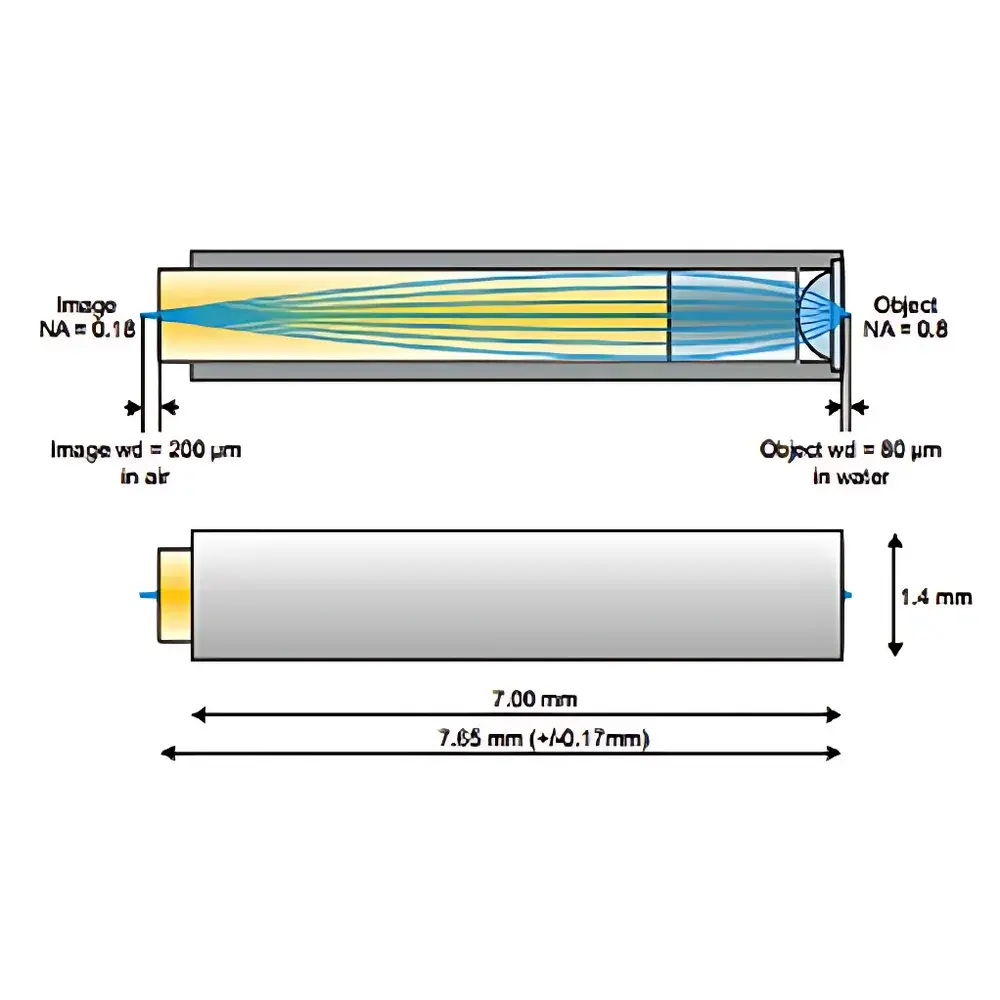
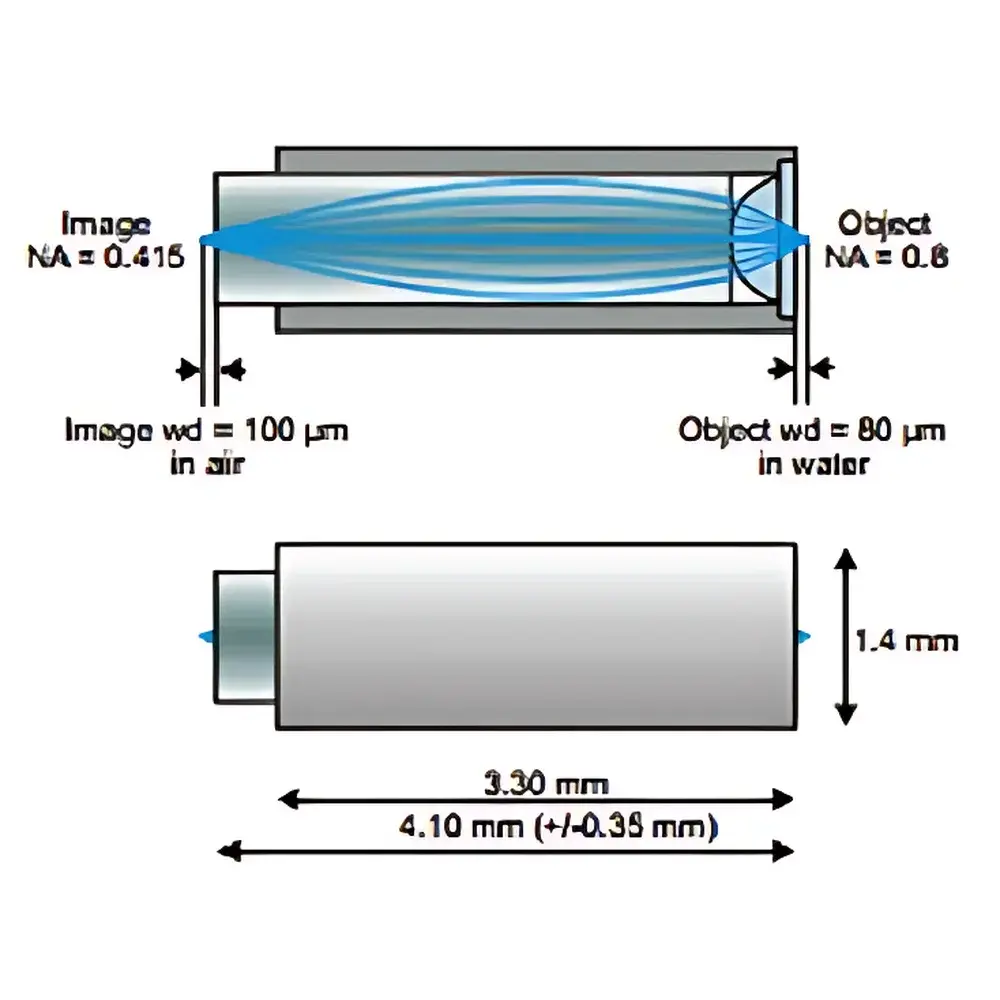
| Numerical Aperture (Object-side) | 0.82 |
| Working Distance (in water) | 80 µm |
| Numerical Aperture (Image-side) | 0.18 / 0.415 |
| Magnification | 4.65× / 1.92× |
| Design Wavelength | 488 nm |
| Housing | Stainless Steel Mount |
| Compliance | ISO 10110 optical surface standards, RoHS-compliant materials |
Overview
The GRINTECH GT-M0-080-018-488 and GT-M0-080-0415-488 are high-numerical-aperture (NA) gradient-index (GRIN) lens objectives engineered specifically for minimally invasive fluorescence microendoscopy. These objectives leverage the unique optical properties of radially graded refractive index glass to achieve diffraction-limited resolution in ultra-compact form factors—critical for intravital imaging through narrow-diameter endoscopic probes. Each objective is optimized for 488 nm excitation, aligning with common fluorophores such as GFP, FITC, and Alexa Fluor 488. With an object-side NA of 0.82 and a working distance of only 80 µm in aqueous medium, they enable high-resolution cellular and subcellular visualization deep within living tissue while maintaining compatibility with standard fiber-optic coupling interfaces. The dual-model configuration provides experimental flexibility: the GT-M0-080-018-488 delivers higher magnification (4.65×) with lower image-side NA (0.18), suited for confocal or two-photon scanning systems requiring precise beam collimation; the GT-M0-080-0415-488 offers reduced magnification (1.92×) but higher image-side NA (0.415), enhancing light collection efficiency for widefield or low-light fluorescence detection.
Key Features
- Ultra-high object-side numerical aperture (NA = 0.82) enabling sub-micron lateral resolution under 488 nm illumination
- Precision-engineered GRIN lens profile with monolithic fused-silica construction for thermal stability and minimal chromatic aberration
- Fixed working distance of 80 µm in water—calibrated for physiological immersion conditions without mechanical focusing mechanism
- Stainless steel mechanical housing with standardized outer diameter (OD = 1.0 mm or 1.4 mm, depending on model) for direct integration into commercial or custom endoscopic shafts
- AR-coated surfaces (R < 0.25% per surface @ 488 ± 10 nm) to maximize transmission and minimize ghost reflections in fluorescence detection pathways
- Compliant with ISO 10110-3 surface quality specifications (scratch-dig 20–10) and ISO 10110-7 centration tolerances (< 1 arcmin)
Sample Compatibility & Compliance
These objectives are validated for use in biological specimens immersed in aqueous environments—including brain slices, intestinal mucosa, tumor xenografts, and embryonic tissues—where refractive index matching is essential for minimizing spherical aberration. Their compact geometry supports integration into rigid or semi-flexible endoscopes with outer diameters down to 1.0 mm. All units undergo individual wavefront testing using a Shack–Hartmann sensor and are certified for use in GLP-compliant preclinical imaging workflows. Materials comply with ISO 10993-5 (cytotoxicity) and RoHS Directive 2011/65/EU. No internal adhesives or organic cements are used in optical assembly—ensuring long-term stability under continuous laser exposure and sterilization cycles (e.g., ethanol wipe, UV-C).
Software & Data Management
While these are passive optical components, their performance is fully characterizable via standard metrology software platforms including Zemax OpticStudio (sequential and non-sequential modes), Code V, and MATLAB-based PSF simulation toolkits. GRINTECH provides downloadable Zemax-compatible .ZMX files for both models, including measured surface irregularity maps and coating spectral transmittance data. For system-level calibration, the objectives support integration with open-architecture acquisition frameworks such as Micro-Manager, ScanImage (v2023+), and NI LabVIEW-based DAQ systems. Traceable calibration reports include MTF measurements at 488 nm, modulation transfer function (MTF) curves up to 200 lp/mm, and point spread function (PSF) full-width-at-half-maximum (FWHM) values in both lateral and axial dimensions.
Applications
- Intravital two-photon microscopy of neuronal dendritic spines and microglial dynamics in awake, head-fixed mice
- Real-time fluorescence lifetime imaging (FLIM) of NAD(P)H metabolism in gastrointestinal epithelium
- Confocal reflectance and autofluorescence endomicroscopy during surgical margin assessment
- High-speed volumetric calcium imaging in zebrafish larval hearts using light-sheet compatible GRIN relay optics
- Development of miniaturized optogenetic stimulation–imaging hybrid probes with integrated multimode fiber coupling
FAQ
Are these objectives compatible with standard C-mount or SM1-threaded systems?
No—these are bare GRIN objectives designed for direct integration into endoscopic shafts or custom lens tubes. Mechanical mounting requires precision press-fit or epoxy-free clamping into stainless steel sleeves with specified inner diameter tolerances (±0.5 µm). Adapters for C-mount or SM1 are available separately upon request.
Can I use these objectives with excitation wavelengths other than 488 nm?
The AR coating is optimized for 488 nm, but broadband operation from 450–520 nm is supported with <5% transmission loss. Performance degrades significantly outside this range due to increased spherical aberration and reduced NA efficiency.
What is the maximum permissible laser power density at the objective front face?
For continuous-wave 488 nm illumination, the damage threshold is 1.2 MW/cm² (measured at 1064 nm equivalent, scaled per ISO 21254-2). Pulsed operation (e.g., femtosecond Ti:sapphire) requires derating based on pulse duration and repetition rate—consult GRINTECH’s pulsed-laser compatibility guide.
Do you provide custom GRIN lens designs?
Yes—GRINTECH offers bespoke GRIN profiles, working distances, NA configurations, and packaging geometries under NDA, with lead times starting at 12 weeks for prototype validation.




