
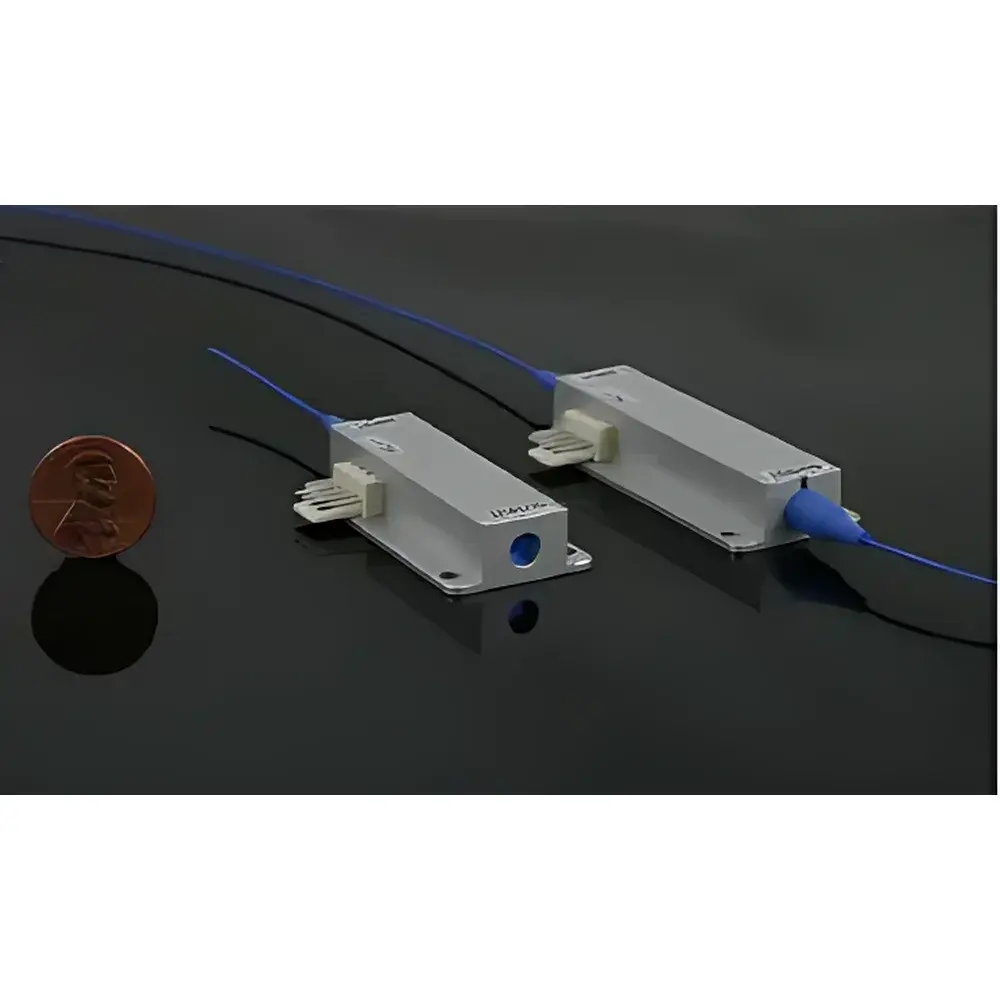
HCP Full-Fiber 780 nm Waveguide Mixer Module
| Brand | HCP (Longcai Technology) |
|---|---|
| Origin | Taiwan |
| Model | 1×1 780 nm Waveguide Mixer |
| Wavelength | 780 nm |
| Configuration | Single-channel integrated waveguide coupler |
| Structural Design | All-fiber, monolithic alignment |
| Form Factor | Compact, mechanically robust, plug-and-play compatible |
| Optional Wavelengths | 532 nm and 780 nm variants available |
| Output Power Range | 10 mW to >3 W (customizable) |
| Customization | Supported for fiber type, connectorization (e.g., FC/APC, PM fiber), polarization-maintaining configuration, and spectral bandwidth optimization |
Overview
The HCP Full-Fiber 780 nm Waveguide Mixer Module is a precision-coupled photonic component engineered for stable, low-loss integration into atomic physics, quantum optics, and ultrafast laser systems. Operating at the fundamental D2 transition wavelength of rubidium-87 (780.24 nm), this module implements a monolithic, single-mode waveguide structure fabricated via ion-exchange or femtosecond-laser-inscribed techniques in doped borosilicate or phosphate glass substrates. Unlike bulk-optic beam combiners or fiber-fused couplers, the all-fiber architecture eliminates free-space alignment, air–glass interfaces, and thermal drift sensitivity—ensuring long-term phase stability and polarization fidelity critical for coherent applications such as magneto-optical trap (MOT) laser systems, Raman sideband cooling, and optical lattice loading. The 1×1 configuration functions as a passive, polarization-insensitive waveguide mixer: it accepts two input beams (e.g., master oscillator and tapered amplifier outputs) and delivers a spatially overlapped, collinear output with minimal modal distortion and insertion loss <0.8 dB (typical). Its hermetically sealed, epoxy-free packaging enables operation in vacuum-compatible environments and supports vibration-isolated optical tables without realignment.
Key Features
- All-fiber monolithic design eliminates alignment sensitivity and reduces susceptibility to thermal expansion and mechanical shock
- 780 nm optimized waveguide core with high mode-matching efficiency (>95%) to standard SMF-28 or HI1060 fibers
- Plug-and-play compatibility with industry-standard FC/APC or SMA905 connectors; optional polarization-maintaining (PM) fiber pigtails available
- Compact footprint (<35 mm × 12 mm × 8 mm) and lightweight (<12 g) for integration into space-constrained UHV chambers or portable quantum sensor platforms
- High power handling capability: CW-rated up to 3 W at 780 nm with no measurable photodarkening or thermal lensing under active cooling
- Manufactured under ISO 9001-certified cleanroom processes; each unit undergoes spectral transmission mapping, polarization extinction ratio (PER) verification (>20 dB), and accelerated life testing
Sample Compatibility & Compliance
The module is compatible with common 780 nm laser sources including distributed feedback (DFB) diodes, external cavity diode lasers (ECDLs), and tapered amplifier systems. It supports both free-running and injection-locked configurations. For quantum experimental workflows, the device meets functional requirements aligned with ASTM E2919 (Standard Guide for Characterization of Optical Components for Laser-Based Systems) and supports traceable calibration per ISO/IEC 17025 when used with NIST-traceable power meters and wavemeters. While not a medical or safety-certified product, its construction complies with IEC 60825-1:2014 Class 3R laser product safety guidelines when integrated into properly interlocked host systems.
Software & Data Management
As a passive optical component, the HCP 780 nm Waveguide Mixer requires no embedded firmware, drivers, or software control. However, it is routinely deployed in systems managed by LabVIEW, Python (via PyVISA or NI-DAQmx), or MATLAB-based automation frameworks for synchronized laser locking, AOM modulation, and real-time intensity stabilization. Integration documentation includes detailed mechanical drawings (STEP/IGES), spectral response curves (300–1100 nm), and fiber pigtail specification sheets (mode field diameter, numerical aperture, cutoff wavelength). All technical data files are provided in machine-readable CSV and PDF formats compliant with FAIR (Findable, Accessible, Interoperable, Reusable) data principles for laboratory metadata management.
Applications
- Rubidium and cesium MOT setups requiring stable, low-noise 780 nm beam combination for repumper and cooling laser paths
- Optical clock and atom interferometry systems where spatial mode purity and wavefront continuity are essential
- Quantum memory experiments utilizing electromagnetically induced transparency (EIT) in warm vapor cells or cold atomic ensembles
- Frequency-doubled 780 nm → 390 nm UV generation chains where high spatial coherence preservation is required upstream of nonlinear crystals
- Education and training platforms for undergraduate photonics laboratories emphasizing fiber-integrated quantum hardware design
FAQ
Is this module polarization-maintaining?
Yes—PM fiber pigtails (e.g., Panda-type) are available upon request; standard version uses non-PM single-mode fiber.
Can I use this mixer with 532 nm light?
A dedicated 532 nm variant is offered separately; the 780 nm version exhibits strong wavelength selectivity and is not optimized for green light transmission.
What is the maximum input power per port?
For continuous-wave operation at 780 nm, the recommended maximum is 1.5 W per input port without active thermal management; up to 3 W is supported with conductive heatsinking.
Do you provide optical isolation integration options?
While the mixer itself does not include isolators, we offer co-packaged 780 nm fiber-pigtailed isolators (30 dB extinction, 1.5 W handling) for back-reflection suppression in amplifier chains.
Is custom fiber length or connector type supported?
Yes—standard lengths are 1.0 m and 1.5 m with FC/APC; custom lengths (0.3–3.0 m), connector types (SMA905, SC/APC), and jacketing (OFNP, Hytrel) are available under NRE-supported customization.




