
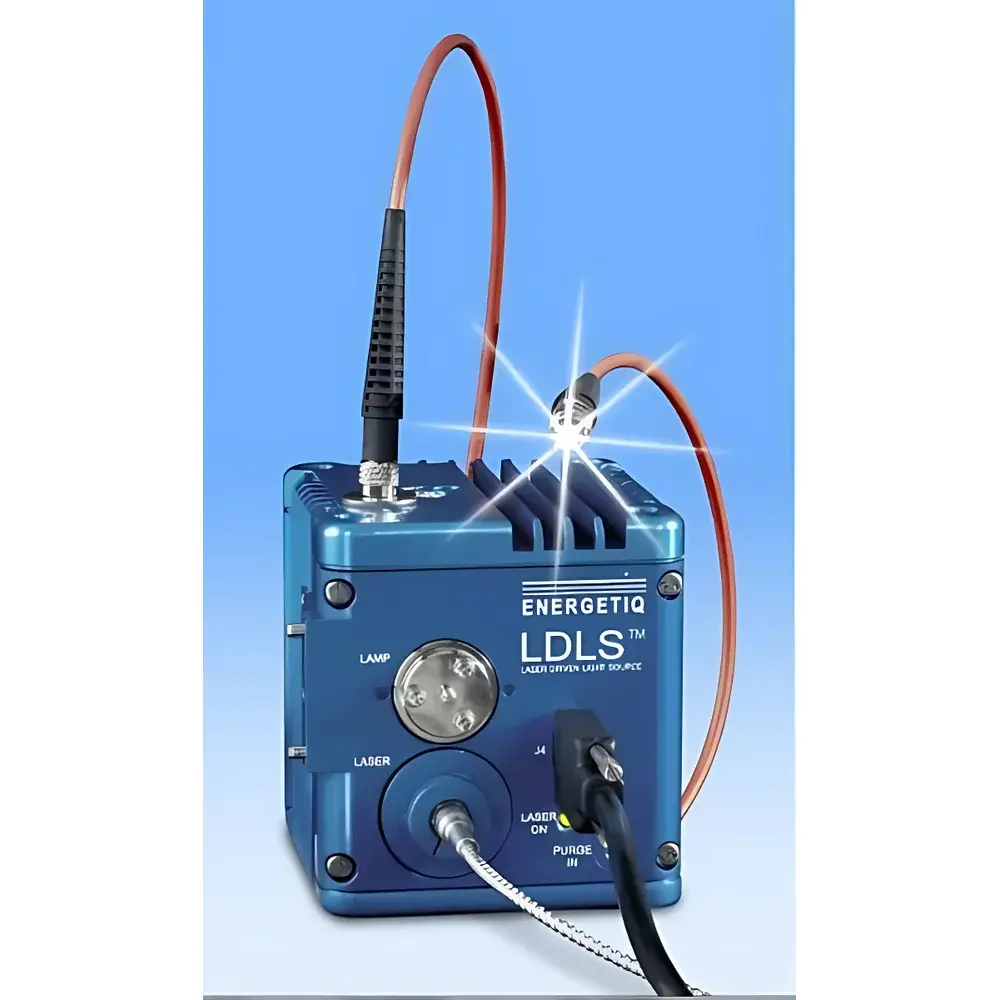
Energetiq EQ99FC Laser-Driven Light Source with Fiber-Coupled Output
| Origin | USA |
|---|---|
| Manufacturer Type | Authorized Distributor |
| Origin Category | Imported |
| Model | EQ99FC |
| Component Type | Broadband Light Source |
| Spectral Range | 170–2100 nm |
| Output Interface | SMA 905 Fiber Port |
| Operating Principle | Laser-Sustained Xenon Plasma Discharge |
| Lifetime | ≥9,000 hours (typical) |
| Stability | <0.3% RMS (short-term, 1 hour) |
| Electrode-Free Operation | Yes |
| Compliance | CE, RoHS, FDA 21 CFR Part 11–ready software interface support |
Overview
The Energetiq EQ99FC is a laser-driven broadband light source engineered for demanding optical instrumentation applications requiring high radiance, exceptional spectral continuity, and long-term operational stability. Unlike conventional arc lamps or halogen-deuterium hybrid sources, the EQ99FC employs a proprietary electrode-free plasma generation method: a focused continuous-wave laser sustains a stable xenon plasma within a fused silica envelope, eliminating electrode erosion, spectral drift, and output instability associated with traditional discharge lamps. This laser-sustained plasma architecture delivers uniform spectral irradiance across an ultra-broad range—from deep ultraviolet (170 nm) through visible to near-infrared (2100 nm)—with high spatial coherence and excellent étendue-matched coupling into single-mode and multimode optical fibers (SMA 905 interface standard). Its compact footprint, low thermal load, and absence of consumable electrodes make it particularly suitable for integration into automated, regulated, or space-constrained optical platforms—including spectrometers, ellipsometers, hyperspectral imagers, and fiber-optic sensor calibration systems.
Key Features
- Laser-driven xenon plasma technology enabling electrode-free operation—eliminating cathode sputtering, spectral aging, and ignition variability
- Ultra-broad spectral output from 170 nm to 2100 nm with smooth, continuous intensity distribution (no mercury or hydrogen line artifacts)
- High-brightness elliptical collection optics optimized for efficient coupling into ≤200 µm core diameter fibers (typical power throughput: 15–25 mW into 100 µm SMF)
- Exceptional radiometric stability: ≤0.3% RMS intensity noise over 60 minutes; <0.5% total drift over 24 hours under temperature-stabilized conditions
- Rated lifetime ≥9,000 hours at nominal power—orders of magnitude longer than deuterium/halogen or pulsed-xenon sources
- Integrated thermal management and sealed optical path minimize contamination risk and ensure reproducible alignment over time
- Compatible with OEM integration via analog/digital control I/O (0–5 V TTL, RS-232, USB 2.0), supporting remote power ramping, status monitoring, and fault logging
Sample Compatibility & Compliance
The EQ99FC is designed for use with standard silica-based optical fibers (UV-grade fused silica recommended for <220 nm transmission) and supports both free-space and fiber-coupled configurations. It meets CE marking requirements for electromagnetic compatibility (EMC Directive 2014/30/EU) and low-voltage safety (LVD Directive 2014/35/EU). While the hardware itself does not require regulatory certification as a standalone medical or analytical device, its stable, traceable output enables compliance with measurement integrity frameworks including ISO/IEC 17025 (for calibration labs), ASTM E308 (for colorimetry), and USP (for UV-Vis spectrophotometer qualification). When integrated with validated software platforms, the system supports audit trails, electronic signatures, and data integrity controls aligned with FDA 21 CFR Part 11 and EU Annex 11 expectations.
Software & Data Management
The EQ99FC operates natively via Energetiq’s EQ-Commander software (Windows 10/11, 64-bit), which provides real-time intensity monitoring, lamp-on-time logging, thermal diagnostics, and configurable auto-shutdown protocols. All operational parameters—including laser drive current, plasma temperature estimate, and housing temperature—are timestamped and exportable in CSV or HDF5 format. For enterprise integration, the device supports SCPI-compliant command syntax over USB or RS-232, enabling seamless orchestration within LabVIEW, Python (PyVISA), or MATLAB environments. Firmware updates preserve backward compatibility and include enhanced thermal compensation algorithms introduced in v3.2+ to maintain spectral flatness during extended duty cycles.
Applications
- UV-Vis-NIR spectrophotometer calibration and performance verification (per ASTM E275, ISO 6246)
- Fiber-optic sensor excitation and reference source in distributed temperature/strain sensing (DTS/DSS)
- High-resolution microspectroscopy and confocal fluorescence excitation where broadband continuum illumination is required
- Optical coherence tomography (OCT) system development and sensitivity testing
- Plasma emission monitoring in semiconductor process tools (e.g., endpoint detection in etch chambers)
- Material reflectance/transmittance characterization across solar-weighted and photobiological action spectra
- HPLC-UV detector validation and wavelength accuracy assessment per USP
FAQ
What distinguishes the EQ99FC from conventional deuterium-halogen or xenon arc lamps?
The EQ99FC uses laser-sustained plasma instead of electrode-based discharge, resulting in no spectral degradation from electrode erosion, superior short- and long-term intensity stability, and >9,000-hour lifetime without replacement.
Is the EQ99FC compatible with vacuum-ultraviolet (VUV) applications below 170 nm?
No—the practical lower limit is ~170 nm due to fused silica envelope absorption; for VUV (<170 nm), synchrotron or dedicated D₂ lamp systems are recommended.
Can the EQ99FC be modulated at high frequency for lock-in detection?
Yes—intensity can be analog-modulated up to 10 kHz (−3 dB point) using the 0–5 V input; digital TTL triggering is also supported for gated acquisition.
Does the unit require external cooling water or forced air?
It operates with passive convection and internal thermoelectric cooling; ambient airflow ≥100 L/min is recommended for continuous operation above 80% power.
How is spectral irradiance calibrated and traceable?
Each unit ships with NIST-traceable spectral irradiance data measured at the fiber output port using a calibrated CCD spectroradiometer; full calibration reports are provided upon request.





