
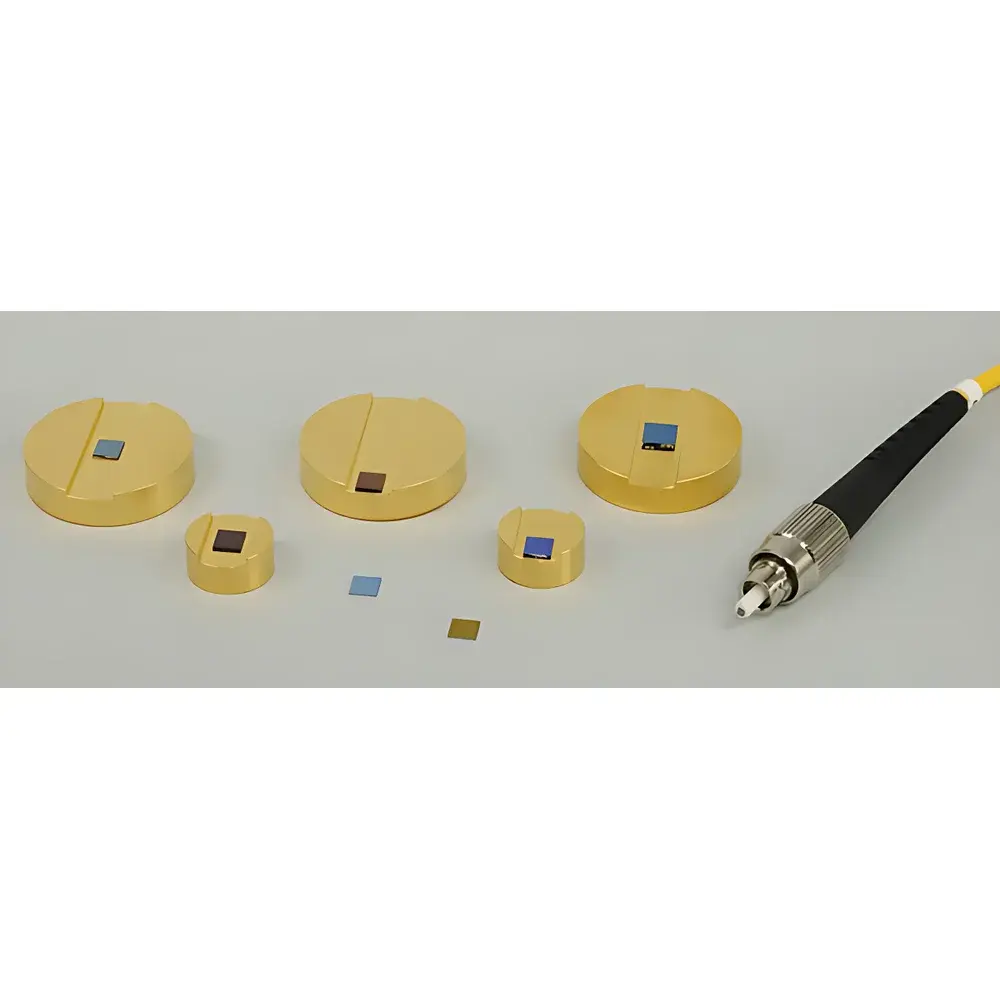
BATOP SESAM Semiconductor Saturable Absorber Mirror
| Brand | BATOP |
|---|---|
| Origin | Germany |
| Product Types | SESAM, RSAM, SOC, PCA |
| Wavelength Range | 800 nm – 3000 nm |
| Saturation Absorption (A₀) | 0.6% – 70% |
| Recovery Time (τ) | 500 fs – 124 ps |
| Packaging Options | Bare Die (4×4 mm, 1×1 mm, 1.3×1.3 mm), Copper-Mounted (12.7 mm / 25.0 mm / 25.4 mm dia., soldered or glued, air-cooled or water-cooled), Fiber-Pigtailed (FC/PC or FC/APC, HI980 fiber) |
Overview
BATOP SESAM (Semiconductor Saturable Absorber Mirror) is a precision-engineered passive mode-locking element designed for diode-pumped solid-state (DPSS) and fiber laser systems operating in the 800 nm to 3000 nm spectral range. Based on low-temperature molecular beam epitaxy (MBE) and dielectric sputter coating, each SESAM integrates a semiconductor Bragg reflector with an embedded quantum well absorber layer—enabling controlled saturable absorption via intensity-dependent reflectivity. Unlike active modulators, SESAMs operate entirely optically, eliminating RF drive requirements and enabling ultrafast pulse generation with high long-term stability. The device functions by exhibiting low reflectivity for low-intensity noise or pre-pulses, while achieving high reflectivity under high-intensity intracavity peak power—thereby favoring pulse formation and suppressing continuous-wave (CW) lasing. This physical mechanism ensures deterministic self-starting mode-locking in compact, alignment-insensitive cavities.
Key Features
- Manufactured in Germany using proprietary MBE growth and ion-beam sputtering for atomic-level layer control and minimal interfacial defects
- Customizable design parameters: center wavelength (λ), small-signal absorption (A₀), and carrier recovery time (τ), enabling optimization for specific laser gain media (e.g., Nd:YVO₄, Yb:KYW, Er:fiber)
- Multiple mechanical configurations: bare die (1×1 mm, 1.3×1.3 mm, 4×4 mm), copper heat-sink mounted (12.7 mm / 25.0 mm / 25.4 mm diameter, air- or water-cooled), and fiber-pigtailed variants (FC/PC or FC/APC connectors, HI980 fiber, 1 m length)
- Complementary product families include RSAM (Resonant Saturable Absorber Mirror) for enhanced modulation depth at cavity resonance, SOC (Saturable Output Coupler) for integrated output coupling and saturation, and SANOS (Saturable Absorber Noise Suppression) cavities for post-amplification ASE and pedestal suppression
- PCA (Photoconductive Antenna) series available for THz generation and detection, with excitation wavelengths spanning 800–1550 nm and options including lens-integrated large-aperture arrays and full THz-TDS spectrometer systems
Sample Compatibility & Compliance
BATOP SESAM devices are compatible with standard DPSS laser platforms (e.g., Nd:YAG, Nd:YVO₄, Yb:KGW), ultrafast fiber oscillators (Er-doped, Yb-doped), and thin-disk lasers. All components undergo rigorous qualification per ISO 9001 manufacturing protocols and meet RoHS Directive 2011/65/EU compliance for hazardous substance restrictions. For regulated environments—including GLP/GMP-compliant laser development labs and medical laser R&D—the SESAM’s traceable fabrication log, wafer-level test data (including reflectivity spectra, saturation fluence, and τ measurements), and lot-specific certification support audit readiness. While not classified as medical devices, SESAMs used in Class IV laser systems conform to IEC 60825-1:2014 safety requirements when integrated into fully certified optical assemblies.
Software & Data Management
As a passive optical component, the SESAM requires no embedded firmware or driver software. However, BATOP provides comprehensive technical documentation packages—including spectral reflectance curves (measured via FTIR), Z-scan characterization reports, and thermal resistance modeling data—for integration into optical simulation workflows (e.g., RP Resonator, MATLAB-based cavity design tools). Customers receive digital calibration records (PDF + CSV) with each shipment, timestamped and signed by BATOP’s quality assurance team. For OEM integrators, BATOP supports extended data retention (≥10 years) and offers optional secure FTP access to historical wafer test databases under NDA—facilitating reproducibility validation across production batches and supporting FDA 21 CFR Part 11-aligned electronic record integrity where required.
Applications
- Self-starting passive mode-locking in compact DPSS lasers (e.g., 1064 nm microchip lasers with Nd:YVO₄ gain medium; typical pulse widths: 90–240 ps, repetition rates: 20–800 kHz)
- Ultrafast fiber oscillator stabilization—particularly in polarization-maintaining Yb- or Er-doped ring cavities requiring sub-picosecond recovery dynamics
- Noise suppression in regenerative amplifiers and pulse pickers using SANOS configurations (spatial or fiber-coupled), reducing amplified spontaneous emission (ASE) and improving signal-to-noise ratio (SNR) of ultrashort pulses
- THz time-domain spectroscopy (THz-TDS) systems utilizing PCA emitters/detectors pumped by Ti:sapphire or fiber lasers (800 nm / 1040 nm / 1550 nm)
- Scientific instrumentation requiring high-reproducibility saturable elements: frequency comb stabilization, optical parametric oscillator (OPO) seeding, and attosecond pulse train generation
FAQ
What is the difference between SESAM, RSAM, and SOC?
SESAM provides broadband saturable absorption with fixed reflectivity; RSAM enhances modulation depth through resonant enhancement at a specific cavity wavelength; SOC integrates partial transmission functionality—acting simultaneously as an output coupler and saturable element.
Can BATOP provide custom SESAMs for non-standard wavelengths?
Yes—BATOP routinely fabricates devices from 780 nm to 3000 nm; custom designs require minimum order quantities and wafer-level process validation, typically delivered within 12–16 weeks.
How is thermal management addressed in high-average-power applications?
Water-cooled copper mounts (e.g., X=25.0h-c/e) reduce thermal lensing and carrier lifetime drift; thermal resistance is characterized per mount geometry and published in datasheets.
Are fiber-pigtailed SESAMs polarization-maintaining?
Standard HI980 fiber pigtails are not PM; however, PM fiber variants (e.g., Panda-type) can be supplied upon request with additional lead time and qualification testing.
Do BATOP SESAMs comply with laser safety standards for Class IV systems?
The SESAM itself is a passive component and carries no laser classification; system-level compliance depends on full optical assembly integration and must be verified per IEC 60825-1 by the end equipment manufacturer.





