
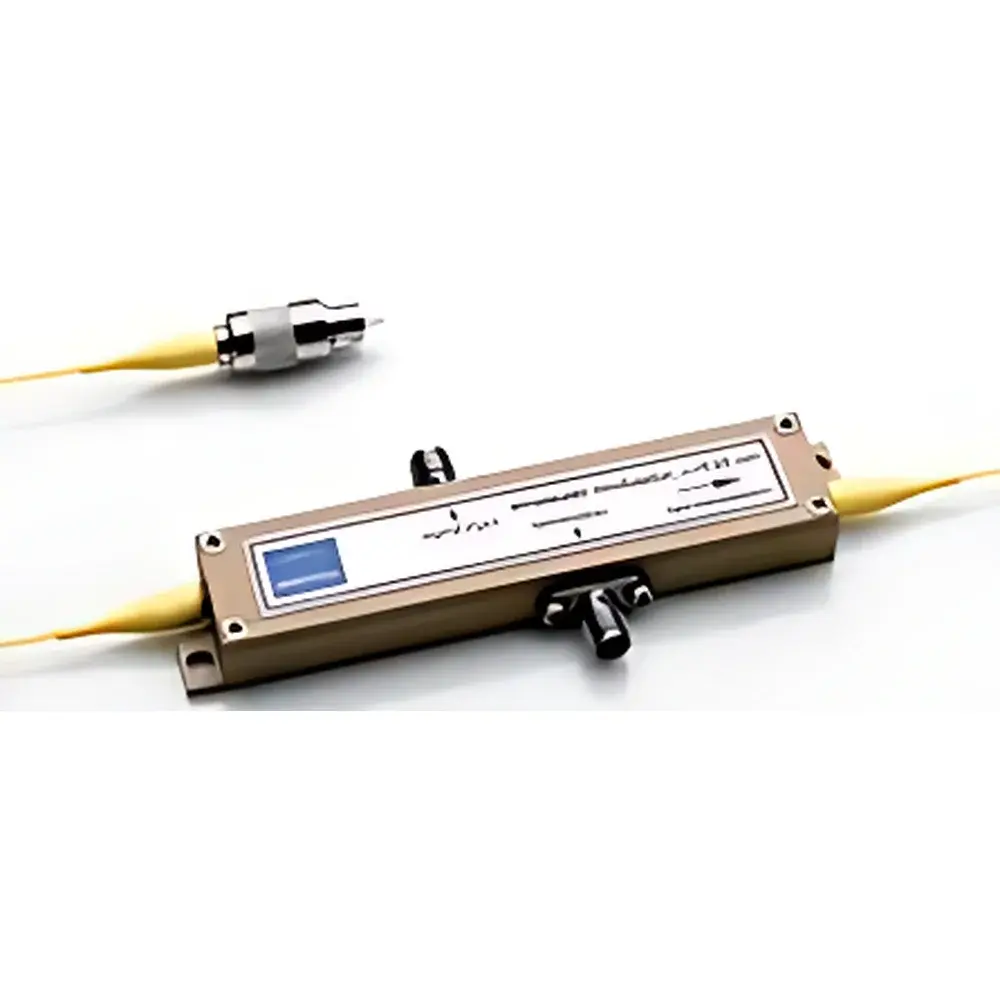
Jenoptik Integrated Optical Amplitude Modulator (MgO:LiNbO₃-based Waveguide EOM)
| Brand | Jenoptik |
|---|---|
| Origin | Germany |
| Model | Integrated Optical Amplitude Modulator |
| Substrate Material | MgO-doped LiNbO₃ |
| Operating Principle | Electro-optic (Pockels effect) in Ti-indiffused waveguide |
| Wavelength Range | 400–2000 nm (VIS to NIR/IR) |
| Modulation Bandwidth | DC to ≥10 GHz |
| Fiber Type | Polarization-maintaining single-mode fiber (PM-SMF) |
| Input/Output Coupling | FC/APC or custom connector options |
| Drive Voltage (Vπ) | Typically 3–6 V (depends on configuration) |
| Optical Power Handling | ≤500 mW (CW), higher for pulsed operation |
| Operating Temperature | 15–35 °C |
| Compliance | RoHS, CE |
Overview
The Jenoptik Integrated Optical Amplitude Modulator is a high-performance, waveguide-based electro-optic modulator engineered for precision amplitude control of laser light in demanding optical laboratory and industrial environments. Built upon titanium-diffused, MgO-doped lithium niobate (MgO:LiNbO₃) substrates, it leverages the linear Pockels effect to achieve ultrafast, low-distortion intensity modulation. Its monolithic planar waveguide architecture ensures exceptional phase stability, minimal insertion loss (25 dB). Designed for direct integration into fiber-optic systems, the device features polarization-maintaining single-mode fiber pigtails with industry-standard FC/APC connectors—enabling seamless coupling with external lasers, amplifiers, and detection subsystems. Unlike bulk-optic modulators, this integrated solution eliminates alignment sensitivity and mechanical drift, delivering long-term operational reliability under continuous laboratory use.
Key Features
- Ultra-broad spectral coverage from visible (400 nm) through near-infrared (2000 nm), supporting HeNe, diode, Ti:Sapphire, Yb-fiber, and quantum cascade laser sources
- DC-coupled RF input enabling both analog intensity modulation and digital on/off switching with rise/fall times <35 ps
- Low half-wave voltage (Vπ) of 3–6 V across standard configurations—compatible with commercial RF amplifiers and arbitrary waveform generators
- Hermetically sealed ceramic package with thermal stabilization design for ambient temperature operation (15–35 °C)
- High optical damage threshold: rated for ≥500 mW CW power and multi-watt peak power in pulsed regimes (e.g., femtosecond pulse picking)
- Factory-calibrated polarization extinction ratio (PER) >20 dB and insertion loss uniformity ±0.3 dB across production lots
Sample Compatibility & Compliance
The modulator is compatible with all common continuous-wave and pulsed laser sources operating within its specified wavelength and power envelope—including but not limited to DPSS lasers, DFB/DBR diodes, mode-locked oscillators, and optical parametric amplifiers. It supports integration into ISO/IEC 17025-compliant optical test benches and meets key regulatory requirements for research instrumentation: RoHS Directive 2011/65/EU, CE marking per EMC Directive 2014/30/EU and Low Voltage Directive 2014/35/EU. While not certified for medical or aerospace deployment out-of-the-box, its design adheres to IPC-A-610 Class 2 workmanship standards and includes traceable calibration documentation upon request—facilitating GLP-aligned validation protocols in university and corporate R&D labs.
Software & Data Management
As a passive electro-optic component, the modulator requires no embedded firmware or driver software. However, it is fully interoperable with industry-standard control ecosystems: analog voltage inputs accept signals from National Instruments DAQ systems (e.g., PCIe-6363), Keysight PXI platforms, or Thorlabs K-Cube drivers; digital TTL/CMOS triggers interface directly with pulse generators (e.g., Stanford Research DG645) and FPGA-based timing controllers. For system-level traceability, users may log drive voltage, temperature, and optical throughput data via external photodiode monitors synchronized to lab-wide NTP time servers—supporting audit-ready records compliant with internal QA procedures and pre-GLP documentation workflows.
Applications
- Analog intensity modulation for coherent optical communications and RF-over-fiber signal distribution
- Digital pulse carving and cavity dumping in ultrafast amplifier chains (e.g., regenerative amplifiers, OPCPA front-ends)
- Active Q-switching and pulse selection in picosecond/femtosecond oscillator-amplifier architectures
- Dynamic contrast control and line-scan synchronization in confocal and multiphoton laser scanning microscopes
- Optical shuttering and feedback gating in time-resolved spectroscopy (e.g., pump-probe, TCSPC)
- Phase-stable amplitude control in interferometric sensing platforms and quantum optics experiments requiring shot-noise-limited stability
FAQ
What is the maximum optical power this modulator can handle in continuous-wave operation?
The standard configuration is rated for up to 500 mW average optical power at 1550 nm with proper thermal management. Higher-power variants with enhanced heat-sinking are available upon request.
Can this modulator be used with femtosecond pulses?
Yes—it supports sub-100-fs pulse widths with negligible group delay dispersion (GDD < 100 fs² over 100 nm bandwidth) when operated within its specified wavelength window.
Is polarization-maintaining performance guaranteed across temperature variations?
The PM fiber pigtails maintain >18 dB PER from 20 °C to 30 °C; for extended thermal ranges, active temperature stabilization modules are recommended.
Do you provide Vπ characterization data for individual units?
Yes—each unit ships with a factory test report including measured Vπ, insertion loss, extinction ratio, and polarization crosstalk at 1310 nm and 1550 nm.
Are custom connector types or fiber lengths supported?
Yes—FC/APC, SC/APC, and angled physical contact (APC) variants are standard; custom lengths (0.5–2 m) and specialty fibers (e.g., SMF-28e+, HI1060) are available with lead times of 4–6 weeks.




