
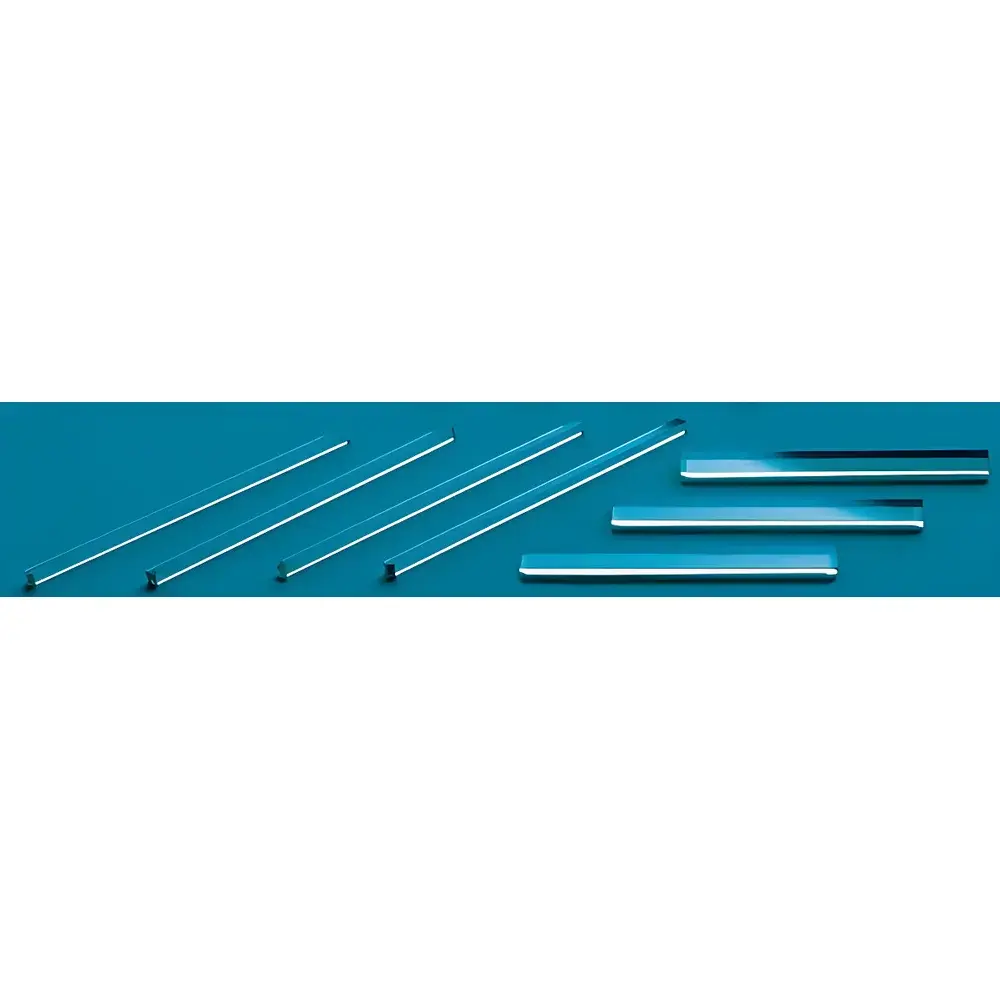
GRINTECH GRIN Cylindrical Lens – Gradient Index Optical Lens
| Brand | GRINTECH |
|---|---|
| Origin | Canada |
| Manufacturer Type | Authorized Distributor |
| Import Status | Imported |
| Model | GRIN Cylindrical Lens |
| Price | Upon Request |
| Core Application Domain | Solid-State Laser Systems & Beam Shaping |
Overview
The GRINTECH GRIN Cylindrical Lens is a precision-engineered gradient-index (GRIN) optical component designed for high-fidelity beam shaping, collimation, and focusing in demanding laser and optical measurement applications. Unlike conventional homogeneous lenses, GRIN lenses feature a radially or axially varying refractive index profile—typically following a parabolic distribution—enabling controlled light propagation without surface curvature. This intrinsic index gradient eliminates spherical aberration at the design wavelength and supports compact, alignment-insensitive integration into solid-state laser cavities, fiber coupling systems, and optical coherence tomography (OCT) setups. The cylindrical geometry provides focusing power along a single axis only, making it ideal for line generation, astigmatism correction, and anamorphic beam expansion in diode-pumped solid-state (DPSS) lasers and ultrafast amplifier systems.
Key Features
- Monolithic fused silica or SF6-based GRIN structure with precisely controlled refractive index gradient (dn/dr ≈ −0.001 to −0.003 mm⁻¹, typical)
- Cylindrical form factor enabling one-dimensional focusing with minimal wavefront distortion
- Anti-reflection (AR) coating options optimized for specific laser bands: C2 coating (R < 0.5% @ 800–960 nm, 0°–30° AOI) ensures minimal insertion loss in Ti:sapphire and Yb-doped fiber laser systems
- No surface curvature required—eliminates sensitivity to mounting tilt and reduces ghost reflections
- Thermal stability up to +80 °C; coefficient of thermal expansion (CTE) matched to common optomechanical mounts
- Surface quality: λ/10 RMS wavefront error over clear aperture; scratch-dig specification per MIL-PRF-13830B
Sample Compatibility & Compliance
The GRIN cylindrical lens is compatible with continuous-wave (CW) and pulsed laser sources operating from visible to near-infrared wavelengths (400–1100 nm), including Nd:YAG (1064 nm), Ti:sapphire (700–1000 nm), and Yb:fiber (1030–1080 nm) systems. Its AR-coated variants meet ISO 10110-3 surface quality standards and are suitable for use in Class 1 and Class 4 laser safety environments when integrated into enclosed beam paths. All GRINTECH lenses comply with RoHS Directive 2011/65/EU and are manufactured under ISO 9001-certified processes. Documentation includes traceable metrology reports (interferometric wavefront mapping, spectral reflectance verification) supporting GLP-compliant optical system validation.
Software & Data Management
While the GRIN cylindrical lens is a passive optical element, its performance characterization data—including measured focal length vs. wavelength curves, transmittance spectra (200–2000 nm), and Zernike decomposition reports—are delivered in standardized ASCII and CSV formats. These datasets integrate directly into optical design software platforms such as Zemax OpticStudio, CODE V, and FRED for rigorous tolerance analysis and system-level modeling. GRINTECH provides full prescription files (.zmx import-ready) and ray-trace validated models upon request, supporting traceability in FDA 21 CFR Part 11–aligned documentation workflows where audit trails for optical component qualification are required.
Applications
- Beam circularization of elliptical laser diode outputs in pump modules for DPSS lasers
- Astigmatic correction in multi-pass amplifier architectures and regenerative amplifiers
- Line illumination generation for structured-light profilometry and laser triangulation sensors
- Input/output coupling optics in fiber-to-free-space interfaces for ultrafast laser delivery systems
- Compact focusing elements in portable Raman spectrometers and handheld OCT probes
- Wavefront conditioning in adaptive optics testbeds and Shack–Hartmann sensor calibration rigs
FAQ
What is the typical focal length tolerance for GRIN cylindrical lenses?
Standard focal length tolerance is ±2% at the design wavelength; tighter tolerances (±0.5%) are available under custom specification with interferometric verification.
Can GRIN cylindrical lenses be used with ultrashort pulses (<100 fs)?
Yes—when fabricated from low-dispersion fused silica substrates and AR-coated for the target bandwidth, they introduce negligible group delay dispersion (GDD) below 5 fs² over 10 mm propagation path.
Is there a maximum input power density limit?
For CW operation, damage threshold exceeds 10 MW/cm² at 1064 nm (10 ns pulse, 10 Hz); for femtosecond pulses, LIDT is specified per ISO 21254-2 and depends on pulse duration and spot size.
Do you provide mounting solutions compatible with standard kinematic mounts?
Yes—custom-designed aluminum or Invar lens cells with centering accuracy better than ±5 µm are available, including SM1- and SM2-threaded versions compliant with Thorlabs and Newport mechanical standards.





