
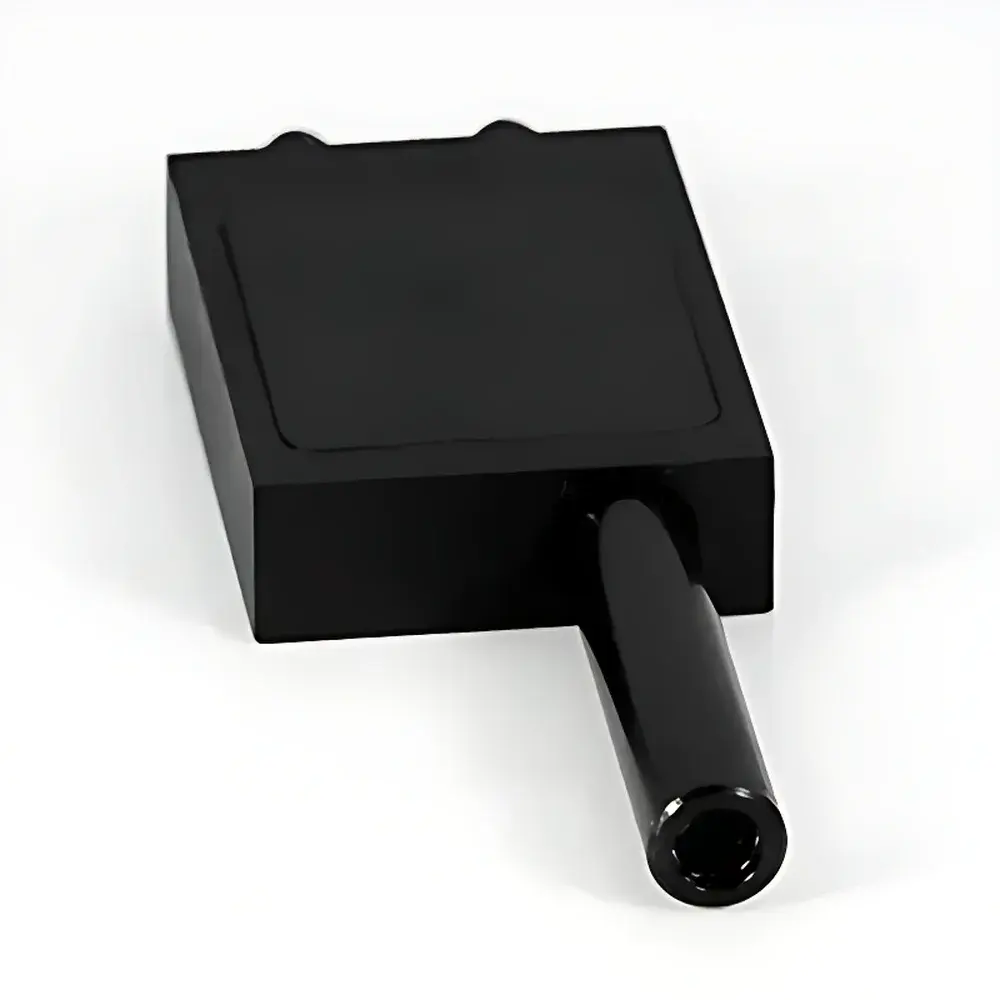
SPL FPB-405 405 nm Laser-Excited Fluorescence Probe
| Brand | SPL |
|---|---|
| Origin | Shanghai, China |
| Manufacturer Type | Authorized Distributor |
| Origin Category | Domestic (PRC) |
| Model | FPB-405 |
| Excitation Wavelength | 405 nm ± 0.5 nm |
| Spectral Bandwidth (Laser Linewidth) | 1 nm FWHM |
| Optical Path | Coaxial Backscattering Configuration |
| Excitation Rejection | OD > 5 at 405 nm |
| Fluorescence Detection Range | 405–850 nm |
| Working Distance | 7.5 mm (standard) |
| Probe Head Dimensions | 120 × 38 × 18 mm (L × W × H) |
| Housing Material | Black Anodized Aluminum |
| Max Operating Temperature | 80 °C |
| Fiber Interface | SMA 905 |
| Compatible Fiber | 400 µm core, NA 0.22 recommended |
| Background Suppression | Eliminates quartz fiber Raman scattering and Rayleigh leakage |
Overview
The SPL FPB-405 is a purpose-engineered coaxial backscattering fluorescence probe optimized for laser-induced fluorescence (LIF) measurements at 405 nm excitation. Built upon a robust optical architecture that integrates high-efficiency dichroic filtering and precise spatial alignment, the probe enables quantitative, contamination-free detection of weak fluorescence emissions from heterogeneous samples—including irregular solids, turbid suspensions, and low-concentration aqueous solutions. Its design adheres to fundamental spectroscopic principles: excitation light is delivered and collected through a single shared optical axis, minimizing path-length variation and maximizing signal reproducibility across variable sample geometries. Unlike conventional front-face or right-angle probes, the FPB-405 eliminates angular misalignment errors and reduces sensitivity to surface roughness or refractive index mismatch—critical advantages in field-deployable or process-integrated applications where sample presentation is uncontrolled.
Key Features
- Coaxial backscattering optical layout ensures consistent illumination-collection geometry across solid, semi-solid, and liquid matrices without reconfiguration.
- Integrated high-optical-density (OD > 5) bandpass/dichroic filter stack fully suppresses 405 nm Rayleigh scatter and residual laser leakage while transmitting >85% of fluorescence photons between 420 nm and 850 nm.
- Mechanically stable black anodized aluminum housing (120 × 38 × 18 mm) provides thermal resilience up to 80 °C and EMI shielding suitable for industrial environments.
- SMA 905 interface supports standardized fiber coupling with traceable calibration compatibility; optimized for 400 µm core, 0.22 NA silica fibers to balance étendue, resolution, and throughput.
- Fixed 7.5 mm working distance enables repeatable standoff positioning—ideal for integration into automated sampling carousels, flow cells, or inline reactor monitoring systems.
- No internal lenses or moving parts: maintenance-free operation with long-term spectral fidelity and minimal drift under continuous duty cycles.
Sample Compatibility & Compliance
The FPB-405 accommodates diverse physical states without sample preparation: intact tablets, polymer films, soil aggregates, biofilms, colloidal dispersions, and clarified or raw water matrices. Its shallow penetration depth (~10–50 µm in aqueous media) ensures surface-selective interrogation aligned with ASTM D5907 (fluorescent organic carbon quantification) and ISO 11929 (evaluation of measurement uncertainty in spectroscopy). The probe’s optical rejection performance meets ICH Q2(R2) requirements for specificity in analytical method validation, particularly when paired with spectrometers compliant with NIST-traceable wavelength calibration protocols. No regulatory submission documentation is embedded; however, its mechanical and optical specifications support GLP-compliant instrument qualification (IQ/OQ/PQ) when integrated into validated laboratory workflows.
Software & Data Management
As a passive optical transducer, the FPB-405 requires no firmware or driver installation. It operates transparently with all major OEM spectroscopy platforms (e.g., Ocean Insight, Avantes, Hamamatsu, StellarNet) supporting SMA 905 fiber inputs. Spectral data acquisition, baseline correction, peak integration, and multivariate analysis are performed within host software environments compliant with FDA 21 CFR Part 11 (when enabled via audit trail and electronic signature modules). Raw intensity vs. wavelength datasets retain full photon-counting linearity, enabling post-acquisition normalization against internal reference standards (e.g., quinine sulfate in 0.1 M H2SO4) per USP guidelines.
Applications
- Real-time monitoring of dissolved organic matter (DOM) in drinking water treatment—tracking humic/fulvic acid fluorescence signatures (Ex/Em ≈ 405/450 nm and 405/520 nm).
- In-line quality control of pharmaceutical tablet coatings using native fluorophore mapping (e.g., riboflavin, tryptophan).
- Microplastic identification in environmental samples via characteristic pyrene-like emission under 405 nm excitation.
- Bioreactor viability assessment through NAD(P)H autofluorescence kinetics (Ex 405 nm / Em 440–470 nm).
- Forensic document analysis—distinguishing ink formulations based on fluorescent dye photostability and spectral shape.
FAQ
Can the FPB-405 be used with pulsed 405 nm lasers?
Yes—its all-passive optical design imposes no duty-cycle or peak-power limitations; however, pulse energy must remain below 10 µJ/pulse to avoid nonlinear effects in fused silica fiber.
Is the probe compatible with UV-grade fiber bundles?
It is optimized for standard solarization-resistant silica fibers; UV-enhanced fibers (e.g., Ocean Insight PX series) may improve transmission below 420 nm but require recalibration due to altered dispersion profiles.
Does the probe include calibration certification?
No factory calibration certificate is supplied; users must perform system-level wavelength and intensity calibration using NIST-traceable standards prior to quantitative use.
Can working distance be adjusted?
The mechanical design fixes the focal plane at 7.5 mm; custom variants with extended or reduced standoff are available under OEM agreement.
What is the maximum allowable ambient humidity?
Rated for continuous operation at ≤85% RH non-condensing; condensation on optical surfaces degrades rejection ratio and must be prevented via enclosure purging or desiccant integration.




