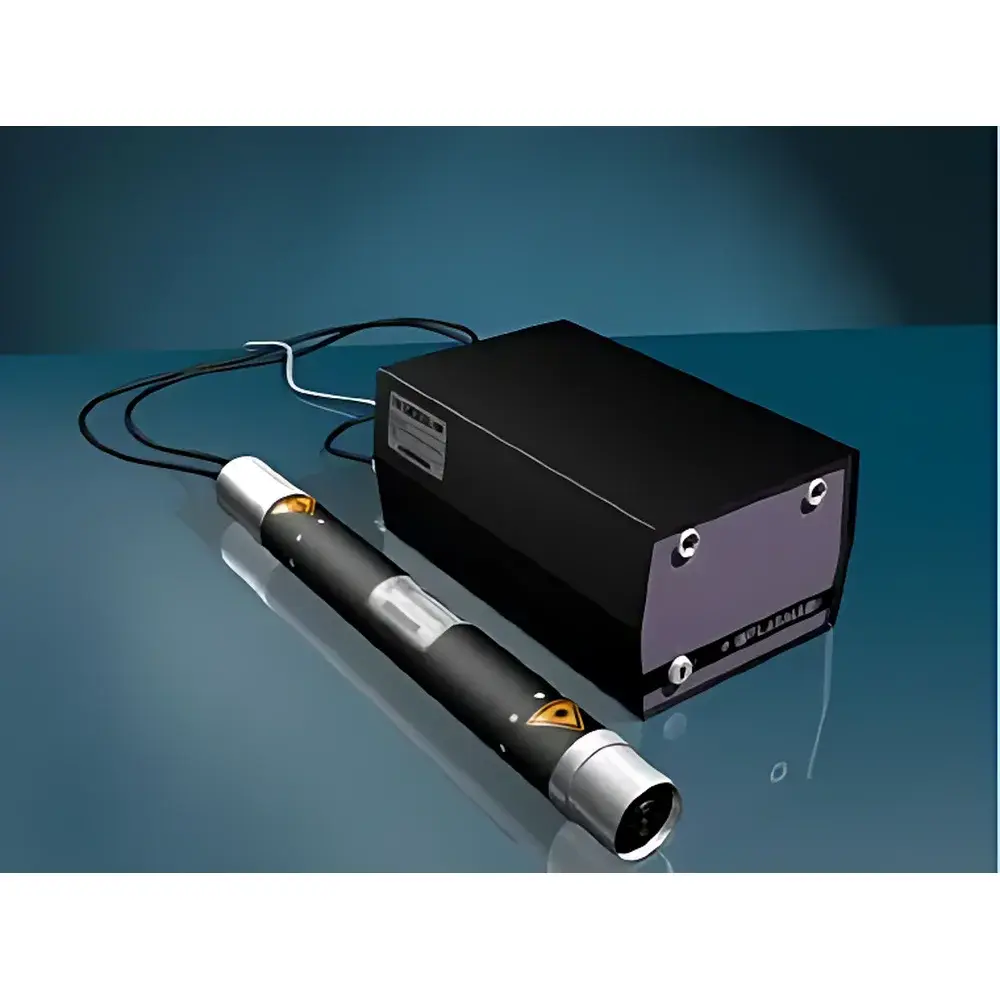
SPL-HN Helium-Neon (He-Ne) Laser System
| Origin | USA |
|---|---|
| Manufacturer Type | Authorized Distributor |
| Origin Category | Imported |
| Model | SPL-HN |
| Pricing | Available Upon Request |
Overview
The SPL-HN Helium-Neon (He-Ne) Laser System is a precision-engineered gas laser platform designed for stable, narrow-linewidth emission in the visible and near-infrared spectral regions. Operating on the fundamental 632.8 nm (0.6328 µm) transition of the He-Ne gain medium, it delivers highly coherent, low-noise output ideal for interferometry, holography, spectroscopic calibration, alignment metrology, and optical teaching laboratories. Additional variants operate at infrared wavelengths—including 1.15 µm, 3.39 µm, 3.5 µm, and 5.4 µm—enabling specialized applications in trace gas detection, industrial emissions monitoring, and fundamental molecular absorption studies. All SPL-HN units employ sealed-plasma discharge tubes with optimized mirror coatings, thermal stabilization, and robust mechanical mounting to ensure long-term power stability (<±1% over 8 hours) and beam pointing reproducibility (<5 µrad). The system conforms to IEC 60825-1:2014 safety standards for Class 3R/3B laser products, with integrated key-switch interlock and emission indicator.
Key Features
- Wavelength options: 632.8 nm (visible red), 1152 nm, 3392 nm, 3500 nm, and 5400 nm (IR variants)
- Output power range: 0.5–100 mW, selectable across single-transverse-mode (TEM00) and multi-transverse-mode (TEMmn) configurations
- Polarization control: Non-polarized (1:1 ratio) or linearly polarized (≥100:1 extinction ratio) output; stabilized models offer orthogonal or dual-frequency polarization states
- Spectral purity: Single-frequency operation available with linewidth <1 MHz; Zeeman-split dual-frequency models provide tunable beat frequencies from 1.5 MHz to 4.5 MHz
- Beam quality: M² ≤ 1.1 for TEM00 models; divergence 20 cm
- Thermal and mechanical stability: Integrated temperature-compensated cavity design; aluminum alloy housing with passive heat sinking
- Electrical interface: Standard 100–240 VAC, 50/60 Hz input; regulated DC power supply with soft-start and overcurrent protection
Sample Compatibility & Compliance
The SPL-HN series is compatible with standard optical breadboards, kinematic mounts (e.g., Thorlabs KM100, Newport U100), and fiber coupling adapters (FC/PC, SMA905) via optional collimation and focusing optics. Units are certified to meet ISO 10110-7:2017 for surface quality and wavefront distortion specifications. For regulated environments, the lasers support GLP/GMP-aligned documentation packages, including factory calibration reports traceable to NIST standards. IR variants comply with ASTM E1421–22 for Fourier-transform infrared (FTIR) source qualification. All systems include CE marking (2014/35/EU Low Voltage Directive and 2014/30/EU EMC Directive) and are classified per FDA 21 CFR 1040.10/1040.11.
Software & Data Management
While the SPL-HN is a hardware-stabilized analog laser requiring no embedded firmware, it integrates seamlessly into automated test environments via analog monitor outputs (0–5 V proportional to output power) and TTL-compatible interlock and ready signals. Optional USB-to-serial interface modules enable remote control of power state and modulation mode through LabVIEW™, MATLAB® Instrument Control Toolbox, or Python-based PyVISA drivers. Calibration certificates include spectral data (wavelength, linewidth, polarization extinction ratio), power stability logs, and beam profile measurements (via ISO 11146-compliant CCD profiling). Audit trails for calibration history are maintained per ISO/IEC 17025:2017 requirements.
Applications
- High-precision interferometric displacement measurement (e.g., Michelson, Twyman-Green, and heterodyne configurations)
- Calibration reference for spectrometers, wavemeters, and optical encoders
- Alignment of large-aperture optical systems in aerospace and semiconductor lithography tooling
- Gas-phase absorption spectroscopy targeting CO, CH₄, NH₃, and NOₓ at 3.39 µm and 5.4 µm lines
- Education and training in quantum electronics, coherence theory, and laser physics
- Stabilized dual-frequency sources for velocity sensing in laser Doppler vibrometry (LDV) and particle image velocimetry (PIV)
FAQ
What is the typical lifetime of an SPL-HN He-Ne laser tube?
Rated mean time between failures (MTBF) exceeds 20,000 hours under continuous operation at nominal current and ambient temperatures of 15–30 °C.
Can the SPL-HN be fiber-coupled?
Yes—standard collimated output (Ø1.0 mm, ±0.1 mm) is compatible with off-the-shelf aspheric coupling lenses and FC/PC or SMA905 fiber adapters; coupling efficiency ≥75% achievable with AR-coated 633 nm fibers.
Do you provide NIST-traceable calibration certificates?
Yes—each unit ships with a factory calibration report including wavelength accuracy (±0.005 nm), output power (±2% uncertainty), polarization extinction ratio, and beam divergence, all traceable to NIST SRM 2034 and 2035.
Is the 3.39 µm variant suitable for environmental monitoring?
Yes—the 3.392 µm line overlaps strongly with C–H stretching vibrations in hydrocarbons; it is widely used in open-path FTIR systems for real-time stack emission analysis per EPA Method 320.
What safety interlocks are built into the SPL-HN?
All models feature a mandatory key-operated main switch, front-panel emission LED, external interlock connector (24 VDC fail-safe), and automatic shutdown upon cabinet door opening or thermal overload detection.