
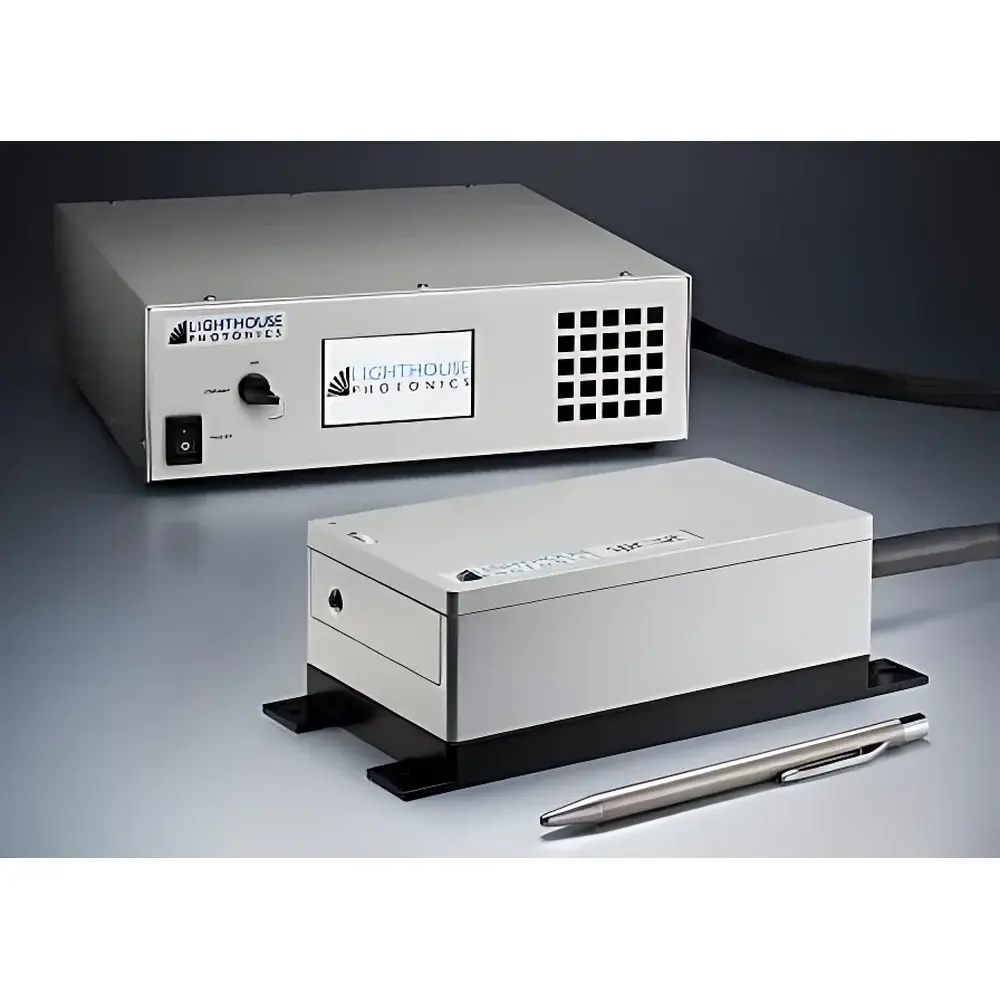
Lighthouse Photonics Sprout-G / Sprout-D / Sprout-H / Sprout-C / Sprout-Solo Series Continuous-Wave 532 nm Solid-State Green Lasers
| Brand | Lighthouse Photonics |
|---|---|
| Origin | USA |
| Model Variants | Sprout-G, Sprout-D, Sprout-H, Sprout-C, Sprout-Solo |
| Wavelength | 532 nm |
| Output Power Range | 3–20 W (model-dependent) |
| Beam Mode | TEM₀₀ |
| M² | 1.0–1.1 |
| Beam Diameter (1/e²) | 2.2–2.3 mm ±10% |
| Beam Divergence | <0.5 mrad |
| Power Stability | <±0.25% RMS (24 h) |
| Intensity Noise | Standard <0.1% RMS (10 Hz–10 MHz), NET Option <0.02% RMS |
| Polarization Ratio | >100:1 (Vertical, Horizontal Optional) |
| Spectral Purity | >99.9% |
| For Sprout-Solo | Linewidth <2 MHz, PZT Tuning Range >8.2 GHz, DC–20 kHz Bandwidth |
Overview
The Lighthouse Photonics Sprout series represents a family of high-power, continuous-wave (CW), diode-pumped solid-state (DPSS) lasers operating at the fundamental wavelength of 532 nm. Engineered for precision optical pumping and demanding scientific applications, each variant—Sprout-G, Sprout-D, Sprout-H, Sprout-C, and Sprout-Solo—is built around a monolithic Nd:YVO₄/KTP cavity architecture optimized for thermal stability, long-term reliability, and minimal maintenance. Unlike traditional lamp-pumped or fiber-coupled green sources, the Sprout platform integrates critical subsystems—including pump diodes, harmonic generation crystals, and thermal management—directly into either the laser head (Sprout-D/H/C/Solo) or the power supply unit (Sprout-G/Solo variants with integrated chiller). This architecture eliminates alignment sensitivity, reduces footprint, and ensures consistent beam pointing and spatial mode fidelity across operational lifetimes exceeding 20,000 hours. The 532 nm output is generated via intracavity frequency doubling of 1064 nm radiation, delivering diffraction-limited TEM₀₀ output with M² values tightly controlled between 1.0 and 1.1.
Key Features
- Ultra-low intensity noise: Standard configuration delivers <0.1% RMS noise over 10 Hz–10 MHz; optional Noise-Elimination Technology (NET) achieves <0.02% RMS—critical for interferometric and quantum optics applications.
- Exceptional power stability: <±0.25% RMS over 24-hour continuous operation, validated under ambient temperature fluctuations of ±2°C.
- Hermetically sealed, alignment-free laser head: No user-accessible optics; no periodic cleaning or realignment required—designed for integration into OEM systems and automated laboratories.
- Compact mechanical form factor: Laser heads measure as small as 120 × 80 × 50 mm (Sprout-C), enabling installation in space-constrained optical tables and vacuum chambers.
- Integrated thermal management: Water-cooling circuit embedded within the power supply (Sprout-G/Solo) or laser head (Sprout-D/H/C), eliminating external chillers and reducing system complexity.
- High spectral purity (>99.9%) and polarization extinction ratio (>100:1), with vertical polarization standard and horizontal available on request.
- Sprout-Solo models add active frequency control via piezoelectric transducer (PZT) with >8.2 GHz tuning range and DC–20 kHz bandwidth—enabling cavity-length stabilization, Pound-Drever-Hall locking, and narrow-linewidth spectroscopy.
Sample Compatibility & Compliance
The Sprout series is designed to meet the stringent environmental and operational requirements of ISO/IEC 17025-accredited laboratories and GLP-compliant research facilities. All units comply with IEC 60825-1:2014 (Class 4 laser safety standards) and are CE-marked per EU Directive 2014/35/EU (Low Voltage Directive) and 2014/30/EU (EMC Directive). Laser housing materials conform to RoHS 2011/65/EU restrictions on hazardous substances. For regulated environments—including pharmaceutical process analytical technology (PAT) and FDA 21 CFR Part 11–governed instrumentation—the Sprout platform supports optional audit-trail-enabled firmware logging and hardware interlock interfaces compatible with third-party SCADA and LabVantage systems. While not inherently GMP-certified, the design basis—including traceable calibration protocols, serial-numbered component logs, and factory-installed NIST-traceable power meters—facilitates qualification under ASTM E2656 (Standard Practice for Qualification of Optical Measurement Instruments).
Software & Data Management
Lighthouse Photonics provides the Sprout Control Suite—a cross-platform (Windows/macOS/Linux) application supporting USB 2.0 and Ethernet (TCP/IP) communication. The suite enables real-time monitoring of output power, head temperature, diode current, and internal photodiode feedback signals. All operational parameters—including power setpoint, modulation mode (analog/digital TTL), and PZT voltage (Sprout-Solo)—are programmable via ASCII command protocol (SCPI-compatible), allowing seamless integration with Python, MATLAB, LabVIEW, and EPICS-based control systems. Data export supports CSV and HDF5 formats, with timestamped metadata compliant with FAIR (Findable, Accessible, Interoperable, Reusable) principles. Optional firmware upgrades include enhanced diagnostics (e.g., predictive pump-diode lifetime estimation based on cumulative drive current and thermal history), configurable alarm thresholds, and dual-channel analog monitoring outputs for external DAQ synchronization.
Applications
- Ti:sapphire laser pumping: High-brightness 532 nm output enables efficient, low-noise excitation of broadband gain media—widely adopted by Coherent, Spectra-Physics, and Avesta for ultrafast oscillator and amplifier systems.
- Dye laser excitation: Stable spatial mode and narrow linewidth support high-resolution tunable visible emission from Rhodamine 6G, Coumarin, and Stilbene dyes.
- Particle Image Velocimetry (PIV): Low beam pointing drift (<2 μrad/°C) and high pulse-to-pulse stability ensure sub-pixel displacement accuracy in time-resolved fluid dynamics studies.
- Optical trapping and atom cooling: TEM₀₀ profile and <0.02% NET noise enable stable dipole trap potentials and sub-Doppler cooling in magneto-optical traps (MOTs) and optical lattices.
- Interferometry and metrology: Sprout-Solo’s <2 MHz linewidth and PZT tunability support heterodyne detection, gravitational wave sensor calibration, and absolute distance measurement via synthetic wavelength interferometry.
- Flow cytometry and confocal microscopy: Compact size and high reliability make Sprout-C/D ideal for OEM integration into clinical and research-grade cytometers requiring multi-line excitation at 532 nm.
FAQ
What is the typical lifetime of the pump diodes in Sprout lasers?
Pump diodes are rated for >20,000 hours MTBF under nominal operating conditions (25°C ambient, rated current). Lifetime is extended via active thermal regulation and soft-start current ramping during power-on sequences.
Can Sprout lasers be operated in external cavity configuration?
No—the cavity is monolithic and hermetically sealed. Frequency selection and linewidth control are limited to intra-cavity PZT tuning (Sprout-Solo) or passive cavity design. External grating or etalon coupling is not supported.
Is remote interlock functionality available for safety-critical installations?
Yes—each model includes a two-channel, fail-safe interlock interface (IEC 61508 SIL2 compliant) supporting dry-contact or TTL-level inputs for emergency shutdown and door interlock integration.
Do Sprout lasers require periodic recalibration?
Factory calibration is performed using NIST-traceable thermal power sensors. Recalibration is recommended every 24 months or after 5,000 hours of operation—service includes full optical alignment verification, noise spectrum analysis, and M² measurement.
Are custom wavelengths or power levels available beyond the standard Sprout portfolio?
Lighthouse Photonics does not offer non-532 nm variants or power levels outside the published specifications. However, OEM partners may engage in co-development programs for mechanically or electronically modified versions under NDA and minimum order quantity agreements.




