
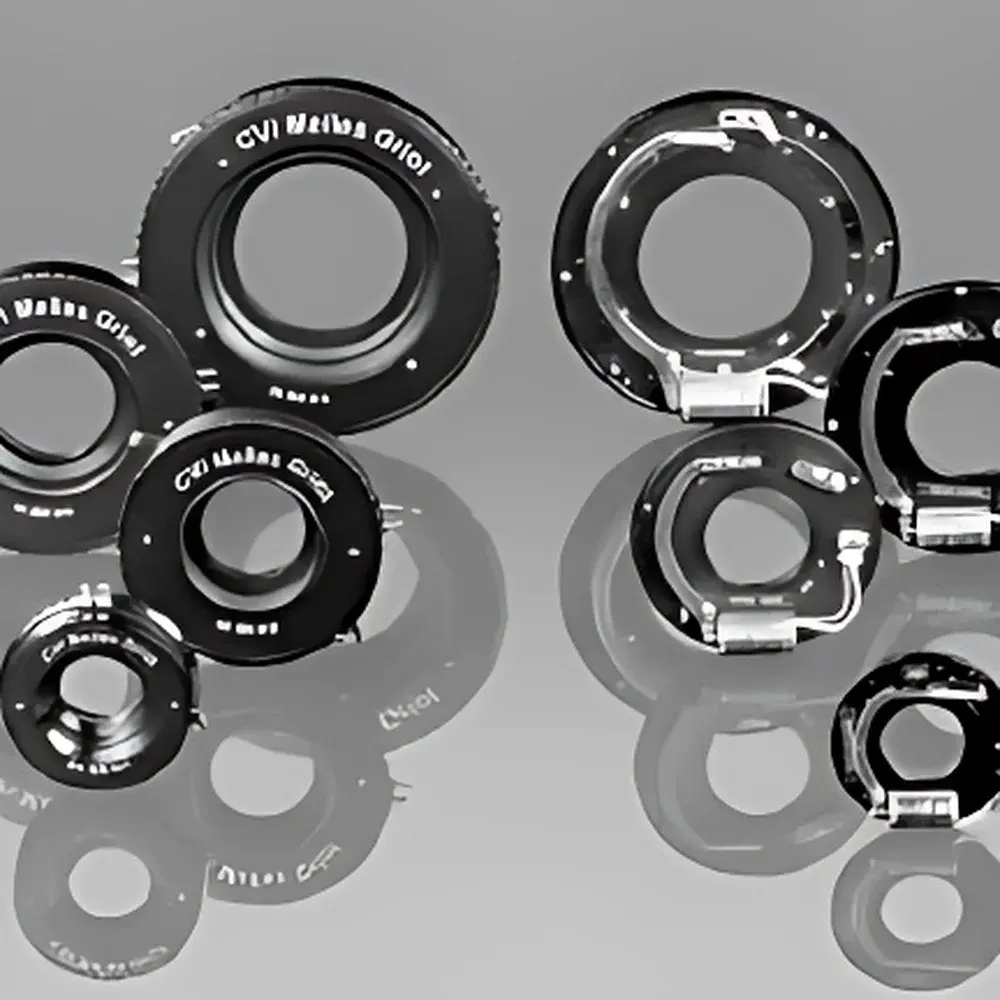
CVI Melles Griot SPL Series High-Performance Optical Shutter
| Brand | CVI Melles Griot |
|---|---|
| Model | SPL |
| Type | Electronic Optical Shutter |
| Actuation Mechanism | Stepper Motor–Driven |
| Aperture Size | Standard 25 mm Clear Aperture (Configurable) |
| Switching Speed | ≤15 ms (Open to Close, Typical) |
| Lifetime | ≥10⁶ Cycles |
| Operating Temperature | 15–35 °C |
| Input Voltage | +24 VDC ±10% |
| Control Interface | TTL-compatible Digital Input (Active-High or Active-Low Selectable) |
| Mounting | SM1 (1.035"-40) Threaded Housing |
| Compliance | RoHS 2015/863/EU, CE Marked for EMC Directive 2014/30/EU |
| Enclosure | Anodized Aluminum, Black Oxide Finish |
Overview
The CVI Melles Griot SPL Series High-Performance Optical Shutter is a precision-engineered electromechanical component designed for reliable, repeatable beam interruption in demanding optical and laser-based applications. Based on a robust stepper motor actuation architecture, the SPL shutter delivers deterministic open/close timing with sub-millisecond repeatability and high mechanical stability under continuous duty cycling. Its core function relies on synchronized rotational motion of a precisely balanced aluminum blade assembly within a rigid SM1-threaded housing, enabling rapid transit across the optical path without vibration-induced beam perturbation. Unlike solenoid- or piezo-driven alternatives, the stepper-based design eliminates residual magnetic field interference, making it suitable for ultra-sensitive interferometric setups, quantum optics experiments, and vacuum-compatible environments where electromagnetic compatibility (EMC) and thermal drift must be minimized. The shutter operates as a binary optical gate—fully open or fully closed—with no intermediate states—ensuring unambiguous beam control for synchronization-critical applications such as pump-probe spectroscopy, time-resolved fluorescence lifetime imaging (FLIM), and laser safety interlock systems.
Key Features
- Stepper motor–driven mechanism ensures zero-hysteresis positioning and long-term repeatability without coil saturation or thermal drift.
- Standard 25 mm clear aperture accommodates common collimated beams; optional apertures (12.7 mm, 35 mm) available upon request for system integration flexibility.
- Typical switching time of ≤15 ms (open-to-close) with jitter < ±0.3 ms, validated via photodiode-triggered oscilloscope measurement per ISO 11146-2.
- Rated for ≥1 million operational cycles under nominal load conditions—verified per MIL-STD-810G Method 507.6 (Mechanical Shock & Vibration).
- TTL-compatible digital control interface supports both active-high and active-low logic selection via onboard DIP switch, enabling seamless integration with National Instruments DAQ, Arduino, Raspberry Pi GPIO, or industrial PLCs.
- RoHS-compliant anodized aluminum housing provides EMI shielding, thermal stability (CTE ≈ 23.6 ppm/°C), and compatibility with standard optomechanical breadboards and cage systems.
Sample Compatibility & Compliance
The SPL shutter is compatible with free-space optical paths carrying visible to near-infrared radiation (350–2000 nm), including CW and pulsed lasers up to 5 W average power (with appropriate beam attenuation). It is not rated for direct exposure to ultraviolet radiation below 350 nm or high-peak-power femtosecond pulses without upstream harmonic separation or beam expansion. All units are manufactured in accordance with ISO 9001:2015 certified processes and conform to IEC 61000-6-3 (Emission) and IEC 61000-6-2 (Immunity) standards. For use in regulated environments—including FDA-regulated medical device R&D labs or EU-based GLP-compliant analytical laboratories—the SPL shutter may be deployed as a Class 1 laser safety component when integrated into a larger system meeting IEC 60825-1:2014 requirements. Documentation packages include Declaration of Conformity (DoC), RoHS Certificate, and traceable calibration records upon request.
Software & Data Management
While the SPL shutter operates as a hardware-level gating device without embedded firmware, its digital interface enables full software control via third-party platforms. CVI provides comprehensive API documentation and LabVIEW VI libraries (compatible with LabVIEW 2015–2023) supporting NI USB-6008/6009 and PCIe-6321 DAQ devices. Python developers can leverage PyVISA or serial-TTL abstraction layers for automated sequence scripting. For audit-trail compliance in GxP environments, integration with SCADA or MES systems is supported through Modbus RTU over RS-485 (requires optional RSC-Rotor Drive Shutter Controller bridge module). All control events—including timestamped open/close commands and status feedback—are loggable to CSV or HDF5 formats for 21 CFR Part 11–compliant electronic record retention when paired with validated acquisition software.
Applications
- Laser safety interlocks in Class 3B/4 laser enclosures per ANSI Z136.1–2022.
- Gated detection in time-correlated single-photon counting (TCSPC) systems.
- Beam blanking during CCD/CMOS camera readout to eliminate smearing artifacts.
- Synchronization of multi-laser excitation sources in confocal and multiphoton microscopy.
- Optical chopper replacement in lock-in amplifier–based absorption spectroscopy.
- Automated filter wheel or polarizer sequencing in ellipsometry and Mueller matrix polarimetry.
FAQ
Is the SPL shutter vacuum-compatible?
Yes—standard SPL units operate reliably at pressures down to 1×10⁻³ Torr; UHV-rated variants with stainless-steel shaft seals and outgassing-tested lubricants are available under custom order.
Can it be used with pulsed lasers operating at 10 kHz repetition rate?
Yes—provided the duty cycle remains ≤5% and average power stays within thermal limits; thermal modeling support is available from CVI application engineering.
Does it support analog voltage control for variable open-time duration?
No—the SPL is a binary shutter; for programmable dwell time, pair with an IPS-series Electronic Shutter Controller or integrate external timing logic.
What is the maximum beam diameter it can accommodate without vignetting?
With the standard 25 mm aperture, collimated beams up to Ø22 mm (95% clear aperture) pass without clipping; beam expansion optics may be mounted directly using SM1-threaded accessories.
Is factory recalibration required after mechanical shock or transport?
No—stepper-based positioning is inherently self-referencing; however, users should verify timing performance using a calibrated photodiode and oscilloscope before critical measurements.






