
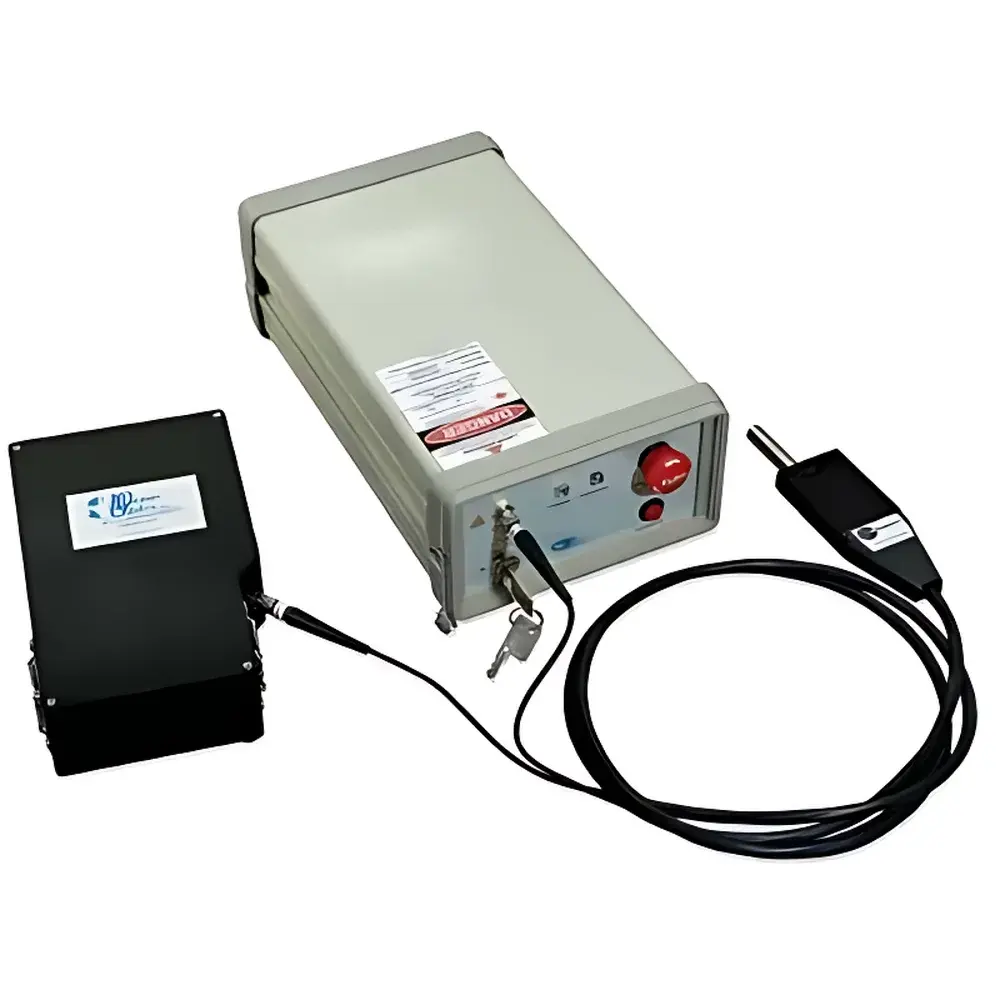
Ocean Optics SPL-RAMAN Modular Raman Spectroscopy System
| Brand | Ocean Optics |
|---|---|
| Origin | USA |
| Manufacturer Type | Authorized Distributor |
| Product Type | Grating-Based Raman Spectrometer |
| Spectral Range | 200–4500 cm⁻¹ |
| Spectral Resolution | 13 cm⁻¹ (FWHM @ 1000 cm⁻¹) |
| Spatial Resolution | 13 cm⁻¹ (calibrated at 1000 cm⁻¹) |
| Minimum Wavenumber Shift | 0.2 nm (laser-dependent) |
| Spectral Repeatability | ±1 nm (at 532 nm excitation) |
Overview
The Ocean Optics SPL-RAMAN Modular Raman Spectroscopy System is an engineered platform for custom integration into OEM instrumentation, process monitoring setups, and advanced research laboratories. Built on the principles of elastic inelastic scattering—where monochromatic laser light interacts with molecular vibrational modes to generate wavelength-shifted Raman photons—the system delivers quantitative, non-destructive chemical identification and structural analysis across solid, liquid, and gel-phase samples. Unlike turnkey benchtop spectrometers, the SPL-RAMAN architecture separates core functional units (spectrometer, excitation laser, fiber-coupled probe, optical mounting hardware, and software stack) to enable application-specific configuration, mechanical packaging optimization, and seamless embedded control via TTL-triggered acquisition or GPIO-synchronized data streaming. Its modular design supports both laboratory validation workflows and industrial deployment under GLP/GMP-aligned environments, with full traceability of spectral calibration, instrument metadata, and acquisition parameters.
Key Features
- Interchangeable high-performance spectrometers: MAYA2000PRO (back-illuminated 2D CCD, 450:1 SNR, 6 ms–5 s integration) or QE65000 (TEC-cooled detector, <0.01 e⁻/pixel/s dark current, up to 15 min integration)
- Stabilized laser sources: SPL-785 series (300–500 mW CW, 0.2 nm linewidth, ±0.5 nm peak stability) or LASER-785-LAB (≥500 mW, >40 dB SMSR, thermally locked wavelength)
- Optimized Raman probes: Inphotonics RamanProbe™ (OD >8 rejection at laser line, background-free operation down to 250 cm⁻¹), RamanProbe II™ (submersible, adjustable focus, sapphire window), or RPB series (cost-optimized lab-grade)
- Configurable optical interface: SMA905 or FC connectors; standard 105 µm excitation / 200 µm collection fibers (NA = 0.22); optional high-temp (200 °C) or long-distance (≤200 m) fiber bundles
- Calibration-ready accessories: HG-1 Hg/Ar wavelength reference lamp (253–1700 nm), PS-HG1-ADP cuvette-style adapter for spectrophotometer cross-calibration
Sample Compatibility & Compliance
The SPL-RAMAN system accommodates diverse sample geometries—including bulk solids, powders, transparent liquids in quartz cuvettes, gels, and in situ aqueous solutions—via interchangeable probe heads and mounting fixtures. All optical components comply with ISO 17025-relevant traceability requirements for spectral calibration, with factory-certified wavenumber accuracy (±1 cm⁻¹) and resolution verification per ASTM E1840. The system supports audit-ready data capture under FDA 21 CFR Part 11 when deployed with Analyze IQ Lab’s electronic signature and audit trail modules. Probe housings meet IP54 environmental rating; stainless-steel and sapphire construction ensures compatibility with Class I laser safety standards (IEC 60825-1). Optional high-temperature probe variants (up to 200 °C) are certified for continuous operation in regulated pharmaceutical drying or catalytic reaction monitoring applications.
Software & Data Management
Analyze IQ Lab provides a validated, model-driven spectral analysis environment compliant with analytical method lifecycle principles (ICH Q2(R2)). It supports PCA, PLS, SIMCA, and proprietary multivariate algorithms optimized for overlapping Raman bands in complex matrices. The software includes step-by-step modeling wizards, real-time residual diagnostics, and exportable validation reports (PDF, CSV, XML). Analyze IQ Spectra Manager serves as a lightweight LIMS alternative—storing CAS numbers, IUPAC names, batch IDs, purity grades, and supplier metadata alongside spectra. Integrated with the commercial Raman Spectra Library (1868 reference spectra, including 765 multi-component mixtures with concentration-weighted annotations), it enables library-matching, mixture deconvolution, and automated QC pass/fail decisions. All spectral acquisitions retain embedded EXIF-like metadata (integration time, laser power, grating ID, temperature logs) for full experimental reproducibility.
Applications
- Pharmaceutical raw material identification and counterfeit detection (USP , EP 2.2.48)
- In-line polymer crystallinity monitoring during extrusion or film casting
- Electrolyte composition tracking in lithium-ion battery R&D (solid-state and liquid electrolytes)
- Geological mineral phase mapping using handheld or microscope-coupled configurations
- Food authenticity screening (e.g., olive oil adulteration, honey purity, spice substitution)
- Biomedical tissue classification (ex vivo cancer margin assessment, biofluid biomarker screening)
FAQ
What spectrometer options are recommended for low-light Raman measurements?
MAYA2000PRO is optimal for rapid (<10 s) identification tasks requiring high quantum efficiency in the 785 nm excitation band. For ultra-low-noise applications—such as fluorescence-suppressed biological samples or long-integration thin-film analysis—the QE65000’s thermoelectric cooling and sub-electron read noise provide superior dynamic range.
Can the system be configured for hazardous area deployment?
Yes. Explosion-proof enclosures, intrinsically safe laser drivers (per ATEX/IECEx), and fiber-optic signal transmission eliminate electrical hazards in Zone 1/2 environments. Probe materials (316L SS, sapphire) resist corrosive vapors common in petrochemical settings.
Is spectral calibration traceable to NIST standards?
All systems ship with HG-1 mercury-argon lamp calibration data and factory-accredited wavenumber certificates aligned to NIST SRM 2241 (polystyrene) and SRM 2242 (silicon). End-user recalibration follows ISO/IEC 17025 Clause 6.4.10 procedures.
How does the software handle mixed-component quantification?
Analyze IQ Lab employs constrained multivariate curve resolution (MCR) and weighted least-squares fitting against the Raman Spectra Library’s experimentally verified mixture references—enabling concentration prediction with ≤5% RSD for binary blends and ≤12% RSD for ternary systems under controlled temperature and focus conditions.
What support is provided for OEM integration?
Ocean Optics supplies SDKs for Python, C++, and LabVIEW; detailed pinout schematics for GPIO/TTL interfaces; and mechanical CAD models (STEP, IGES) for custom housing design. Application engineering assistance includes optical path modeling (Zemax-compatible ray sets) and thermal derating guidance for embedded thermal management.





