
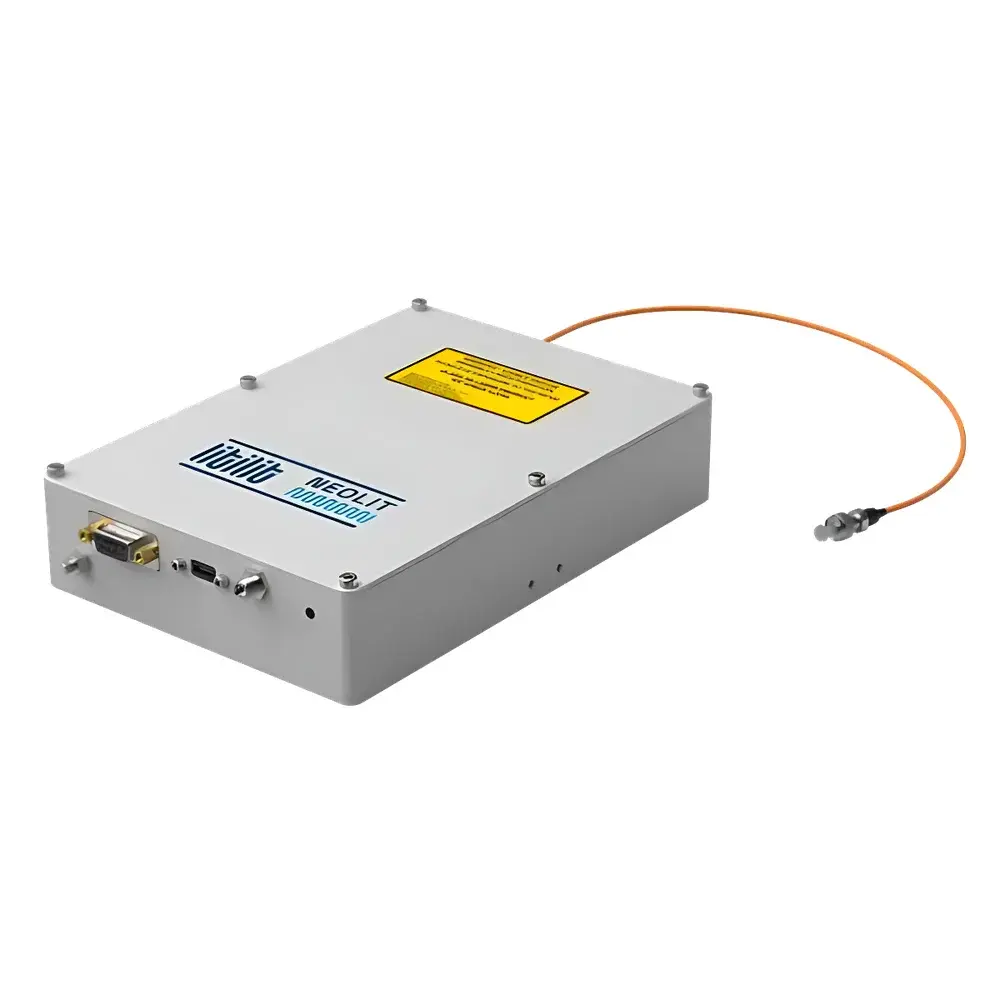
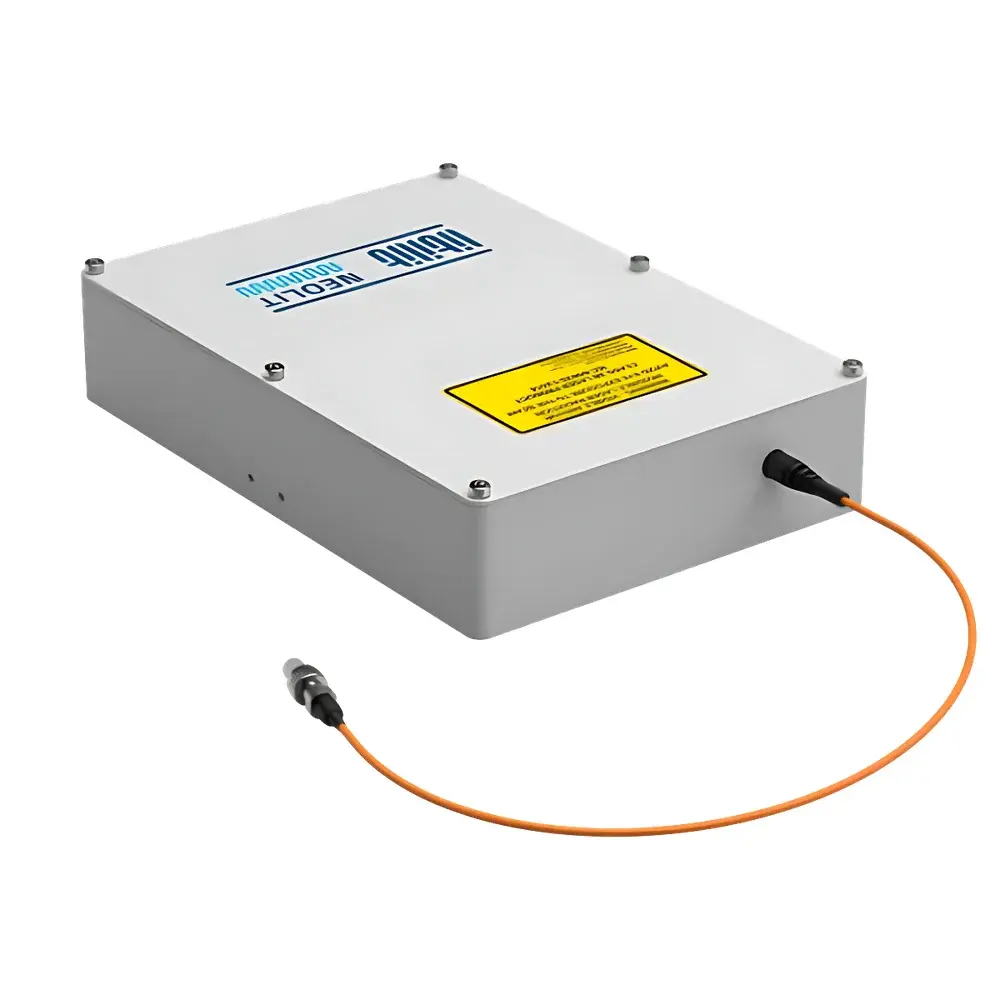
Litilit Neolit Ultrashort-Pulse Fiber Seeder for Laser Amplifiers
| Brand | Litilit |
|---|---|
| Model | Neolit |
| Type | All-Fiber Mode-Locked Femtosecond Seed Source |
| Wavelength Range | 1020–1070 nm (Neolit), 1040 nm (Neolit AMP & BB) |
| Pulse Duration (as-is) | 1–5 ps (Neolit), 5–10 ps (Neolit AMP), 7 ps (Neolit BB) |
| Spectral Bandwidth (FWHM) | 4–12 nm (Neolit), 8–12 nm (Neolit AMP), 20–70 nm (Neolit BB) |
| Average Power | 1–5 mW (Neolit), 20–50 mW (Neolit AMP/BB) |
| Repetition Rate | 15–40 MHz (factory-fixed) |
| Polarization | Linear, PER > 100:1 |
| Output Connector | FC/APC |
| RF Sync Output | SMA |
| Control Interfaces | USB, CAN |
| Power Supply | 12 ± 2 V, max. 3 A |
| Operating Temperature | 15–45 °C |
| Dimensions (L×W×H) | 194 × 135 × 40 mm³ |
| Laser Class | 3B |
| Patented Technology | US10038297, JP6276471, EP3178137, CN106575849 |
Overview
The Litilit Neolit is an all-fiber, passively mode-locked ultrashort-pulse seed source engineered specifically for integration into high-performance femtosecond and picosecond laser amplifier systems. Unlike conventional seeders relying on semiconductor saturable absorber mirrors (SESAMs) or bulk-optic components, the Neolit employs a proprietary, monolithic fiber-integrated pulse generation architecture—protected under international patents (US10038297, EP3178137, etc.)—to deliver exceptional long-term stability, immunity to mechanical vibration and thermal drift, and zero consumable optics. Its core operating principle is based on nonlinear polarization evolution (NPE) in highly nonlinear photonic crystal fiber combined with precisely engineered dispersion management, enabling self-starting, environmentally robust mode-locking without active stabilization. Designed for OEM integration, the Neolit serves as the primary temporal and spectral reference for chirped-pulse amplification (CPA) and optical parametric amplification (OPA) architectures, where deterministic pulse fidelity, low timing jitter (< 50 fs RMS, typical), and transform-limited compressibility are critical.
Key Features
- All-fiber monolithic design eliminates alignment sensitivity, SESAM degradation, and air-path contamination risks—ensuring > 50,000 hours MTBF and maintenance-free operation.
- Passive thermal management via conduction-cooled single-chassis enclosure (194 × 135 × 40 mm³), eliminating fans, pumps, or thermoelectric coolers—ideal for vacuum-compatible or EMI-sensitive environments.
- Factory-set repetition rate (15–40 MHz) with < ±10 ppm stability over full temperature range; RF sync output (SMA) provides low-jitter trigger for pump lasers, Pockels cells, or data acquisition systems.
- High-fidelity pulse characteristics: near-Fourier-transform-limited spectra (M² 100:1) directly from FC/APC output.
- Scalable platform architecture: Neolit base model (1–5 mW, 1–5 ps), Neolit AMP (20–50 mW, 5–10 ps), and Neolit BB (20–50 mW, 7 ps, 20–70 nm FWHM) support tailored dispersion pre-compensation and post-compression down to <30 fs (within 10% of transform limit).
- Dual-control interface (USB + CAN bus) enables seamless integration into automated manufacturing lines or GLP-compliant test benches, supporting remote parameter logging and firmware updates.
Sample Compatibility & Compliance
The Neolit is compatible with standard single-mode polarization-maintaining (PM) fiber inputs and outputs (FC/APC), ensuring low-loss coupling into Ti:sapphire, Yb-doped fiber, or Nd:YVO₄ amplifier stages. It meets IEC 60825-1:2014 Class 3B laser safety requirements; integrated interlock circuitry disables lasing upon cover removal or power anomaly detection. The device complies with CE marking directives (EMC 2014/30/EU, RoHS 2011/65/EU) and supports traceable calibration records per ISO/IEC 17025 guidelines when deployed in accredited laboratories. While not FDA-cleared as a medical device, its optical performance aligns with key parameters referenced in ASTM F2793 (laser-based surgical tool characterization) and ISO 11554 (laser beam parameter measurement standards).
Software & Data Management
Litilit provides the Neolit Control Suite—a cross-platform application (Windows/Linux/macOS) supporting real-time monitoring of output power, internal temperature, and sync signal integrity. All operational logs—including timestamped power fluctuations, thermal transients, and control-command history—are stored locally in CSV/SQLite format with optional encryption. For regulated environments, audit-trail functionality satisfies 21 CFR Part 11 requirements when used with validated network storage and user-role authentication. Firmware updates retain full backward compatibility and include built-in checksum validation to prevent unauthorized modification. CAN bus integration allows synchronization with third-party motion controllers or PLCs in industrial laser processing cells.
Applications
- Seed source for Yb-fiber, Nd-glass, and Ti:sapphire CPA systems requiring high-repetition-rate, low-noise pulse trains.
- Primary oscillator in industrial micromachining platforms (e.g., glass cutting, solar cell scribing) demanding >10⁹ shot reliability.
- Time-resolved spectroscopy and pump-probe setups where sub-100-fs timing precision and amplitude noise < 0.2% RMS (10 Hz–1 MHz) are essential.
- Frequency comb stabilization reference for metrology-grade optical clocks and dual-comb spectroscopy.
- OEM integration into turnkey ultrafast systems subject to MIL-STD-810G vibration/shock specifications and extended-temperature qualification (−5 °C to +55 °C optional).
FAQ
Is the Neolit compatible with commercial chirped-pulse amplifiers from vendors such as Amplitude, Light Conversion, or Coherent?
Yes—the Neolit’s FC/APC output, stable polarization, and low timing jitter enable direct coupling into most commercially available Yb-based CPA front-ends without additional mode-matching optics.
Can pulse duration be adjusted post-manufacture?
No—repetition rate and intrinsic pulse width are factory-set via fixed cavity dispersion and nonlinear gain dynamics. However, external compression (e.g., grating or prism pairs) achieves sub-30-fs durations across all variants.
What is the expected lifetime of the Neolit under continuous operation?
Rated for >50,000 hours MTBF at 25 °C ambient, verified by accelerated life testing per Telcordia GR-468-CORE. No scheduled maintenance or periodic recalibration is required.
Does the Neolit support external cavity length modulation for carrier-envelope phase (CEP) control?
Not natively—the base Neolit operates in CEP-unstable mode. CEP-stabilized variants (e.g., Neolit-CEP) are available under custom engineering engagement with Litilit R&D.
How is thermal drift compensated in the all-fiber cavity?
Through athermalized fiber coil winding geometry, stress-engineered PM fiber splices, and passive thermal mass design—achieving < ±0.05 nm wavelength drift over 15–45 °C operating range.




