
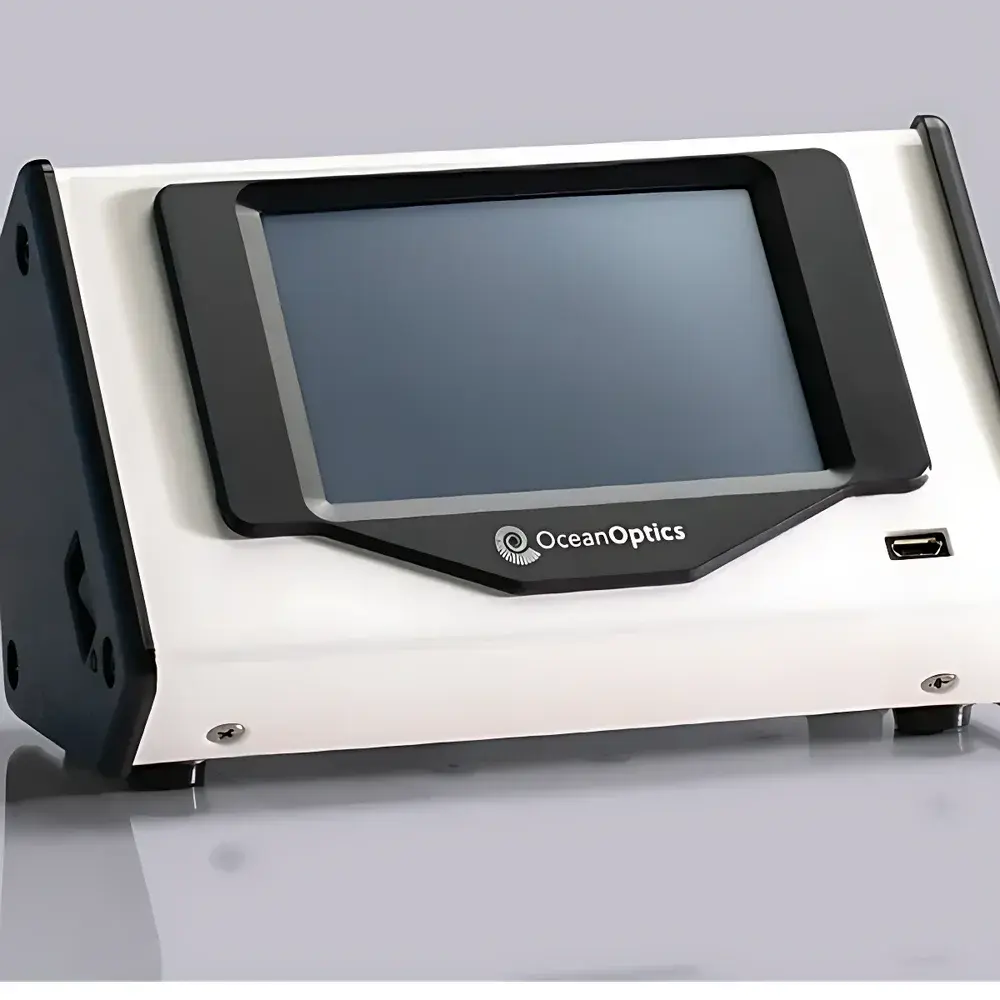
Ocean Optics LSM Series UV-Vis-NIR Broadband LED Light Source
| Brand | Ocean Optics |
|---|---|
| Origin | USA |
| Manufacturer Type | Authorized Distributor |
| Product Origin | Imported |
| Model | LSM |
| Light Source Type | High-Stability Monochromatic & Broadband LED |
| Illumination Mode | Internal (Fiber-Coupled) |
| Wavelength Range | 310–880 nm (Discrete Peaks) + 3000K Warm White Broadband |
| Driver/Controller | LDC-1 Single-Channel Intelligent Driver |
| Coupling Interface | SMA 905 |
| Mounting Options | DIN Rail, Optical Table, 19″ Rack |
| Packaging | Rugged Carry Case for Multi-LED Configurations |
Overview
The Ocean Optics LSM Series is a modular, fiber-coupled LED light source platform engineered for precision optical excitation in analytical and research applications. Built upon solid-state LED technology with thermally stabilized drive electronics, the LSM series delivers narrow-spectrum output at discrete ultraviolet (UV), visible (VIS), and near-infrared (NIR) wavelengths—spanning 310 nm to 880 nm—as well as a calibrated 3000K warm white broadband spectrum. Unlike arc lamps or filtered broadband sources, each LSM module employs wavelength-specific high-radiance LEDs coupled directly into SMA 905 fiber connectors, enabling efficient, low-noise, and drift-free illumination ideal for fluorescence excitation, absorbance spectroscopy, reflectance measurements, and time-resolved photometric assays. The system’s core architecture emphasizes spectral purity, intensity stability (<±0.5% RMS over 4 hours), and rapid TTL-compatible on/off switching (<10 µs rise time), making it suitable for synchronized detection schemes in lock-in or pulsed excitation workflows.
Key Features
- Fiber-coupled design with SMA 905 interface ensures >75% optical power coupling efficiency into standard 400 µm or 600 µm core fibers
- Thermally regulated LED modules maintain spectral center wavelength stability within ±0.3 nm over ambient temperature variations from 15–35 °C
- LDC-1 intelligent driver provides digital current control (0–100% full scale), analog modulation input (0–5 V), and TTL triggering with configurable pulse width and delay
- Modular configuration supports single-wavelength, multi-wavelength, or hybrid (narrowband + broadband) setups via mechanical stacking or external beam combiners
- Robust mechanical housing rated IP52 for dust resistance and vibration tolerance; compatible with DIN rail (EN 60715), optical breadboard (M6 threaded holes), and 19″ rack mounting (optional adapter kit)
- Compliance with IEC 61000-6-3 (EMC Emission) and IEC 61000-6-2 (Immunity); CE and RoHS certified
Sample Compatibility & Compliance
The LSM series is optimized for use with standard silica-based optical fibers (UV-VIS-NIR grade), cuvette holders, flow cells, and microplate readers. Its stable, low-heat output eliminates thermal artifacts common with halogen or xenon sources—critical for temperature-sensitive biological samples and long-duration kinetic assays. All discrete-wavelength models meet ASTM E308-18 spectral bandwidth definitions for narrowband sources (<20 nm FWHM). The 3000K warm white variant conforms to CIE 15:2018 illuminant specifications for correlated color temperature (CCT) and chromaticity coordinates (x = 0.440, y = 0.403). For regulated environments, LDC-1 firmware supports audit trail logging (user actions, timestamps, parameter changes) and optional password-protected configuration modes aligned with GLP/GMP documentation requirements.
Software & Data Management
The LSM series integrates natively with Ocean Insight’s OceanView spectroscopy software (v3.5+), enabling real-time intensity monitoring, automated wavelength sequencing, and synchronization with spectrometer acquisition triggers. A comprehensive SDK (C/C++, Python, LabVIEW, .NET) allows integration into custom instrument control frameworks—including MATLAB-based data acquisition systems and NI LabVIEW DAQ environments. All LDC-1 controllers support USB CDC virtual COM port communication and Modbus RTU over RS-485 for industrial SCADA compatibility. Firmware updates are delivered via signed binary packages with SHA-256 checksum verification, ensuring traceable version control per ISO/IEC 17025 clause 5.9.
Applications
- Fluorescence excitation in confocal microscopy, flow cytometry, and microplate-based ELISA assays
- Multi-wavelength absorbance ratio measurements for dissolved organic carbon (DOC) and nitrate quantification in environmental water analysis
- Reflectance calibration standards for hyperspectral imaging systems operating across UV-VIS-NIR domains
- Photostability testing of pharmaceutical formulations under controlled UV exposure (ICH Q1B)
- Optical sensor validation—e.g., oxygen sensors (470 nm), pH indicators (533 nm), or NIR glucose monitors (880 nm)
- Teaching laboratories requiring safe, maintenance-free alternatives to mercury/xenon arc lamps
FAQ
Can multiple LSM modules be synchronized for sequential or simultaneous excitation?
Yes—the LDC-1 controller supports master-slave daisy-chaining via RS-485, enabling precise inter-module timing alignment within ±100 ns jitter.
Is the 3000K warm white LED spectrally flat across its output range?
No—it follows a blackbody-like distribution peaking near 620 nm; spectral irradiance data (350–950 nm) is provided in NIST-traceable calibration reports shipped with each unit.
What is the maximum recommended duty cycle for pulsed operation?
For optimal lifetime (>10,000 hours L70), continuous DC operation is rated at 100%; for pulsed mode, peak current must not exceed 1.5× rated DC current, with minimum off-time ≥1 ms between pulses.
Are OEM integration options available for embedded designs?
Yes—Ocean Optics offers board-level LDC-1 derivatives (LDC-1-OEM) with UART/I²C interfaces, reduced footprint (50 × 30 mm), and extended temperature range (−20 to +60 °C).
Does the system support FDA 21 CFR Part 11 compliance?
While the base hardware does not include electronic signatures, the OceanView software suite (with optional Validation Package) provides audit trails, role-based access control, and electronic signature capability for regulated QC/QA labs.




