
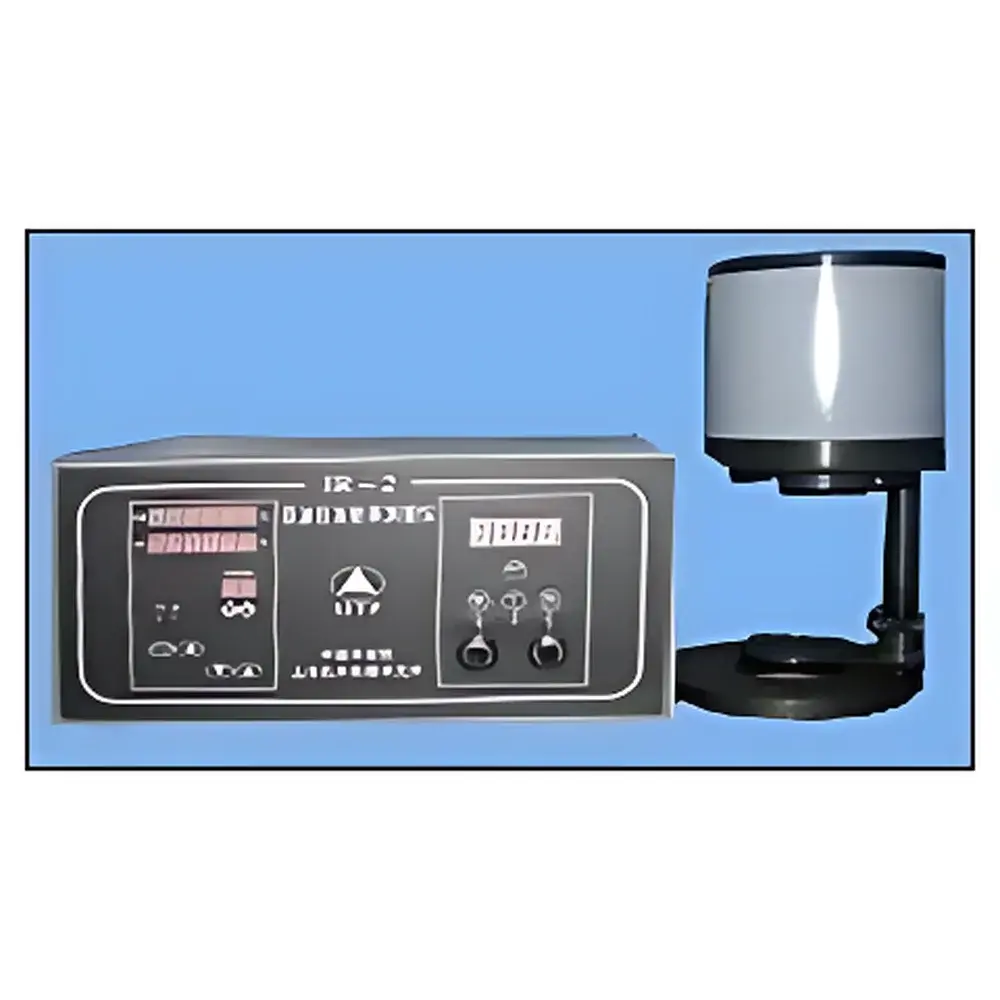
IR-2 Dual-Band Emissivity Tester for Far-Infrared Radiation
| Origin | Beijing, China |
|---|---|
| Manufacturer Type | Authorized Distributor |
| Origin Category | Domestic (China) |
| Model | IR-2 |
| Pricing | Available Upon Request |
| Measurement Principle | Normal Reflectance Method (via Integrated Blackbody Source) |
| Spectral Bands | 3–5 µm, 8–14 µm, 1–22 µm |
| Emissivity Range | 0.100–0.990 |
| Sensitivity (NEΔε) | 0.001 |
| Accuracy | ±0.02 (for ε > 0.50) |
| Repeatability | ±0.01 |
| Sample Temperature Range | Ambient to 300 °C (with optional heating stage) |
| Sample Diameter | Ø50 mm |
| Measurement Time | <3 s after trigger |
| Display Resolution | 0.001 (LED digital) |
| Interface | RS-232 serial port |
| Power Supply | AC 220 V, 50 Hz |
Overview
The IR-2 Dual-Band Emissivity Tester for Far-Infrared Radiation is a precision optical instrument engineered for quantitative determination of normal spectral emissivity (εn) of solid planar materials in the mid- and long-wave infrared (MWIR/LWIR) regions. It operates on the reflectance-based principle: a stabilized, miniature cavity-type blackbody radiation source (calibrated to traceable NIST-equivalent standards) illuminates the sample surface at near-normal incidence; the instrument simultaneously measures both specular (mirror) and diffuse components of reflected radiance using dual-channel detection architecture. By applying Kirchhoff’s law of thermal radiation (εn = 1 − ρn, assuming opaque, non-transmissive samples), the system computes emissivity values with high metrological integrity. Designed specifically for textile R&D labs, building material certification centers, and defense-related thermal signature analysis units, the IR-2 supports standardized evaluation of infrared radiative properties under ambient and controlled elevated temperature conditions (up to 300 °C).
Key Features
- Integrated high-stability blackbody source with six-digit microprocessor-controlled temperature regulation—capable of resolution down to 1 mK—ensuring spectral radiance stability across extended measurement cycles.
- Dual-detection optical path: separate mirror-reflection (MR) and diffuse-reflection (DR) channels compensate for surface scattering effects inherent in woven, knitted, or coated fabrics—critical for accurate emissivity assessment of heterogeneous textile substrates.
- Optical modulation technique suppresses interference from ambient thermal background and self-emission of the sample during ambient-temperature measurements, eliminating need for vacuum or cryogenic shielding.
- Lock-in amplifier circuitry combined with low-noise microelectronic signal processing enables reliable detection of weak reflectance signals—particularly essential for low-emissivity, highly reflective textiles such as metallized polyester or ceramic-coated nylon.
- Modular filter wheel interface allows rapid interchange of bandpass filters to accommodate user-defined spectral bands beyond standard 3–5 µm, 8–14 µm, and broadband 1–22 µm configurations—supporting ASTM E1933-19 and ISO 18434-1 compliant test protocols.
- Non-contact, non-destructive measurement process preserves sample integrity—vital for evaluating finished garments, technical textiles, flame-retardant coatings, or smart fabrics with embedded conductive elements.
- Front-panel LED display with 0.001 resolution and dedicated E-key trigger enables single-button operation; measurement result appears within 3 seconds post-activation.
- RS-232 serial interface facilitates integration into automated QA/QC workflows and supports data logging compatible with GLP-compliant laboratory information management systems (LIMS).
Sample Compatibility & Compliance
The IR-2 is optimized for flat, opaque, non-transmissive samples with diameters up to Ø50 mm—ideal for cut specimens from woven fabrics, nonwovens, laminates, paperboard, and ceramic-coated substrates. Its temperature-controlled stage option (ambient to 300 °C) enables emissivity vs. temperature profiling per ASTM C1371-22 (Standard Test Method for Determination of Emittance of Materials Near Room Temperature Using Portable Emissometers). The instrument meets electromagnetic compatibility (EMC) requirements per IEC 61326-1 and conforms to safety standards IEC 61010-1 for electrical equipment used in measurement, control, and laboratory applications. While not FDA-regulated, its data output structure supports 21 CFR Part 11 audit-trail readiness when paired with validated third-party software for regulated textile testing environments.
Software & Data Management
Though the IR-2 operates autonomously via front-panel controls, its RS-232 interface enables bidirectional communication with host PCs running custom or OEM-supplied terminal emulation software. Raw emissivity values, timestamp, band selection, and temperature setpoint (when applicable) are transmitted as ASCII strings—facilitating direct import into Excel, MATLAB, or Python-based analysis pipelines. Optional firmware upgrades support CSV export with header metadata, enabling traceability required under ISO/IEC 17025-accredited textile testing laboratories. No proprietary runtime or dongle licensing is required; all configuration and calibration parameters reside in non-volatile memory with battery-backed retention.
Applications
- Infrared camouflage evaluation of military-grade uniforms and vehicle covers—quantifying emissivity contrast against natural backgrounds in MWIR/LWIR atmospheric windows.
- Thermal efficiency validation of radiant heating textiles (e.g., carbon-fiber heated apparel, phase-change material (PCM)-integrated fabrics).
- Quality assurance of infrared-reflective coatings applied to fire-resistant workwear or space-suit thermal micrometeoroid garments.
- Building envelope material characterization—including insulation facings, roofing membranes, and low-emissivity window films—aligned with ISO 6946 and EN 13344 standards.
- Academic research on phonon-mediated thermal radiation in nanostructured fibers and plasmonic textile metamaterials.
FAQ
Does the IR-2 require external calibration references or certified standards?
No—its integrated blackbody source is factory-calibrated against traceable reference cavities; annual verification using NIST-traceable transfer standards is recommended but not mandatory for routine textile screening.
Can the IR-2 measure emissivity of curved or irregularly shaped textiles?
It is designed for flat, planar specimens only; curvature introduces angular deviation from normal incidence, violating Kirchhoff’s law assumptions—flat-cut coupons are required per ISO 105-X12 and AATCC TM110 protocols.
Is the heating stage included by default?
No—the ambient-temperature configuration is standard; the 300 °C programmable heating stage is an optional accessory ordered separately with thermal safety interlocks.
What is the minimum measurable emissivity value, and how is low-ε uncertainty quantified?
The lower limit is 0.100; uncertainty increases near this threshold due to detector noise floor—NEΔε = 0.001 applies across the full 0.100–0.990 range, verified per ISO/IEC 17025 clause 7.6.3.
Are spectral responsivity corrections applied for different filter sets?
Yes—each installed bandpass filter has a unique spectral correction factor embedded in firmware, derived from calibrated spectral irradiance measurements using a Fourier-transform infrared (FTIR) spectroradiometer.




