
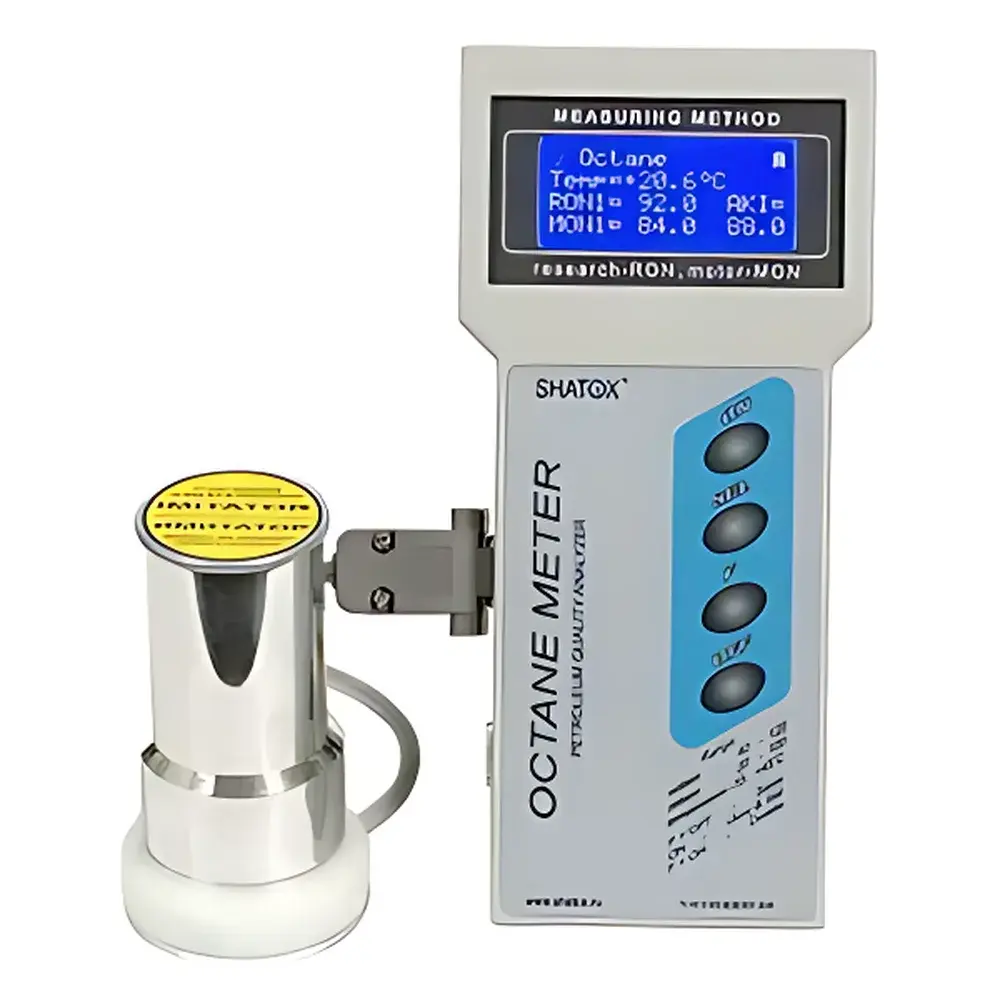
SHATOX SX-100K Portable Octane and Cetane Analyzer
| Origin | Russia |
|---|---|
| Manufacturer Type | Distributor |
| Origin Category | Imported |
| Model | SHATOX SX-100K |
| Price | Upon Request |
Overview
The SHATOX SX-100K Portable Octane and Cetane Analyzer is a field-deployable, electromagnetic property-based instrument engineered for rapid, on-site determination of gasoline octane ratings (Research Octane Number, RON; Motor Octane Number, MON; Anti-Knock Index, AKI) and diesel fuel cetane number (CN), along with derived cold flow properties including cloud point and pour point estimation. Unlike combustion-based standard test engines (e.g., CFR engines per ASTM D2699/D2700), the SX-100K employs dielectric permittivity and magnetic susceptibility sensing to correlate electromagnetic response signatures with hydrocarbon composition, branching, aromaticity, and ignition delay characteristics. This non-destructive, solvent-free methodology enables measurement without sample preparation or hazardous reagents—making it suitable for refinery off-gas lines, fuel distribution terminals, roadside quality verification, and mobile laboratory applications where compliance with ASTM D4737, ASTM D613, EN ISO 5165, and ASTM D2699/D2700 is required.
Key Features
- Field-portable architecture: Integrated sensor head (60 × 100 mm) and electronics module (100 × 210 × 25 mm), total mass 680 g, enabling handheld operation or tripod mounting.
- Dual-fuel capability: Simultaneous RON/MON/AKI and cetane number quantification in a single 10-second measurement cycle.
- Derivative cold flow assessment: Estimates diesel cloud point and pour point via empirical correlation with measured cetane value and fuel density profile.
- Onboard digital display: High-contrast LCD shows real-time numerical results, calibration status, battery level, and environmental conditions (temperature, humidity, pressure).
- Low-power design: 30 mA typical current draw; supports >100 hours of continuous operation on standard AA batteries.
- Environmental robustness: Operational range from –10 °C to +40 °C, 30–80% RH, and ambient pressure 64–106 kPa—validated for outdoor and industrial site use.
Sample Compatibility & Compliance
The SX-100K accepts all commercially available gasoline formulations—including unleaded, oxygenated (MTBE, ethanol-blended), and reformulated fuels—as well as conventional and ultra-low-sulfur diesel (ULSD), biodiesel blends (B5–B20), and synthetic diesel (F-T). It does not require sample filtration or temperature equilibration prior to analysis. Measurement traceability aligns with internationally recognized reference methods: RON/MON per ASTM D2699-86 and D2700-86; cetane number per ASTM D4737-03 and EN ISO 5165; and derived cold flow behavior consistent with ASTM D2500 and D97 principles. The instrument’s electromagnetic sensing principle eliminates dependence on standardized reference fuels during routine field use, though periodic verification against certified reference materials (CRMs) is recommended per ISO/IEC 17025 quality management requirements.
Software & Data Management
The included PC software suite (delivered on CD, compatible with Windows 7–11) provides full instrument control via RS232 interface. It enables automated logging of sample metadata (batch ID, location, operator, timestamp), export of measurement records directly into Excel-compatible .CSV files, and visualization of historical trends across multiple fuel lots. Software-supported functions include firmware updates, calibration coefficient adjustment, database expansion for regional fuel specifications (e.g., Euro 5/6, GB 17930–2016), and audit-trail generation compliant with GLP documentation practices. All data entries are time-stamped and user-logged, supporting basic 21 CFR Part 11 readiness when deployed in regulated QA/QC environments.
Applications
- Real-time quality assurance at fuel loading racks and tanker truck discharge points.
- Rapid screening of suspect or adulterated gasoline/diesel batches prior to acceptance.
- Supporting refinery blending optimization through immediate feedback on octane/cetane response to additive dosing.
- Field verification of fuel conformity during customs inspections or regulatory audits.
- Educational use in petroleum engineering labs for teaching fuel property–composition relationships.
- Mobile service units performing on-site diagnostics for fleet maintenance depots.
FAQ
What physical principles underlie the SX-100K’s measurement method?
It measures changes in complex permittivity and magnetic permeability induced by fuel composition—correlating electromagnetic response to molecular structure, saturation level, and ignition propensity.
Does the analyzer require reference fuel standards for daily operation?
No—calibration is factory-established using traceable CRMs; however, quarterly verification with NIST-traceable reference fuels is advised for ISO/IEC 17025 compliance.
Can the device measure ethanol content in gasoline?
Not directly; ethanol concentration must be determined separately (e.g., by FTIR or GC); however, its presence is implicitly accounted for in octane prediction algorithms.
Is the instrument suitable for marine diesel or jet fuel analysis?
It is validated for automotive gasoline and diesel only; use with aviation turbine fuel (Jet A/A-1) or marine distillate (DMA/DMB) is outside its specified scope and unsupported.
How is measurement uncertainty defined for this instrument?
Stated accuracy is ±0.5 octane number units (RON/MON) and ±1 cetane number unit, based on repeatability testing per ISO 5725-2 under controlled lab conditions.




