
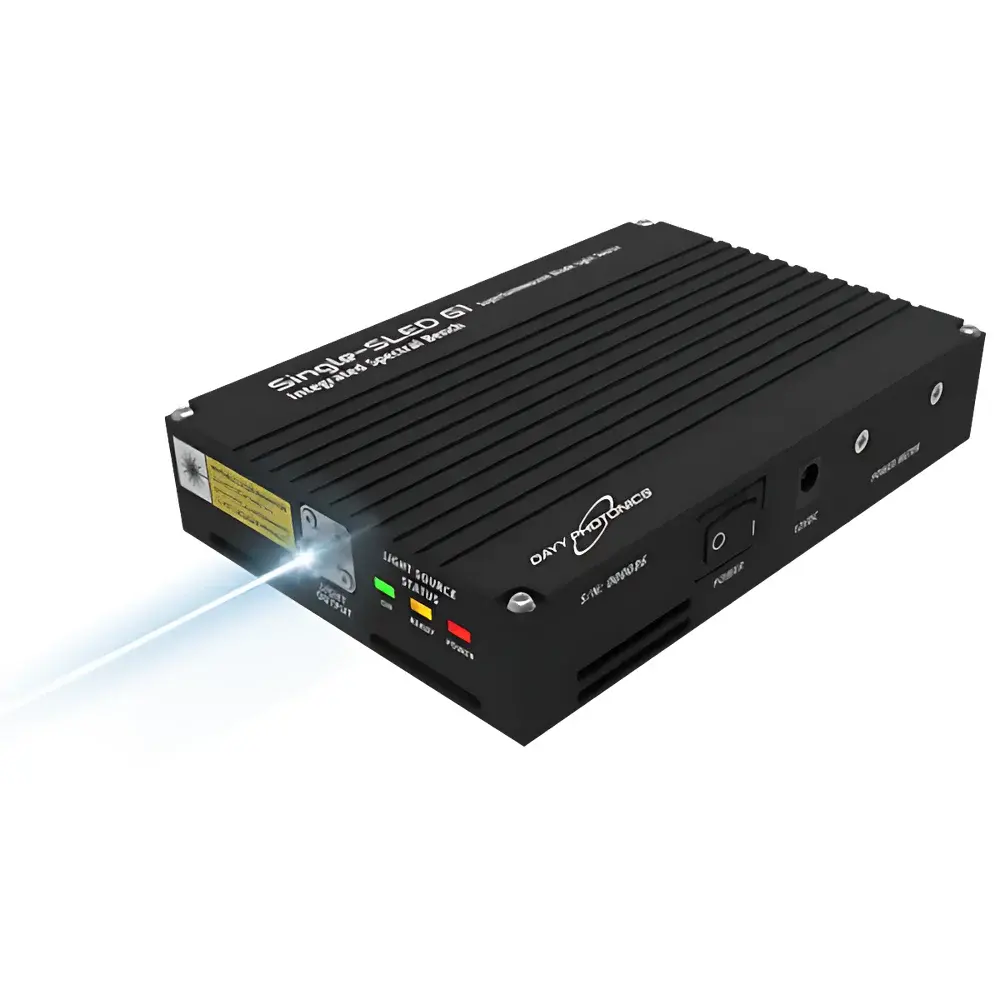
DAYY Photonics ISB1 Single-Channel Superluminescent LED (SLED) Integrated Spectral Bench
| Key | Brand=DAYY Photonics |
|---|
Overview
The DAYY Photonics ISB1 Single-Channel Superluminescent LED (SLED) Integrated Spectral Bench is a compact, turnkey broadband light source engineered for high-stability, low-coherence illumination in demanding optical measurement and imaging applications. Based on DAYY’s proprietary Optical Spectral Engine (OSE1) module, the ISB1 leverages superluminescent diode technology to generate spatially coherent yet temporally incoherent radiation—ideal for applications requiring high brightness without laser speckle or interference artifacts. Operating across the near-infrared spectrum from 770 nm to 1680 nm, the ISB1 delivers spectrally smooth, Gaussian-like emission profiles with full-width-at-half-maximum (FWHM) bandwidths ranging from 15 nm to 110 nm, depending on selected SLED configuration. Its integrated architecture eliminates alignment complexity and ensures repeatable spectral output, making it suitable for integration into OEM systems, laboratory test benches, and regulated instrumentation platforms.
Key Features
- Turnkey spectral bench incorporating a single high-performance SLED, precision current driver, thermoelectric cooler (TEC), and real-time monitoring photodiode—all housed in a rugged, shielded control enclosure
- 15 discrete center wavelength options spanning 770–1680 nm, each optimized for spectral purity, power stability, and thermal drift compensation
- Selectable polarization states: low-depolarized, medium-polarized, and high-polarization-maintaining (PM) variants available via polarization-maintaining fiber (PMF) or standard single-mode fiber (SMF) coupling
- Integrated broadband optical isolator (dual-stage in select models) to suppress back-reflections and ensure source stability under varying load conditions
- Real-time optical power monitoring via built-in calibrated photodiode with analog voltage output and digital readout via GUI
- Flexible control architecture supporting USB 2.0, RS-232 serial, and TTL-compatible trigger/monitoring I/O for synchronization with external acquisition hardware
- Software-controllable output power from 0% to 100% of maximum rated level, with <±0.5% RMS power stability over 8 hours at constant temperature
Sample Compatibility & Compliance
The ISB1 is compatible with industry-standard single-mode (G.652.D, G.657.A1) and polarization-maintaining (PANDA, Bow-tie) fibers terminated with FC/APC connectors (FC/PC and SMA adapters available upon request). Its low temporal coherence (coherence length < 30 µm for 50 nm FWHM configurations) minimizes parasitic interference in interferometric setups such as OCT and fiber optic gyroscopes. The device complies with IEC 61347-1 (lamp control gear safety), IEC 60825-1:2014 (laser product classification—Class 1M per EN 60825-1 when used with specified fiber termination), and RoHS 2015/863/EU directives. For regulated environments, firmware supports audit-trail logging of operational parameters (power setpoint, temperature, drive current) compatible with GLP/GMP documentation workflows.
Software & Data Management
The ISB1 ships with a cross-platform graphical user interface (GUI) for Windows, Linux, and macOS, enabling real-time parameter adjustment, spectral logging, and system diagnostics. The GUI provides live plots of monitored photodiode signal, temperature feedback, and driver current, along with configurable alarm thresholds. A documented RESTful API and Python SDK are provided for automated test sequencing, integration with LabVIEW, MATLAB, or Python-based metrology frameworks, and compatibility with CI/CD pipelines for production calibration validation. All communication protocols adhere to ASCII command syntax over USB CDC or RS-232, ensuring deterministic latency and interoperability with legacy industrial controllers.
Applications
- Optical coherence tomography (OCT) system development and calibration, including swept-source and spectral-domain implementations
- Fiber-optic component characterization: insertion loss, polarization-dependent loss (PDL), and chromatic dispersion measurement
- Interferometric sensor interrogation for fiber Bragg grating (FBG) and Fabry–Pérot sensing networks
- Calibration reference source for spectrometers, optical spectrum analyzers (OSAs), and wavelength meters
- Low-coherence interferometry (LCI) in metrology for surface profiling and thin-film thickness measurement
- Development and validation of photonic integrated circuits (PICs) requiring broadband excitation with controlled spectral shape
- Biomedical imaging system prototyping where laser safety constraints preclude use of conventional lasers
FAQ
What is the typical coherence length of the ISB1 at 1310 nm with 60 nm FWHM?
For a Gaussian-shaped spectrum with 60 nm FWHM centered at 1310 nm, the theoretical coherence length is approximately 18–22 µm in air; actual measured values depend on fiber dispersion and collimation optics.
Can the ISB1 be operated in continuous wave (CW) mode only, or does it support modulation?
The ISB1 operates exclusively in CW mode; however, its TTL-compatible analog monitor output and fast current driver enable external amplitude modulation up to 10 kHz using an external bias-T circuit.
Is factory recalibration required, and what is the recommended recalibration interval?
DAYY Photonics recommends annual traceable recalibration against NIST-traceable power and wavelength standards; calibration certificates include uncertainty budgets per ISO/IEC 17025 requirements.
Does the ISB1 meet FDA 21 CFR Part 11 requirements for electronic records in regulated laboratories?
While the hardware itself is not Part 11-certified, the API and GUI support electronic signatures, audit trails, and role-based access control when deployed within validated software environments compliant with 21 CFR Part 11 Annex 11.
How is thermal management implemented to ensure wavelength stability?
The OSE1 engine incorporates a closed-loop TEC controller with ±0.1 °C setpoint accuracy and embedded thermistor feedback; wavelength drift is limited to <0.02 nm/°C across the operating range (15–35 °C ambient).




