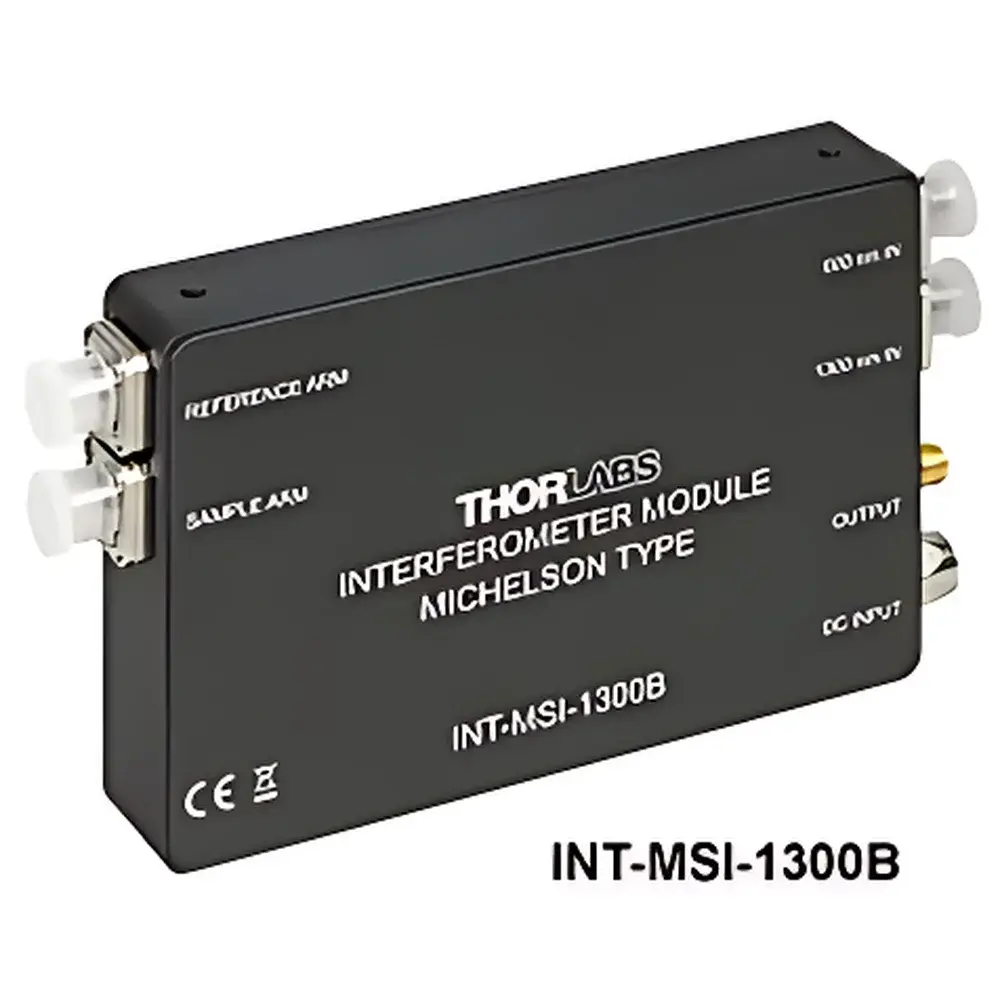
Thorlabs INT-COM-1300 Common-Path Optical Coherence Tomography Interferometer
| Brand | Thorlabs |
|---|---|
| Origin | USA |
| Manufacturer Type | Authorized Distributor |
| Origin Category | Imported |
| Model | INT-COM-1300 |
| Price | Upon Request |
| Optical Wavelength Range | 1250–1350 nm |
| Fiber Type | Corning SMF-28e |
| Input/Output Connectors | FC/APC |
| Insertion Loss (1300 nm IN → Probe Port) | ≤1.2 dB |
| Insertion Loss (1300 nm IN → VOA IN) | ≤3.5 dB |
| Insertion Loss (660 nm IN → Probe Port) | ≤2.0 dB |
| Detector Material/Type | InGaAs Balanced Photodetector |
| Electrical Wavelength Range | 800–1700 nm |
| Max Responsivity | 1.0 A/W (typ.) |
| Output Bandwidth (3 dB) | DC–15 MHz |
| Transimpedance Gain | 51 kV/A |
| DC Offset | < ±5 mV |
| Saturation Power | 70 µW @ 1300 nm |
| Damage Threshold | 20 mW |
| Output Impedance | 50 Ω |
| Power Supply | ±12 V, 200 mA |
| Dimensions | 120 mm × 80 mm × 21 mm |
Overview
The Thorlabs INT-COM-1300 is a fiber-coupled, common-path interferometer engineered specifically for swept-source optical coherence tomography (SS-OCT) systems operating in the 1250–1350 nm spectral window. Unlike conventional Michelson or Mach-Zehnder interferometers, the INT-COM-1300 implements a monolithic, all-fiber common-path architecture—where both reference and sample arms propagate collinearly through shared optical paths—minimizing sensitivity to environmental perturbations such as thermal drift, vibration, and polarization fluctuations. This design inherently suppresses phase noise and enables high-stability, long-term interferometric signal acquisition without active path-length stabilization. The device integrates a wavelength-division multiplexing (WDM) coupler that combines the 1300 nm OCT sweep beam with a 660 nm visible alignment beam, facilitating real-time probe alignment and system calibration. Its core optical network includes a 95/5 fused-fiber coupler and a slope-compensated coupler optimized for broadband flatness and ultra-low polarization-dependent loss (<0.05 dB), ensuring consistent coupling efficiency across the full SS-OCT sweep range.
Key Features
- Fully integrated common-path interferometer with embedded balanced InGaAs photodetector and active anti-aliasing filter
- Optimized for swept-source OCT systems: 1250–1350 nm operational bandwidth, compatible with standard Corning SMF-28e fiber
- Low insertion loss: ≤1.2 dB from 1300 nm input to probe port; ≤2.0 dB from 660 nm alignment input to probe port
- Flat, broadband wavelength response enabled by dual-stage coupler design—95/5 main splitter and slope-compensated auxiliary coupler
- DC-offset suppression: < ±5 mV typical; transimpedance gain of 51 kV/A supports high-sensitivity detection of low-amplitude interference fringes
- Compact, benchtop-ready form factor (120 × 80 × 21 mm) with SMA electrical output and FC/APC optical interfaces
- Integrated active anti-aliasing filtering (DC–15 MHz bandwidth) minimizes harmonic distortion and aliasing artifacts in digitized fringe signals
Sample Compatibility & Compliance
The INT-COM-1300 is designed for use with commercially available SS-OCT light sources (e.g., Axsun, Santec, or Insight Photonics modules) and external common-path probe assemblies—including endoscopic, needle-based, or handheld configurations. Its FC/APC connectors ensure low back-reflection performance critical for high-dynamic-range OCT imaging. The device complies with IEC 61340-5-1 (ESD control), RoHS Directive 2011/65/EU, and meets CE marking requirements for electromagnetic compatibility (EN 61326-1). While not certified as medical-grade hardware, its optical and electrical specifications align with ISO 13485-aligned manufacturing practices when deployed in R&D or preclinical OCT platforms. All optical components are qualified per Telcordia GR-1221-CORE reliability standards for fiber-optic passive devices.
Software & Data Management
The INT-COM-1300 operates as a hardware-level signal conditioning stage and requires no embedded firmware or driver software. Its analog voltage output (SMA connector, 50 Ω impedance) is directly compatible with commercial data acquisition systems (e.g., National Instruments PCIe-6363, AlazarTech ATS9373) and OCT reconstruction toolchains including MATLAB-based SS-OCT processing pipelines (e.g., custom Fourier-domain resampling, dispersion compensation, and Hilbert transform demodulation). When integrated into GLP- or GMP-regulated environments, users may configure third-party DAQ software (e.g., LabVIEW with 21 CFR Part 11-compliant audit trail modules) to log detector output timestamps, gain settings, and power supply telemetry—enabling traceable signal provenance for validation documentation.
Applications
- Preclinical ophthalmic and dermatological OCT imaging requiring long-term phase stability and minimal motion artifact
- Endoscopic and intravascular OCT catheter development, where compact size and common-path immunity to bending-induced phase noise are essential
- Industrial metrology applications involving transparent or semi-transparent layered materials (e.g., polymer film thickness profiling, coating uniformity assessment)
- Development of portable or point-of-care OCT systems leveraging swept-source engines and FPGA-based real-time processing
- Academic research in low-coherence interferometry, optical coherence elastography (OCE), and Doppler OCT flow quantification
FAQ
What OCT source wavelengths is the INT-COM-1300 rated for?
The interferometer is specified for operation between 1250 nm and 1350 nm, with optimal performance centered at 1300 nm. It is not intended for use outside this band.
Can the 660 nm alignment port be used simultaneously with the OCT sweep beam?
Yes—the integrated WDM coupler enables concurrent transmission of both beams without crosstalk; the 660 nm channel is isolated from the detection path and serves solely for visual alignment.
Is the INT-COM-1300 suitable for time-domain OCT (TD-OCT)?
No—it is architecturally optimized for swept-source (Fourier-domain) systems and lacks the delay-line mechanics required for TD-OCT implementations.
Does the unit include calibration certificates or traceable metrology data?
Thorlabs provides factory-measured insertion loss, polarization-dependent loss, and detector responsivity curves with each unit; NIST-traceable calibration is available upon request as a value-added service.
How is DC bias compensated in the balanced detection scheme?
The 5% tap feeds a dedicated VOA-controlled path to the second detector channel; this enables real-time adjustment of common-mode rejection ratio (CMRR) and suppression of laser intensity noise and low-frequency drift.