
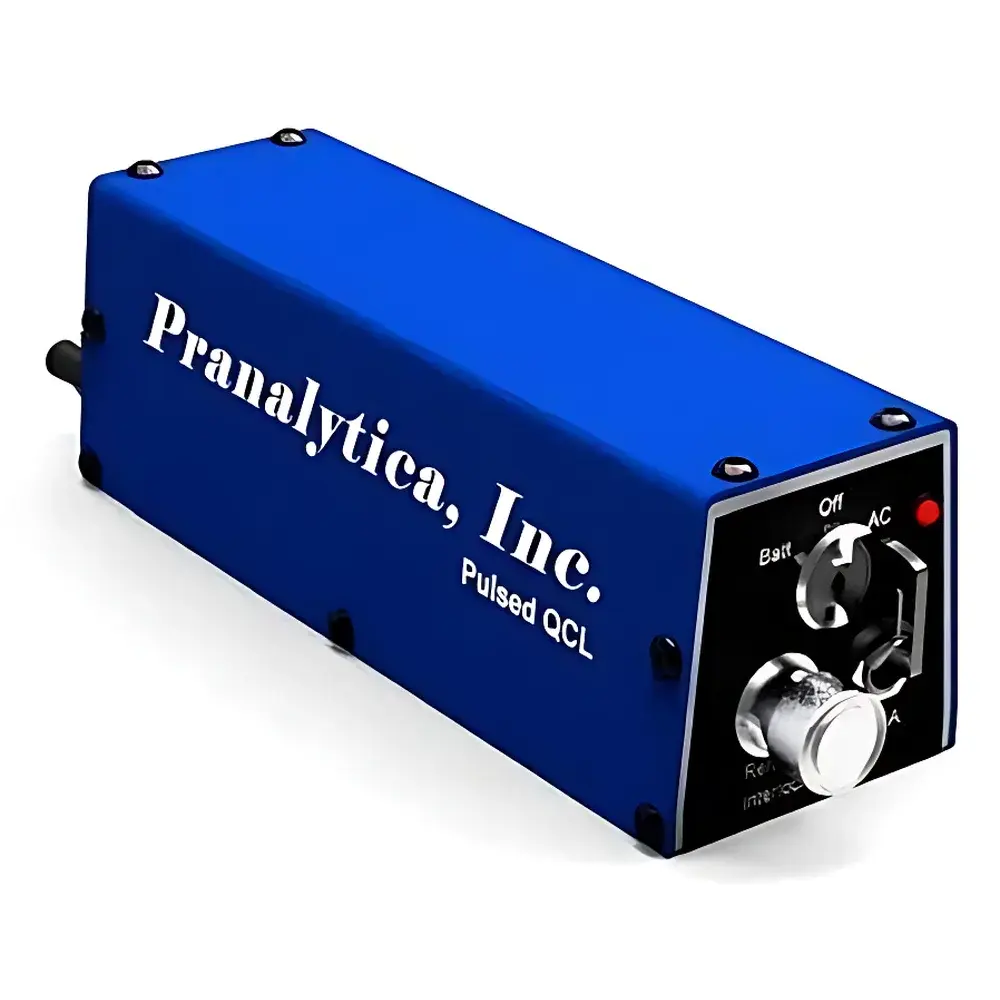
Pranalytica 1101-XX-QCW-YYYY MicroTT-EXT High-Power Quasi-Continuous-Wave Quantum Cascade Laser System
| Brand | Pranalytica |
|---|---|
| Origin | USA |
| Manufacturer Type | Authorized Distributor |
| Product Category | Imported Optical Instrument |
| Model | 1101-XX-QCW-YYYY-MicroTT-EXT |
| Output Wavelength Range | 3.8–12.0 µm |
| Avg. Output Power | >2.5 W @ 4.6 µm, >2.0 W @ 4.0 µm, >1.5 W @ 3.8 µm & 9.3 µm, >1.2 W @ 7.2 µm |
| Pulse Width | 200–500 ns |
| Duty Cycle | High (Quasi-CW) |
| Cooling | Passive (Conduction-Cooled) |
| Power Supply | 20 V DC (External) or Internal CR123A Battery Pack (≥30 min runtime @ 2 W) |
| Beam Delivery | Integrated Collimation Optics |
| Enclosure | Sealed, Vibration-Isolated, Benchtop-Optimized Housing |
| Compliance | MIL-STD-810G (Shock/Vibration), RoHS, CE |
Overview
The Pranalytica 1101-XX-QCW-YYYY-MicroTT-EXT is a high-average-power, benchtop-optimized quantum cascade laser (QCL) system engineered for precision mid-infrared spectroscopy and field-deployable sensing applications. Unlike conventional interband diode lasers, QCLs operate on intersubband transitions within a repeated stack of precisely engineered quantum wells—typically exceeding 500 periods—enabling unipolar carrier injection and photon emission in the 3.8–12.0 µm spectral region. This architecture delivers intrinsic advantages in wavelength flexibility, thermal stability, and power scalability. The MicroTT-EXT implements a quasi-continuous-wave (QCW) operating mode with high duty-cycle pulsing (200–500 ns pulses), achieving >2.5 W average optical power at 4.6 µm—among the highest demonstrated output levels for commercially available, passively cooled QCL systems. Its monolithic, sealed optomechanical housing integrates the laser chip, thermally stabilized mount, collimating optics, and pulse-forming electronics, eliminating alignment requirements and ensuring long-term operational stability under ambient laboratory conditions.
Key Features
- High average output power: >2.5 W @ 4.6 µm; >2.0 W @ 4.0 µm; >1.5 W @ 3.8 µm and 9.3 µm; >1.2 W @ 7.2 µm
- Wavelength coverage from 3.8 µm to 12.0 µm, with standard configurations at 3.8, 4.0, 4.6, 7.1, 8.5, and 9.3 µm—custom wavelengths available upon request
- Fully integrated, vibration-isolated benchtop enclosure with passive conduction cooling—no active chillers or water lines required
- Single 20 V DC input for full system operation; optional internal CR123A battery pack supports ≥30 minutes of continuous operation at 2 W output
- Pre-aligned, hermetically sealed optical path including AR-coated collimating lens; zero user alignment needed
- Engineered to exceed MIL-STD-810G environmental specifications for mechanical shock and broadband vibration
- OEM-ready mechanical and electrical interfaces—including TTL-triggered pulse control, analog power modulation, and real-time temperature monitoring outputs
Sample Compatibility & Compliance
The MicroTT-EXT is designed for compatibility with standard mid-IR gas cells (e.g., White cell, Herriott cell), photoacoustic spectroscopy modules, and external cavity absorption setups. Its narrow linewidth (<0.001 cm⁻¹ typical), stable pointing (<10 µrad drift over 8 h), and low amplitude noise (<1% RMS, 10 Hz–1 MHz) ensure high-fidelity spectral acquisition in both laboratory and mobile platforms. The system complies with RoHS Directive 2011/65/EU and carries CE marking for electromagnetic compatibility (EN 61326-1) and safety (EN 60825-1:2014 Class 4 laser product). While not certified for medical device use per ISO 13485, its performance parameters meet technical prerequisites for integration into FDA-submitted analytical instruments used in breath analysis and environmental monitoring workflows. Traceable calibration reports (NIST-traceable power meter and wavemeter) are provided with each unit to support GLP-compliant data acquisition protocols.
Software & Data Management
The MicroTT-EXT supports direct integration via USB 2.0 or RS-232 serial interface into third-party data acquisition environments (LabVIEW, Python, MATLAB). Pranalytica provides a vendor-agnostic command set (ASCII-based SCPI-like syntax) enabling precise control of pulse repetition frequency (1–500 kHz), peak current, and internal temperature setpoint (±0.1 °C resolution). All operational parameters—including junction temperature, drive current, and output power—are logged with timestamped metadata to facilitate audit-ready traceability. For regulated environments requiring electronic records integrity, the system’s firmware supports configurable audit trail logging aligned with FDA 21 CFR Part 11 principles when deployed with compliant host software. No proprietary GUI is bundled; instead, the architecture emphasizes interoperability with existing spectroscopic control stacks and LIMS integrations.
Applications
- Defense & Security: Infrared countermeasure (IRCM) simulation, standoff explosive vapor detection, toxic industrial chemical (TIC) identification, container screening via backscattered IR absorption
- Medical Diagnostics: Real-time breath analysis for ammonia (liver/kidney function), acetone (diabetes monitoring), isoprene (oxidative stress), and halogenated anesthetics (sevoflurane, desflurane)
- Environmental Monitoring: Open-path atmospheric sensing networks, shipboard NOx/SO2/CH4 emission profiling, landfill methane flux quantification, agricultural NH3 volatilization studies
- Industrial Process Control: In-line natural gas composition analysis (C1–C4 hydrocarbons), refinery flare gas monitoring, pharmaceutical solvent residue detection in lyophilized products
- Semiconductor Manufacturing: In-situ chamber gas purity verification (NF3, SiF4, HF), cleanroom ambient monitoring for ppb-level HCl/HF leaks, etch endpoint detection via radical species tracking
FAQ
What distinguishes quasi-continuous-wave (QCW) operation from true CW or pulsed modes?
QCW operation enables higher average power than conventional nanosecond-pulsed QCLs by using longer pulses (200–500 ns) at elevated duty cycles (typically 1–10%), balancing thermal management with signal-to-noise ratio—ideal for lock-in or time-resolved absorption measurements.
Can the MicroTT-EXT be integrated into an external cavity configuration?
Yes—the collimated output beam (M² < 1.3) is compatible with standard off-axis parabolic mirrors and diffraction gratings; external cavity tuning ranges up to ±5 cm⁻¹ are achievable with appropriate retro-reflection feedback design.
Is temperature stabilization active or passive?
The laser chip is mounted on a thermoelectric cooler (TEC) with closed-loop PID control, but the entire module relies on passive conduction cooling through the aluminum housing—no forced air or liquid coolant is required.
Does the system support wavelength calibration against reference gases?
Yes—its narrow instantaneous linewidth and stable repetition rate allow direct referencing to fundamental rovibrational transitions of N2O, CO, or CH4 in multipass cells, supporting absolute wavenumber accuracy better than ±0.01 cm⁻¹.
What documentation is supplied for regulatory validation?
Each unit ships with a Factory Calibration Certificate (including power vs. current curves, spectral centroid verification, and thermal drift characterization), RoHS/CE declarations, and a detailed mechanical drawing package for OEM integration validation.





