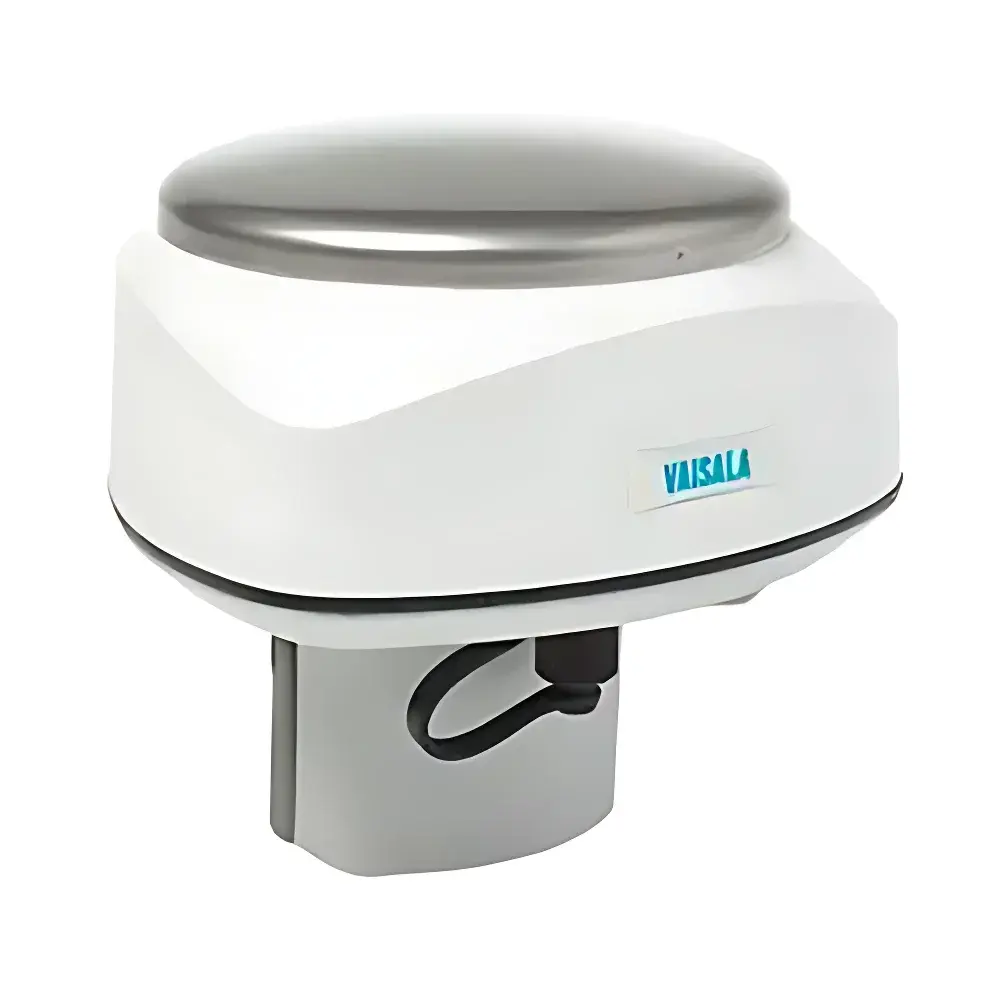
Vaisala WXT531 Precipitation Sensor
| Brand | Vaisala |
|---|---|
| Origin | Finland |
| Model | WXT531 |
| Measurement Principle | Ultrasonic Rain Detection (RAINCAP®) |
| Output | Cumulative Rainfall (mm), Rain Duration (s), Rain Intensity (mm/h) |
| Range | 0–200 mm/h |
| Resolution | 0.01 mm |
| Accuracy | ±5% (field-dependent) |
| Rain Duration Resolution | 10 s |
| Rain Intensity Calculation | Sliding 1-minute average, 10-s step |
| Operating Temperature | −52 to +60 °C |
| Storage Temperature | −60 to +70 °C |
| Enclosure Rating | IP65 (without mounting gland), IP66 (with mounting gland) |
| Power Supply | 6–24 VDC |
| Typical Current Consumption | 3 mA @ 12 VDC (default measurement interval) |
| Heating Option | 12–24 VDC / 12–17 VAC, 0.8 A @ 12 VDC |
| Digital Interfaces | SDI-12 v1.3, RS-232, RS-485, RS-422 |
| Communication Protocols | ASCII Polling/Automatic Mode, NMEA 0183 v3.0 |
| Analog Outputs | 4–20 mA (optional, configurable per parameter) |
| Compliance | IEC 60945 (Maritime), EN 61326-1 (EMC), RoHS, CE |
Overview
The Vaisala WXT531 Precipitation Sensor is a dedicated ultrasonic rainfall measurement module within the modular WXT530 series of intelligent environmental transmitters. Unlike traditional tipping-bucket or weighing rain gauges, the WXT531 employs Vaisala’s proprietary RAINCAP® technology — a solid-state, non-mechanical acoustic sensing principle that detects raindrop impact energy on a calibrated hydrophobic surface. This enables continuous, high-temporal-resolution quantification of precipitation without mechanical wear, clogging, evaporation loss, or overflow errors. The sensor operates as a standalone rainfall monitor or integrates seamlessly into multi-parameter meteorological stations, delivering cumulative rainfall (mm), rain duration (s), and real-time rain intensity (mm/h) derived from a sliding one-minute average with 10-second update steps. Engineered for long-term unattended operation in extreme climates — from Arctic tundra to tropical coastal zones — the WXT531 maintains functional integrity across −52 °C to +60 °C and meets IP66 ingress protection when installed with appropriate cable glands.
Key Features
- Ultrasonic RAINCAP® sensing technology eliminates moving parts, ensuring zero maintenance and immunity to debris, freezing, or mechanical fatigue.
- Simultaneous output of three precipitation metrics: cumulative rainfall (resettable), rain duration (10-s resolution), and rain intensity (1-min sliding average).
- Low-power architecture supports solar-powered deployments: typical current draw is only 3 mA @ 12 VDC during standard measurement cycles; standby consumption drops to 0.1 mA in SDI-12 sleep mode.
- Integrated heater option (12–24 VDC / 12–17 VAC) prevents snow/ice accumulation and ensures reliable detection under sub-zero conditions — critical for automated weather observation networks (AWOS) and climate monitoring stations.
- Flexible digital interfacing via SDI-12 v1.3, RS-232, RS-485, and RS-422 with support for both polled and autonomous ASCII/NMEA 0183 v3.0 messaging protocols.
- Optional 4–20 mA analog outputs enable direct integration with PLCs, SCADA systems, and industrial control panels without external signal conditioning.
- Compact, lightweight housing (IP65/IP66 rated) allows rapid deployment on masts, towers, or building facades with minimal structural reinforcement.
Sample Compatibility & Compliance
The WXT531 is designed for outdoor atmospheric precipitation monitoring in accordance with international observational standards. Its measurement methodology aligns with WMO Guide to Meteorological Instruments and Methods of Observation (CIMO Guide, Chapter 12) for solid-state rain detection. While not a primary reference standard, its ±5% field accuracy is validated under controlled precipitation simulation per IEC 60945 Annex E for maritime environmental sensors. The device complies with EN 61326-1 for electromagnetic compatibility in industrial environments and meets RoHS and CE directives. It is certified for marine use beyond minimum IEC 60945 requirements, making it suitable for offshore platforms, port authority networks, and coastal research buoys. No calibration traceability to national metrology institutes (e.g., NIST, PTB) is provided out-of-box; however, field verification using calibrated catchment gauges remains feasible per ISO 9060:2018 (Class C spectral response classification for precipitation instruments).
Software & Data Management
The WXT531 operates autonomously without embedded firmware requiring user configuration — all parameters are set via serial command or SDI-12 instruction sets. Data logging is handled externally by connected dataloggers (e.g., Campbell Scientific CR1000X, Onset HOBO RX3000) or SCADA hosts. Vaisala’s free WXT Utility software provides configuration, diagnostics, and real-time data visualization for Windows-based commissioning. For enterprise integration, the sensor supports Modbus RTU over RS-485 (via optional firmware upgrade) and is compatible with common IIoT platforms including Ignition SCADA, ThingWorx, and AWS IoT Core through protocol translation gateways. Audit-trail-capable systems may log command history and measurement timestamps in compliance with GLP/GMP-aligned environmental monitoring practices, though native 21 CFR Part 11 electronic signature functionality is not implemented — external validation layers are required for regulated pharmaceutical or nuclear site applications.
Applications
- Automated Weather Stations (AWS) deployed by national meteorological services, airports (ICAO Annex 3), and hydrometric agencies for real-time flash flood forecasting.
- Hydrological monitoring networks measuring basin-level rainfall-runoff relationships for reservoir management and drought early-warning systems.
- Renewable energy sites (solar farms, wind parks) where precipitation data informs soiling rate models and predictive maintenance scheduling.
- Smart city infrastructure integrating environmental telemetry into municipal IoT platforms for stormwater drainage optimization and urban heat island studies.
- Research-grade field campaigns in polar, alpine, and desert environments where mechanical reliability and low-temperature operability are mission-critical.
- Industrial process control in sectors such as mining, construction, and agriculture where rainfall-triggered operational halts require precise timing and intensity thresholds.
FAQ
Does the WXT531 require periodic recalibration?
No — the RAINCAP® sensor has no consumable or drift-prone components. However, annual visual inspection and cleaning of the sensing surface per Vaisala’s Maintenance Guide (M211201EN) are recommended to maintain specified accuracy.
Can the WXT531 measure snowfall or sleet?
It detects liquid-equivalent precipitation only. Solid-phase hydrometeors (snow, sleet) are not reliably quantified unless melted on contact; for solid precipitation, complementary heated weighing gauges or laser disdrometers are advised.
Is the heater function mandatory for sub-zero operation?
Not mandatory, but strongly recommended below −10 °C to prevent ice bridging and ensure drop detection continuity. Heater activation is programmable and power-managed to avoid excessive battery drain.
What is the maximum cable length for RS-485 communication?
Up to 1,200 meters at 100 kbps, compliant with TIA/EIA-485-A; termination and shielding are required for noise immunity in electrically noisy industrial settings.
How does the WXT531 handle heavy rainfall events exceeding 200 mm/h?
The sensor reports saturation at 200 mm/h; sustained intensities above this threshold will be capped in output. Such extremes are rare outside tropical cyclones and localized cloudbursts — users should consider spatial redundancy or complementary radar-gauge merging for critical flood modeling.