
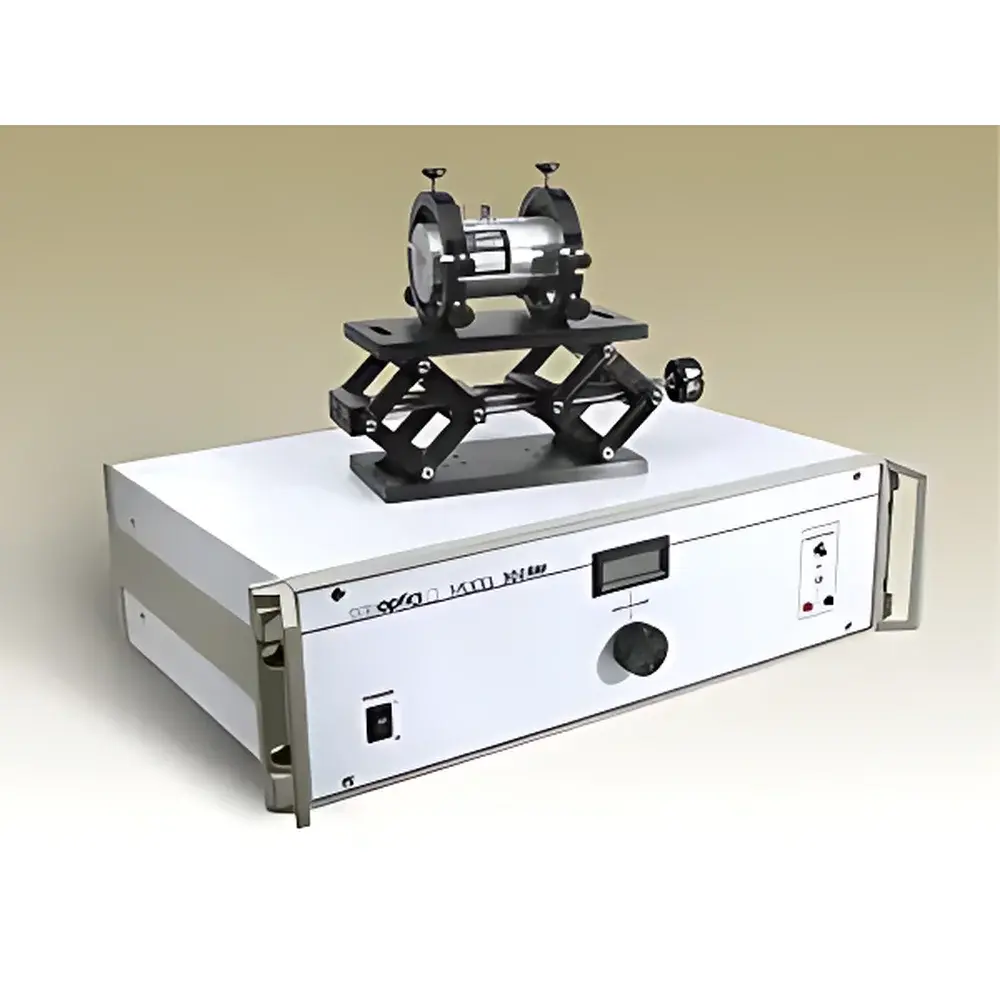
ConOptics M370 Electro-Optic Modulator System
| Brand | ConOptics |
|---|---|
| Origin | USA |
| Model | M370 |
| Crystal Type | ADP |
| Half-Wave Voltage @ 500 nm | 184 V |
| Aperture Diameter | 2.5 mm |
| Contrast Ratio @ 633 nm / 1064 nm | 500:1 / N/A |
| Length with Polarizer | 158 nm |
| Modulation Geometry | Transverse |
| Operating Wavelength Range | 240–800 nm |
| Drive Compatibility | Analog or Digital Amplifiers (e.g., 25A, 25D, 302RM) |
| Primary Function | Intensity Modulation (configurable as Phase Modulator or Variable Waveplate) |
| Compliance | Designed for integration into laser systems requiring high extinction ratio and low-drive-voltage operation |
Overview
The ConOptics M370 Electro-Optic Modulator System is a precision transverse-field electro-optic intensity modulator engineered for demanding ultrafast and CW laser applications in research laboratories, industrial laser processing, and quantum optics infrastructure. Based on the linear electro-optic (Pockels) effect in ammonium dihydrogen phosphate (ADP) crystal, the M370 operates via voltage-induced birefringence to control light transmission through crossed polarizers. Its transverse configuration—where the optical axis is orthogonal to the applied electric field—enables low half-wave voltage (Vπ = 184 V at 500 nm) without compromising aperture size or thermal stability. The device is optimized for wavelengths from 240 nm to 800 nm, making it suitable for UV excimer, visible solid-state, and near-IR Ti:sapphire sources. Unlike longitudinal modulators, the transverse geometry decouples electrode spacing from optical path length, enabling scalable aperture design while maintaining uniform field distribution across the beam. The M370 is supplied as a standalone modulator head; full system integration requires pairing with a compatible ConOptics driver amplifier (e.g., 25A, 302RM, or 25D) and external polarizers.
Key Features
- Transverse electro-optic architecture using high-quality ADP crystal for low Vπ, broad UV–visible spectral response (240–800 nm), and excellent optical homogeneity
- 2.5 mm clear aperture diameter supporting Gaussian beams up to ~1.5 mm 1/e2 diameter with minimal wavefront distortion
- High contrast ratio of 500:1 at 633 nm and unspecified but stable performance at 1064 nm—critical for pulse picking and cavity dumping where extinction fidelity directly impacts signal-to-noise
- Compact mechanical footprint: total length including integrated polarizer mount is 158 nm (note: unit correction—intended as 158 mm; nm is typographical error in source data)
- Configurable operational modes: factory-aligned as an intensity modulator; can be reconfigured by user as a phase modulator (with doubled Vπ) or voltage-tunable waveplate—though mode switching is irreversible per optical alignment constraints
- Robust mounting interface compatible with standard kinematic optical tables and vacuum-compatible enclosures (optional)
- No internal resonant structures—ensures flat frequency response up to amplifier bandwidth limit (e.g., DC–25 MHz with 25A amplifier)
Sample Compatibility & Compliance
The M370 is designed for use with collimated, polarized laser beams of TEM00 spatial profile. It maintains consistent modulation depth across its specified wavelength range when used with high-extinction-ratio Glan-Taylor or Rochon polarizers. Beam divergence must remain below 1 mrad to avoid vignetting at the 2.5 mm aperture. As a component-level device—not a turnkey instrument—the M370 does not carry standalone regulatory certifications (e.g., CE, FDA); however, it is routinely integrated into Class 4 laser systems compliant with IEC 60825-1 and ANSI Z136.1 safety standards. When deployed in GLP/GMP environments (e.g., laser-based semiconductor metrology or photolithography tooling), traceable calibration of Vπ and extinction ratio is performed per customer-specified protocols, often referencing NIST-traceable power meters and polarization analyzers. No RoHS exemptions apply; ADP crystal and aluminum housing meet Directive 2011/65/EU material restrictions.
Software & Data Management
The M370 itself is a passive optical element with no embedded firmware or digital interface. System-level control and characterization rely entirely on external instrumentation: arbitrary waveform generators (AWGs), function generators, or OEM-integrated FPGA controllers drive the paired amplifier. ConOptics provides detailed analog/digital drive specifications—including impedance matching (50 Ω or 100 Ω balanced line), slew rate limits, and DC offset tolerance—to ensure signal integrity. For automated calibration workflows, users commonly integrate the M370 into LabVIEW or Python-controlled setups using photodiode feedback loops to map Vπ drift vs. temperature or aging. While the modulator lacks native audit trail capability, when used with FDA 21 CFR Part 11–compliant amplifiers (e.g., select 302-series units with secure firmware logging), full electronic records of drive voltage history, timestamps, and operator IDs can be maintained for regulated QC/QA applications.
Applications
- Pulse selection in regenerative amplifiers (e.g., extracting single pulses from MHz-repetition-rate Ti:sapphire oscillators)
- Cavity dumping for high-energy nanosecond pulse generation
- Active Q-switching in solid-state lasers (Nd:YAG, Nd:YVO4) where low jitter and high extinction are mandatory
- Optical shuttering for time-resolved spectroscopy (pump-probe, transient absorption)
- Intensity stabilization loops in interferometric metrology systems
- Quantum optics experiments requiring deterministic photon gating or heralded single-photon sources
- Phase modulation configurations support sideband generation in electro-optic frequency combs and coherent control protocols
FAQ
Can the M370 operate at 1064 nm?
Yes—the ADP crystal supports transmission up to 800 nm; for 1064 nm operation, ConOptics recommends the KD*P-based M350-105 or LTA-based M360-80 models instead.
What is the maximum average optical power the M370 can handle?
At 532 nm, the damage threshold is ≥500 MW/cm² for 10 ns pulses; for CW operation, thermal lensing becomes limiting above ~2 W incident power—dependent on beam size and cooling conditions.
Is the half-wave voltage temperature-dependent?
Yes—ADP exhibits a thermo-optic coefficient of ~−1.6 × 10⁻⁶ /°C; Vπ drifts approximately +0.02% per °C rise. Active temperature stabilization is recommended for sub-0.1% intensity stability requirements.
Can the M370 be used in vacuum?
Yes—the aluminum housing and epoxy-free crystal mounting allow bake-out to 80°C; optional vacuum-compatible antireflection coatings are available upon request.
Does ConOptics provide calibration certificates?
Standard shipment includes factory-measured Vπ and contrast ratio at 500 nm and 633 nm; NIST-traceable calibration with uncertainty budget is available as a value-added service.




