Wiley KnowItAll Analytical Edition Spectral Data Analysis Platform
| Brand | Wiley |
|---|---|
| Origin | USA |
| Model | KnowItAll Analytical Edition |
| Supported Techniques | FTIR, Raman, UV-Vis, NMR, Mass Spectrometry |
| Instrument Format Compatibility | 130+ vendor-specific file formats |
| Database Integration | Wiley’s curated spectral reference libraries (IR, MS, NMR, Raman, UV-Vis) |
| Software Architecture | Desktop application with optional cloud-enabled collaboration modules |
| Regulatory Readiness | Audit trail logging, user access control, and electronic signature support compliant with FDA 21 CFR Part 11 and GLP/GMP documentation requirements |
| Licensing | Perpetual or subscription-based (annual renewal available) |
Overview
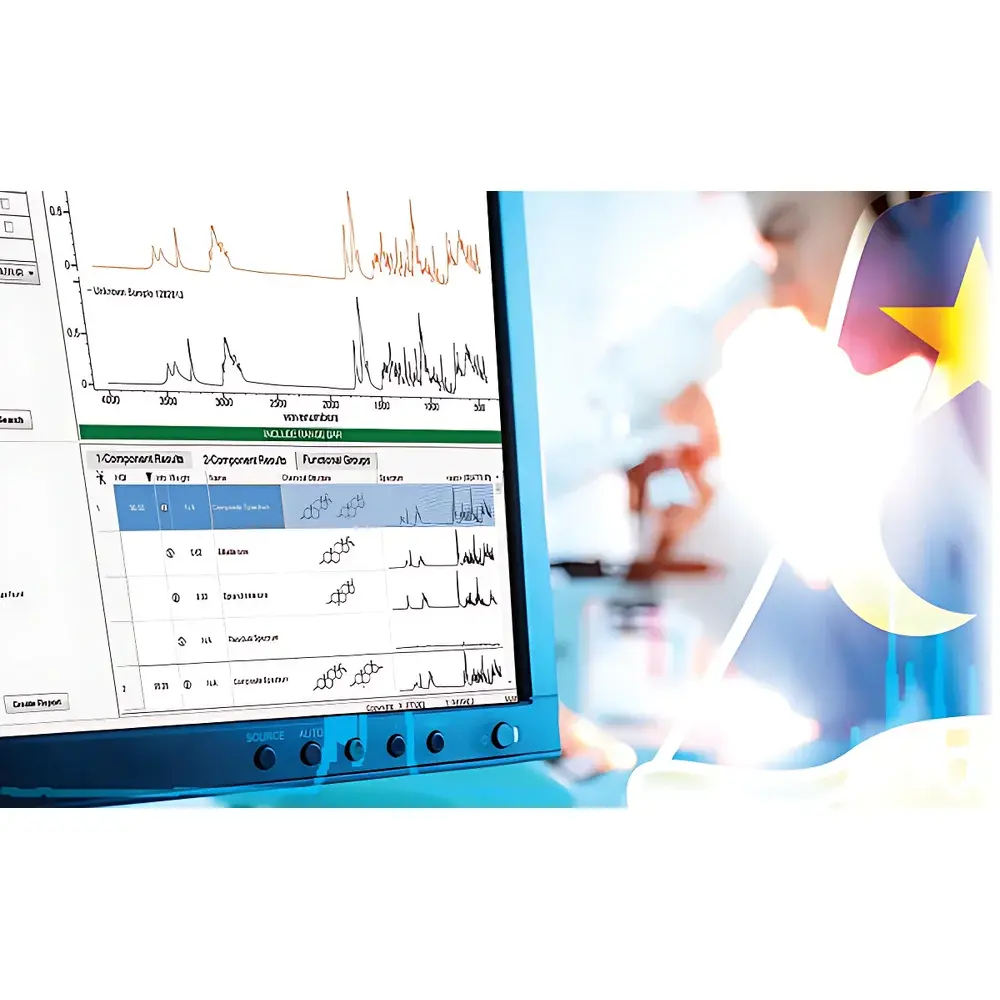
Wiley KnowItAll Analytical Edition is a domain-specific spectral data analysis platform engineered for analytical laboratories requiring rigorous, reproducible interpretation of spectroscopic data across multiple techniques. Built on over four decades of spectral science expertise, the platform implements standardized chemometric algorithms—including peak detection, baseline correction, spectral subtraction, and multivariate curve resolution—to ensure traceable, method-driven analysis. It operates as a unified environment for raw data ingestion, preprocessing, identification, quantification, and reporting—eliminating the need to export between disparate instrument-specific software suites. Its architecture supports both single-technique deep analysis and cross-technique correlation (e.g., IR + MS confirmation of functional group presence), enabling comprehensive structural elucidation workflows in pharmaceutical QC, polymer characterization, forensic chemistry, and materials R&D.
Key Features
- Multi-technique spectral processing engine: Native support for FTIR, Raman, UV-Vis, NMR (1H/13C), and mass spectrometry data—each with technique-optimized preprocessing tools (e.g., apodization for FTIR, deisotoping for MS, phase correction for NMR).
- Patented Adaptive Search™ algorithm: A context-aware spectral matching technology that dynamically weights spectral regions based on chemical class probability, improving hit ranking accuracy for unknown identification without manual region masking.
- Automated mixture analysis & deconvolution: Integrated algorithms for resolving overlapping peaks in complex spectra (e.g., GC-MS co-elution, polymer blend IR), generating component-specific spectra and relative abundance estimates.
- ChemWindow-powered structure drawing & prediction: Bidirectional integration between spectral interpretation and molecular sketching; supports automated NMR chemical shift prediction (based on incremental substituent models) and IR/Raman functional group assignment mapping.
- Extensible database framework: Supports creation, validation, and version-controlled management of in-house spectral libraries—with metadata tagging (sample prep, instrument parameters, calibration status) aligned with ISO/IEC 17025 documentation requirements.
- Regulatory-compliant workflow controls: Configurable audit trails, role-based permissions, electronic signatures, and locked report templates—designed to meet FDA 21 CFR Part 11, EU Annex 11, and ISO 17025 record retention mandates.
Sample Compatibility & Compliance
The platform accepts raw and processed data files from all major instrumentation vendors—including Thermo Fisher, Agilent, Bruker, PerkinElmer, Shimadzu, JEOL, and Waters—via native import of over 130 proprietary formats (e.g., .spa, .ngs, .jdx, .mnova, .raw, .d). No format conversion utilities or third-party translators are required. All spectral operations preserve original acquisition metadata (instrument model, detector type, resolution, scan count, aperture settings), ensuring full traceability from measurement to final report. The software has been validated for use in GLP-regulated environments per OECD Principles of Good Laboratory Practice, and its library curation protocols align with ASTM E1421 (Standard Guide for Describing and Exchanging Infrared Spectral Data) and IUPAC recommendations for spectral data reporting.
Software & Data Management
KnowItAll Analytical Edition employs a modular licensing model: core spectral analysis capabilities are included with the base license, while advanced modules (Quantitative Analysis, NMR Prediction Suite, Cloud Collaboration Hub) are enabled via optional add-ons. Data storage is local-first, with optional encrypted synchronization to on-premises or private-cloud repositories. All user actions—including spectrum manipulation steps, library search parameters, and report generation—are logged in an immutable, time-stamped audit trail. Reports export in PDF/A-1b (ISO 19005-1) and CSV formats, with embedded digital signatures and hash verification for long-term archival integrity. Integration with LIMS and ELN systems is supported via RESTful API and configurable ODBC drivers.
Applications
- Pharmaceutical raw material identity testing per USP <1118> and EP 2.2.47
- Polymorph screening and crystallinity assessment using FTIR and Raman spectral fingerprinting
- Contaminant identification in failure analysis (e.g., extractables/leachables in packaging)
- Reaction monitoring via time-resolved IR or UV-Vis kinetics
- Forensic drug profiling with library-matched MS/IR dual-confirmation
- Academic research in organic synthesis, where rapid spectral correlation accelerates structure verification
FAQ
Does KnowItAll require internet connectivity to perform spectral searches?
No—local database searches execute entirely offline. Internet access is only required for optional cloud-based spectral sharing, remote library updates, or activation of subscription-based modules.
Can I import and manage my own custom spectral libraries?
Yes. The platform includes a validated library builder with batch validation tools, spectral quality scoring, and version history tracking compliant with ISO/IEC 17025 clause 7.7.
Is method validation documentation provided for regulated use?
Wiley supplies a comprehensive Installation Qualification (IQ) and Operational Qualification (OQ) protocol package, along with test scripts and acceptance criteria aligned with GAMP 5 guidelines.
How does KnowItAll handle instrument calibration drift in quantitative workflows?
The Quantitative Analysis module supports internal standard normalization, multi-point calibration curves with residual error reporting, and periodic recalibration alerts triggered by user-defined signal-to-noise or peak width thresholds.
What training and technical support options are available?
Wiley offers instructor-led virtual workshops, on-demand video modules, and dedicated application scientist support—including method development assistance and regulatory documentation review—for licensed customers under active maintenance agreements.
Related Products