
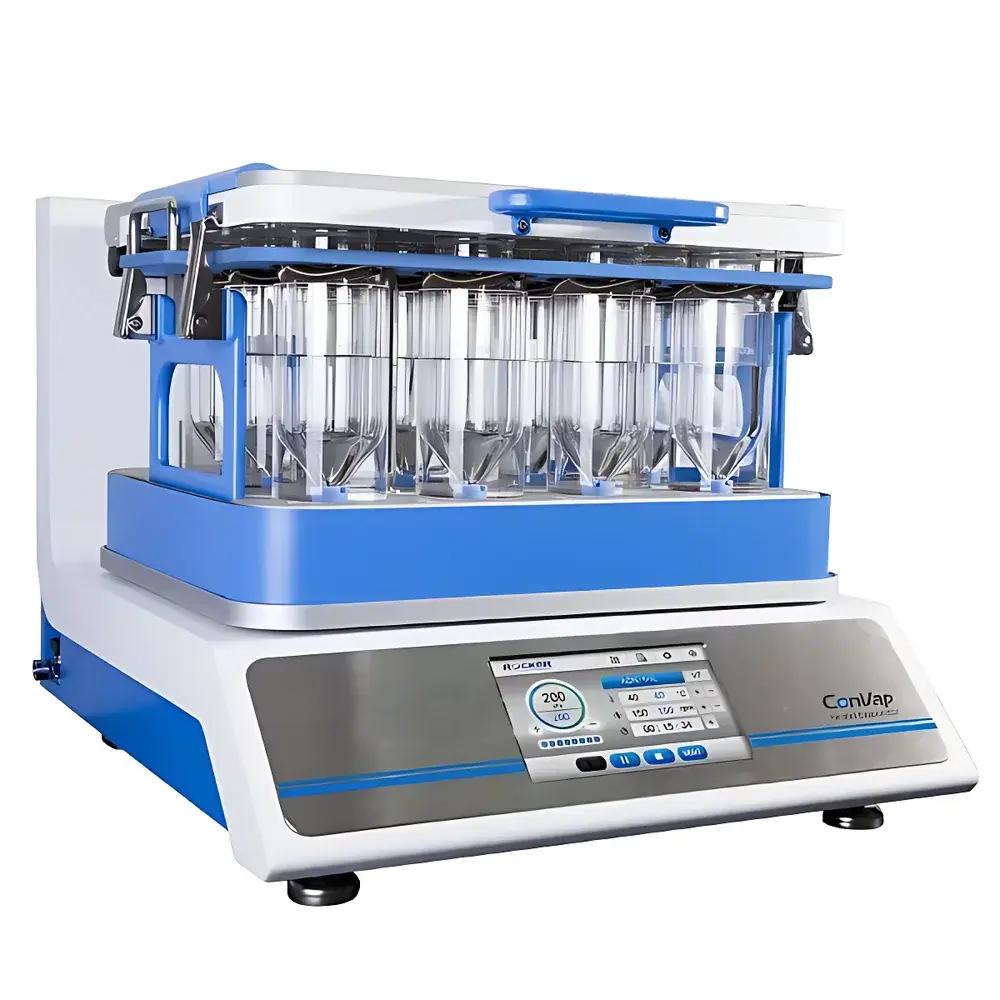
ROCKER ConVap Vacuum Oscillating Concentrator
| Brand | ROCKER |
|---|---|
| Origin | Taiwan |
| Model | ConVap |
| Instrument Type | Vacuum Parallel Concentrator |
| Temperature Range | Ambient +5°C to 80°C |
| Temperature Accuracy | ±1.0°C |
| Sample Capacity | 150 mL per tube |
| Pressure Control Range | 0–1013 mbar (0–760 mmHg) |
| Pressure Accuracy | ±2 mbar (after calibration at fixed temperature) |
| Oscillation Speed | 50–300 rpm |
| Timer Range | 00:01–99:59 (hh:mm) |
| Heating Bath Power | 1650 W / 1800 W |
| Condenser Power | 500 W |
| Noise Level | ≤65 dB(A) |
| Dimensions (Concentrator) | 59.2 × 47.4 × 42 cm |
| Dimensions (Condenser) | 60 × 33 × 44 cm |
| Weight (Concentrator) | 80 kg |
| Weight (Condenser) | 33 kg |
| Display | 7" capacitive touch screen |
| Safety Features | Thermal cut-off, fuse protection, real-time error diagnostics |
| Certifications | CE, RoHS |
Overview
The ROCKER ConVap Vacuum Oscillating Concentrator is an engineered solution for high-throughput, solvent-sensitive sample concentration in regulated laboratory environments. It operates on the principle of vacuum-assisted evaporation coupled with controlled orbital oscillation and precise bath- and lid-based thermal management. Unlike static rotary evaporators or nitrogen blow-down systems, the ConVap system maintains sample integrity through gentle, uniform agitation under reduced pressure—minimizing thermal degradation, foaming, and analyte loss. Its dual-zone temperature control (heating bath + heated lid) ensures rapid vapor removal while suppressing condensation re-deposition, thereby improving reproducibility and recovery rates across diverse matrices including biological fluids, environmental extracts, and food safety samples.
Key Features
- Integrated Vacuum Control Architecture: Direct parameter setting via 7″ capacitive touch interface—no external controllers required. Real-time vacuum adjustment from atmospheric pressure (1013 mbar) down to near-complete vacuum (0 mbar), with ±2 mbar accuracy post-calibration.
- Dual-Zone Thermal Management: Independent control of heating bath (ambient +5°C to 80°C) and heated lid (ambient +5°C to 70°C). The lid actively prevents condensate formation on tube walls, enhancing evaporation kinetics and reducing cross-contamination risk.
- Optimized Sample Handling Design: Patented guided-lid geometry eliminates bumping and splashing during rapid pressure transitions. Tube racks accommodate up to 48 × 15 mL tubes (ConVap 15) or 12 × 150 mL tubes (ConVap 150), with ergonomic access and secure positioning.
- Resource-Efficient Operation: Self-contained water bath design reduces water consumption by up to 85% compared to traditional circulating chillers. Rapid thermal response enables faster method development and shorter run times.
- Robust Safety & Diagnostics: Built-in thermal cutoff, fuse protection, and dynamic error logging ensure uninterrupted operation in unattended workflows. All fault conditions are displayed with actionable codes on the main interface.
Sample Compatibility & Compliance
The ConVap system supports a wide range of solvent classes—including aqueous, polar organic (e.g., methanol, acetonitrile), and semi-volatile mixtures—commonly encountered in pesticide residue analysis (AOAC 2007.01), veterinary drug screening (EU Commission Decision 2002/657/EC), and dioxin/furan extraction (EPA Method 1613B). Its construction adheres to IEC 61010-1 for electrical safety and meets RoHS Directive 2011/65/EU for hazardous substance restrictions. CE marking confirms conformity with EU Machinery Directive 2006/42/EC and Electromagnetic Compatibility Directive 2014/30/EU. While not inherently 21 CFR Part 11 compliant, audit-ready data export (CSV, PDF) and timestamped event logs support GLP/GMP documentation requirements when integrated into validated laboratory information management systems (LIMS).
Software & Data Management
All operational parameters—including vacuum setpoint, bath/lid temperatures, oscillation speed, and timer duration—are stored locally with time/date stamps. The system exports session logs and final concentration reports in CSV format via USB port. No proprietary software installation is required; exported files are compatible with common statistical packages (e.g., JMP, Minitab) and electronic lab notebooks (ELN). For laboratories implementing electronic signatures, the ConVap’s deterministic parameter locking and immutable log structure facilitate alignment with ALCOA+ principles (Attributable, Legible, Contemporaneous, Original, Accurate, Complete, Consistent, Enduring, Available) during regulatory audits.
Applications
- Foodsafety testing: Concentration of QuEChERS extracts prior to GC-MS/MS or LC-MS/MS analysis of pesticides, mycotoxins, and veterinary antibiotics.
- Environmental monitoring: Pre-concentration of EPA SW-846 Method 3550C solid-phase extracts for PAHs, PCBs, and organochlorine pesticides.
- Clinical & pharmaceutical research: Parallel processing of plasma, urine, or tissue homogenates in pharmacokinetic studies requiring quantitative recovery of low-abundance metabolites.
- Academic & method development labs: Flexible platform for optimizing evaporation profiles across varying solvents, viscosities, and initial concentrations without hardware modification.
FAQ
What is the maximum number of samples that can be processed simultaneously?
The ConVap 15 model supports up to 48 × 15 mL tubes; the ConVap 150 model accommodates 12 × 150 mL tubes. Both configurations maintain consistent thermal and vacuum uniformity across all positions.
Can the system be used with corrosive solvents such as hydrochloric acid or trifluoroacetic acid?
Standard ConVap units are not chemically resistant to strong acids or halogenated solvents. For such applications, optional Chemker 610 corrosion-resistant vacuum pumps and PTFE-lined condensers must be deployed in conjunction with inert tubing (e.g., silicone or fluoropolymer).
Is remote monitoring or network connectivity supported?
The base ConVap system does not include Ethernet or Wi-Fi interfaces. However, its USB data export functionality enables integration with third-party automation platforms via script-driven file polling and parsing.
How often does the pressure sensor require recalibration?
ROCKER recommends annual calibration using traceable reference standards. Field verification can be performed using a certified digital manometer at ambient temperature and stable vacuum conditions.
What maintenance intervals are specified for routine operation?
Daily: Visual inspection of seals and tube rack integrity. Weekly: Cleaning of bath chamber and lid gasket. Quarterly: Inspection of vacuum hose integrity and condenser coil cleanliness. Annual: Full system performance validation including temperature uniformity mapping and pressure drift assessment.



