
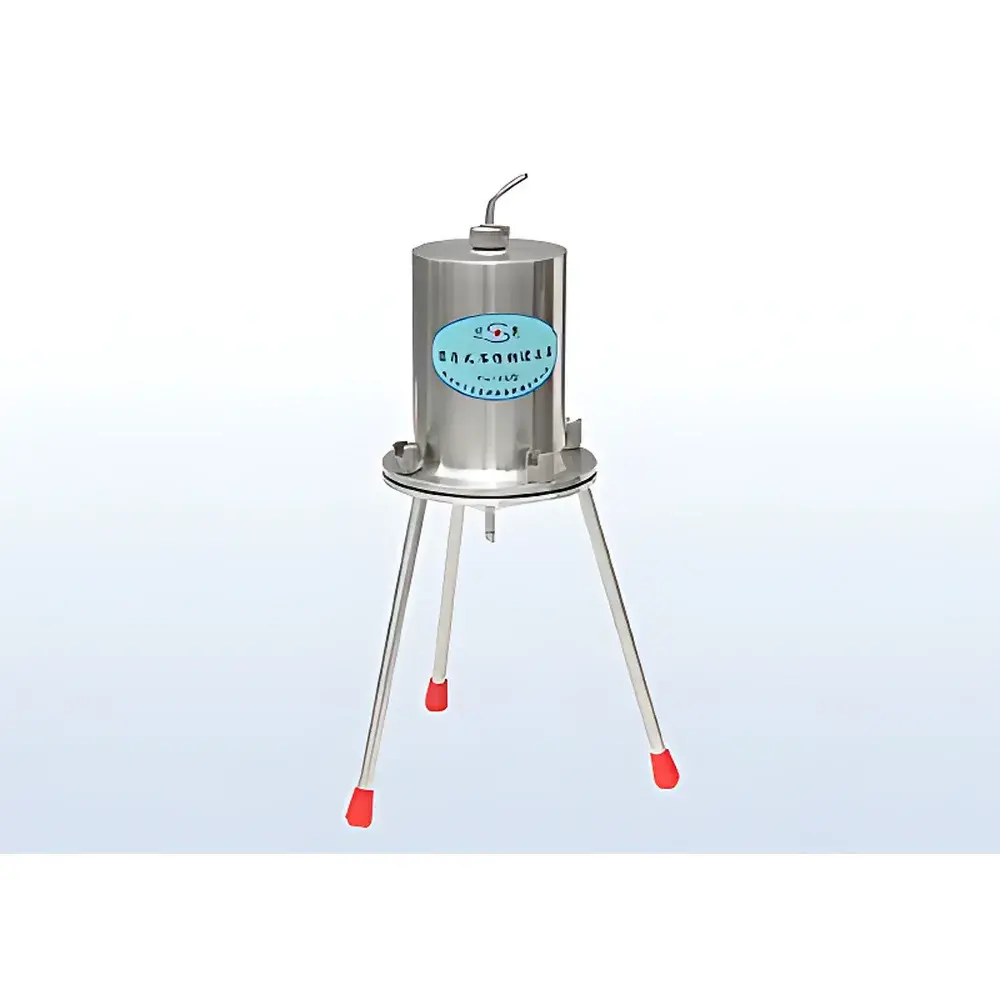
YG-1000 Cylindrical Pressure-Driven Sterile Filtration Unit
| Origin | Zhejiang, China |
|---|---|
| Manufacturer Type | Authorized Distributor |
| Origin Category | Domestic (China) |
| Model | YG-1000 |
| Capacity | 1000 mL |
| Compatible Filter Disc Diameter | Φ100 mm |
| Inlet Port Diameter | 6 mm |
| Outlet Port Diameter | 7.8 mm |
| Stand Height Options | 18 cm or 27 cm |
| Total Unit Height | 45 cm |
| Water Flow Rate | 0.7 L/min |
| Construction Material | AISI 304 or 316L Stainless Steel |
Overview
The YG-1000 Cylindrical Pressure-Driven Sterile Filtration Unit is a benchtop, manually pressurized filtration system engineered for reliable, repeatable sterile and clarifying filtration in life science and biopharmaceutical workflows. Designed around the principle of positive-pressure-driven cross-flow and dead-end filtration, the unit utilizes compressed gas (typically nitrogen or filtered air) applied to the feed reservoir to force liquid through a membrane or depth filter disc seated in a precision-machined stainless-steel housing. Its cylindrical architecture ensures uniform pressure distribution across the filter surface, minimizing channeling and maximizing retention efficiency—critical for applications requiring high microbial removal (e.g., 0.22 µm sterilizing-grade filtration) or particulate clarification. The system operates without electricity or integrated pumps, making it suitable for GMP-aligned cleanroom environments where equipment qualification complexity must be minimized. It complies with fundamental design principles referenced in ISO 8573-1 (compressed air purity), ASTM F838-22 (bacterial retention testing of filters), and USP (particulate matter in injections), supporting validation documentation for laboratory-scale process development and quality control use.
Key Features
- Robust dual-material construction: Housing and fittings fabricated from electropolished AISI 304 or corrosion-resistant 316L stainless steel, ensuring compatibility with acidic, alkaline, and organic solvent-based solutions.
- Optimized fluid dynamics: Smooth internal surfaces (Ra ≤ 0.4 µm) and minimal dead-leg geometry reduce product hold-up volume and facilitate complete drainage and cleaning-in-place (CIP) procedures.
- Modular stand configuration: Two vertical stand options (18 cm and 27 cm) accommodate varying lab bench heights and downstream collection vessel depths while maintaining stable alignment between inlet, filter holder, and outlet.
- Standardized filter interface: Accepts widely available Φ100 mm circular filter discs—including cellulose acetate, PVDF, PES, nylon, and mixed ester membranes—as well as depth filters (e.g., glass fiber or diatomaceous earth cartridges).
- Controlled pressure operation: Integrated pressure gauge port (not supplied) allows real-time monitoring of upstream pressure; maximum recommended operating pressure: 0.3 MPa (3 bar) to preserve filter integrity and seal performance.
Sample Compatibility & Compliance
The YG-1000 is validated for use with aqueous buffers, culture media, biological fluids (e.g., serum-supplemented media, clarified lysates), and low-viscosity pharmaceutical solutions (e.g., parenteral preparations, ophthalmic formulations). It supports both sterile filtration (using 0.22 µm or 0.45 µm rated membranes) and pre-filtration/clarification steps (e.g., 1.2 µm or 5 µm depth filters). All wetted parts meet USP Class VI biocompatibility requirements. When operated under documented SOPs—including pre-use integrity testing (e.g., bubble point or diffusion test per ASTM F316-21) and post-use cleaning validation—the system aligns with GLP and early-stage GMP expectations for non-critical process steps. It is not intended for terminal sterilization of final drug products per FDA guidance but serves as a qualified tool for intermediate purification in R&D and QC laboratories.
Software & Data Management
As a manual, non-automated filtration device, the YG-1000 does not incorporate embedded electronics, sensors, or software. All operational parameters—including applied pressure, filtration time, volume processed, and filter lot traceability—are recorded manually in laboratory notebooks or electronic lab notebooks (ELNs) compliant with 21 CFR Part 11. Users are advised to integrate the unit into broader data management workflows by logging batch records, filter certificates of conformance (CoC), and integrity test results alongside associated analytical data (e.g., turbidity, endotoxin, or microbiological assay outcomes). This approach ensures full auditability during internal QA reviews or regulatory inspections.
Applications
- Sterile filtration of cell culture media, sera, and reagents prior to aseptic processing in academic and industrial biotechnology labs.
- Clarification of crude biological extracts, fermentation broths, or chromatography eluates prior to further purification steps.
- Pre-filtration of HPLC mobile phases and sample solutions to protect analytical columns from particulate fouling.
- Processing of blood-derived products (e.g., plasma fractions, immunoglobulin solutions) under controlled pressure conditions to minimize shear-induced protein denaturation.
- Validation studies for filter selection, including comparative retention testing of bacteria, yeasts, or model viruses using standardized challenge protocols.
FAQ
Is the YG-1000 compatible with aggressive solvents such as acetone or chloroform?
Yes—when constructed from 316L stainless steel and paired with chemically resistant filter membranes (e.g., PTFE or PVDF), the unit withstands intermittent exposure to common organic solvents. Always verify membrane compatibility separately.
Can I validate filter integrity on this system?
Yes—integrity testing (bubble point, forward flow, or water intrusion) can be performed using external test instruments. The unit’s sealed housing and standardized port dimensions support standard test fixture integration.
What is the maximum recommended operating temperature?
The unit is rated for continuous operation up to 80 °C when using 316L construction and high-temperature gasket materials (e.g., EPDM or silicone); consult gasket specifications before thermal cycling.
Does the system include a pressure regulator or gas source?
No—users must supply an external regulated gas source (e.g., nitrogen cylinder with 0–0.6 MPa adjustable regulator) and appropriate tubing (6 mm OD).
How often should the O-rings and gaskets be replaced?
Under routine use with proper cleaning and storage, fluorocarbon or silicone gaskets typically require replacement every 6–12 months or after 50–100 filtration cycles—whichever occurs first. Visual inspection for compression set or cracking is recommended before each use.
Related Products




