
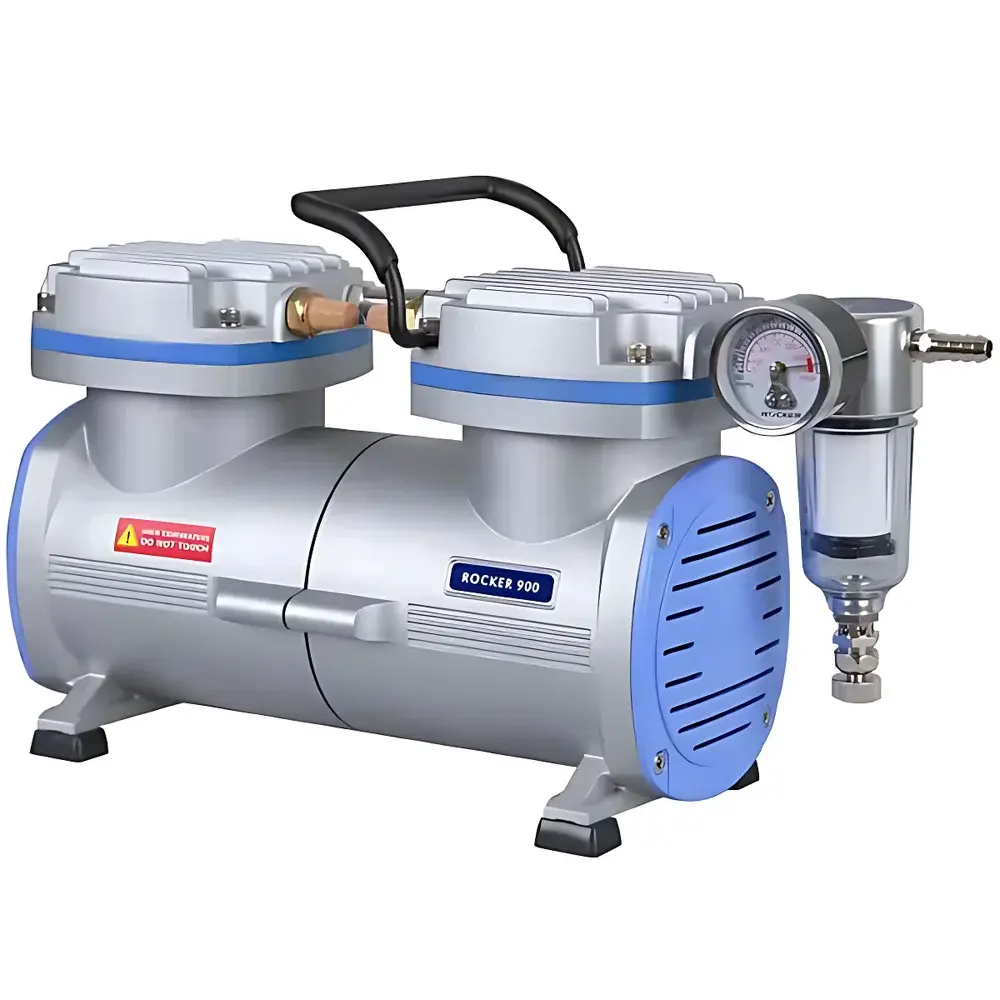
ROCKER Rocker900 Oil-Free Piston Vacuum Pump
| Brand | ROCKER |
|---|---|
| Origin | Taiwan |
| Model | Rocker900 |
| Pump Type | Oil-Free Piston Vacuum Pump |
| Ultimate Vacuum | 85 mbar (abs) |
| Flow Rate | 90 L/min |
| Dimensions (L×W×H) | 35 × 13 × 21 cm |
| Weight | 7 kg |
| Motor Power | 255 W |
| Input Voltage/Frequency | 220 V, 50 Hz (optional 110 V, 60 Hz) |
| Noise Level | 68 dB(A) |
| Inlet Hose ID | 8 mm |
| Built-in Vacuum Regulator | Yes |
| Integrated Inlet Filter Cartridge | Yes |
| Thermal Overload Protection | Yes |
| Certifications | CE, UKCA, RoHS |
Overview
The ROCKER Rocker900 is an oil-free piston vacuum pump engineered for reliable, contamination-free operation in analytical, quality control, and research laboratory environments. Unlike oil-lubricated vacuum systems, the Rocker900 employs a precision-machined, dry-running piston mechanism that eliminates hydrocarbon vapor backstreaming, oil mist generation, and associated cross-contamination risks—making it ideal for applications where sample integrity, operator safety, and regulatory compliance are paramount. Its ultimate vacuum of 85 mbar (abs) and continuous flow rate of 90 L/min provide sufficient suction capacity for routine vacuum filtration, desiccation, degassing, and low-pressure sampling tasks. Designed with robust mechanical architecture and thermally stable motor windings, the Rocker900 delivers consistent performance under sustained duty cycles without degradation in vacuum stability or flow repeatability.
Key Features
- Oil-free piston technology ensures zero hydrocarbon emission and eliminates need for oil changes, drain maintenance, or vapor traps.
- Integrated vacuum regulator enables precise, stepless adjustment of operating vacuum level—from atmospheric pressure down to 85 mbar—without external valves or controllers.
- Thermal overload protection circuit automatically interrupts power when internal motor temperature exceeds safe thresholds; system resumes operation after passive cooling, enhancing equipment longevity and operational safety.
- Dual-stage inlet filtration includes a replaceable hydrophobic filter cartridge rated for particulate and moisture removal, protecting cylinder walls and piston seals from abrasion and condensation-induced wear.
- Low-noise enclosure (68 dB[A] at 1 m) minimizes acoustic interference in shared lab spaces and meets occupational noise exposure guidelines per ISO 11201.
- Compact footprint (35 × 13 × 21 cm) and lightweight design (7 kg) facilitate benchtop integration, mobile cart mounting, or placement within fume hoods and gloveboxes.
Sample Compatibility & Compliance
The Rocker900 is compatible with standard laboratory vacuum accessories including Büchner funnels, filter flasks (up to 5 L), vacuum ovens (≤100 °C), and air-sampling manifolds. Its oil-free operation supports ISO/IEC 17025-accredited testing workflows where trace organic interference must be excluded—particularly relevant for EPA Method 160.1 (suspended solids), ASTM D2987 (polymer volatiles), and USP (dissolution apparatus vacuum lines). The unit carries CE marking per Directive 2014/35/EU (Low Voltage), UKCA certification for Great Britain market access, and RoHS 2011/65/EU conformity—verifying restriction of hazardous substances including lead, mercury, cadmium, and brominated flame retardants. No lubricants or consumables requiring scheduled replacement are used in its core pumping mechanism, simplifying GLP/GMP documentation for maintenance logs and equipment qualification (IQ/OQ).
Software & Data Management
The Rocker900 operates as a standalone analog device with no embedded firmware, touchscreen interface, or digital connectivity. This design prioritizes electromagnetic compatibility (EMC), long-term reliability, and immunity to software obsolescence—critical for regulated laboratories maintaining validated methods over extended instrument lifecycles. Vacuum regulation is fully manual via front-panel rotary valve; no calibration or firmware updates are required. For users integrating the pump into automated systems, analog vacuum sensors (e.g., capacitance manometers) may be connected externally to record pressure trends in LIMS or ELN platforms compliant with FDA 21 CFR Part 11 audit trail requirements. All mechanical components—including piston rings, cylinder bore, and inlet filter housing—are serviceable using factory-authorized spare parts kits (ROCKER P/N: FTR-001, RING-KIT-900), with documented torque specifications and maintenance intervals provided in the English-language technical manual.
Applications
- Vacuum-assisted filtration of aqueous, organic, or biological samples using membrane or qualitative filter paper.
- Controlled-rate drying of heat-sensitive compounds in vacuum desiccators or chamber-style vacuum ovens.
- Removal of entrapped air bubbles from adhesives, resins, casting media, and composite precursors prior to curing.
- Microbiological analysis workflows including membrane filtration for coliform enumeration (ISO 9308-1) and suspended solids quantification (ISO 11923).
- Low-flow active air sampling for ambient VOC monitoring, particulate matter collection, and workplace exposure assessment per ISO 16000-6.
- Supporting vacuum line integrity in HPLC degassers, GC carrier gas purging, and mass spectrometer foreline evacuation where oil-free conditions are mandatory.
FAQ
Is the Rocker900 suitable for continuous 24/7 operation?
Yes—the motor is rated for S1 continuous duty, and thermal protection prevents overheating during extended use. However, for optimal service life, intermittent operation (e.g., ≤8 hours/day with ≥30 min cooldown between cycles) is recommended in high-ambient-temperature environments (>35 °C).
Can the inlet filter be cleaned or must it be replaced?
The hydrophobic filter cartridge (ROCKER FTR-001) is non-washable and must be replaced after 500 hours of cumulative runtime or upon visible clogging, moisture saturation, or pressure drop exceeding 15 mbar across the filter.
Does the Rocker900 meet requirements for ISO 13485-certified medical device manufacturing labs?
Yes—its oil-free construction, CE/UKCA certifications, and absence of lubricant migration satisfy clause 7.5.1.2 (Contamination Control) and Annex C.2.3 (Equipment Suitability) of ISO 13485:2016 when used for non-sterile process support functions such as component drying or packaging line vacuum checks.
What is the expected service interval for piston seal replacement?
Under typical lab usage (≤4 hrs/day, clean environment), piston rings require replacement every 12–18 months. A full service kit (RING-KIT-900) includes seals, gaskets, and alignment tools with step-by-step instructions aligned to ISO 9001 maintenance procedures.
Is AC110V/60Hz version available for North American laboratories?
Yes—model variant 167900-11 ships with UL-listed power cord and conforms to ANSI C84.1 voltage tolerance standards. Output performance (90 L/min @ 85 mbar) remains identical to the 220 V version.



