
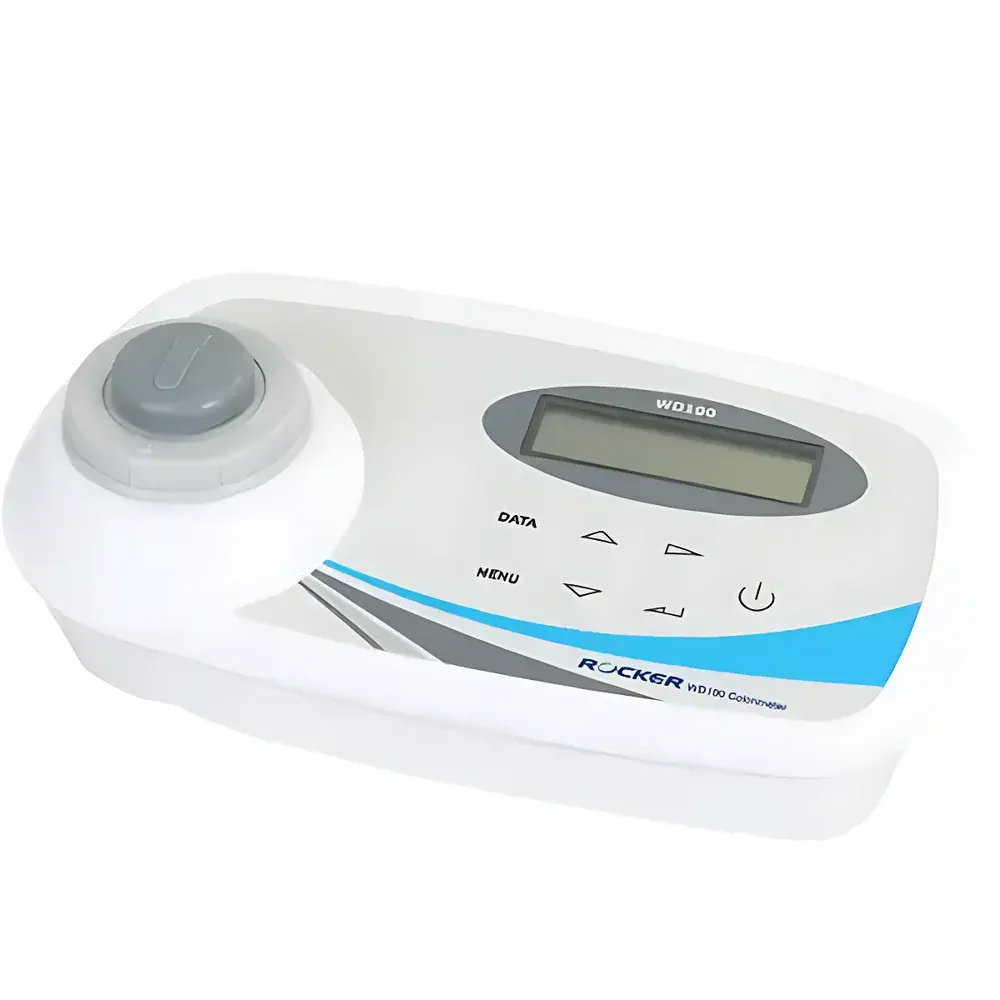
Rocker WD100 Portable 4-in-1 Water Quality Analyzer for COD, Ammonia-N, Total Phosphorus & Total Nitrogen
| Brand | Rocker |
|---|---|
| Origin | Taiwan |
| Model | WD100 |
| Instrument Type | Portable |
| Measurement Principle | UV-Vis Absorption Spectrophotometry |
| Wavelengths | 420 nm, 610 nm (auto-selected) |
| Measurement Range | 10–5000 mg/L |
| Accuracy | ≤ ±10% |
| Repeatability | ≤ 0.005 Abs / 30 min |
| LOD | 0.1 mg/L |
| Measurement Time | 3 seconds |
| Sample Throughput | 1 cuvette per assay |
| Display | Backlit LCD |
| Light Source | LED |
| Data Storage | 100 records |
| Data Fields | Parameter, Wavelength, Concentration, Sample ID, Timestamp |
| Power Supply | DC 9 V battery or AC adapter (100–240 V AC input) |
| Dimensions | 23 × 13 × 9 cm |
| Certifications | CE |
Overview
The Rocker WD100 is a portable, multi-parameter spectrophotometric water quality analyzer engineered for rapid, field-deployable quantification of four critical environmental parameters: Chemical Oxygen Demand (COD), Ammonia-Nitrogen (NH₃-N), Total Phosphorus (TP), and Total Nitrogen (TN). It operates on the principle of ultraviolet–visible (UV-Vis) absorption spectroscopy, leveraging fixed-wavelength LED sources at 420 nm and 610 nm—automatically selected based on the preloaded or user-defined method. This dual-wavelength architecture enables selective detection of chromophore-specific reactions generated by standardized colorimetric reagents (e.g., Hach-certified kits), ensuring compatibility with widely accepted EPA- and ISO-aligned test chemistries. Designed for operational continuity in resource-constrained environments, the WD100 requires no warm-up time; measurements initiate immediately upon sample insertion into the integrated cuvette chamber, delivering stable absorbance readings within 3 seconds. Its optical system maintains long-term baseline stability (≤ 0.005 Abs drift over 30 minutes), minimizing recalibration frequency and supporting consistent inter-day reproducibility across diverse ambient conditions.
Key Features
- True 4-parameter capability: Simultaneous method support for COD, NH₃-N, TP, and TN using industry-standard reagent kits (Hach-compatible)
- Auto-wavelength selection: Intelligent firmware switches between 420 nm and 610 nm based on selected parameter and calibration curve
- Zero warm-up operation: Ready for measurement immediately after power-on—no thermal stabilization delay
- User-customizable calibration: 11 programmable method slots for storing custom calibration curves, enabling adaptation to non-standard reagents or site-specific matrix corrections
- Favorites menu: One-touch recall of frequently used methods—including wavelength, range, and unit settings—eliminating manual method navigation
- Robust data management: Stores up to 100 complete measurement records with timestamp, sample ID, parameter name, wavelength, and concentration value
- Field-optimized power architecture: Dual-power operation via rechargeable or replaceable 9 V DC battery pack or universal AC adapter (100–240 V, CE-compliant)
Sample Compatibility & Compliance
The WD100 is validated for use with Hach’s certified reagent systems—including COD vials (150, 1500, and 15,000 mg/L ranges), ammonia-N kits (0.02–2.50 mg/L and 0.4–50.0 mg/L), total phosphorus reagents (0.06–3.50 mg/L and 1.0–100.0 mg/L), and total nitrogen digestion-based assays (0.5–25.0 mg/L and 2–150 mg/L). All methods align with standard colorimetric procedures referenced in ASTM D1253 (COD), ISO 7150-1 (ammonia), ISO 6878 (total phosphorus), and ISO 11905-1 (total nitrogen). The instrument complies with EU Directive 2014/30/EU (EMC) and 2014/35/EU (LVD), bearing the CE marking for safety and electromagnetic compatibility. While not inherently GLP/GMP-validated, its audit-ready data logging—capturing full metadata per measurement—supports traceability requirements under ISO/IEC 17025-accredited laboratories when paired with documented SOPs and external calibration verification.
Software & Data Management
Data are stored internally in non-volatile memory with automatic timestamping and full parameter metadata. Each record includes: measured concentration, applied wavelength, selected method identifier, user-assigned sample ID, and acquisition time. Export is performed manually via visual readout on the backlit LCD; while the WD100 does not feature USB or Bluetooth connectivity, its structured data format facilitates transcription into LIMS or Excel-based QA/QC workflows. The device supports method validation through repeated blank and standard measurements, and its 11-user-defined curve slots allow storage of slope/intercept values derived from in-house calibration series—enabling compliance with internal quality control protocols requiring method-specific linearity verification per ISO 8466-1. Firmware updates are performed via proprietary service tools; no end-user software installation is required.
Applications
- Environmental monitoring of surface water (rivers, lakes, reservoirs) and groundwater for regulatory compliance reporting
- Influent and effluent analysis in municipal wastewater treatment plants and industrial pretreatment facilities
- On-site process control in food & beverage, pharmaceutical, and chemical manufacturing where rapid nutrient or organic load assessment is required
- Educational laboratory instruction for water chemistry fundamentals and standard method validation
- Field deployment by environmental consultancies conducting rapid screening prior to lab-based ICP-MS or TOC confirmation
FAQ
Is the WD100 compliant with US EPA methods?
The WD100 implements optical detection compatible with EPA-approved colorimetric chemistries (e.g., Hach’s TNTplus COD vials conform to EPA Method 410.4), but the instrument itself is not EPA-verified as a “listed device.” Users must validate method performance per 40 CFR Part 136 requirements.
Can it measure samples with high turbidity?
The WD100 lacks integrated turbidity compensation; highly turbid samples require pretreatment (e.g., centrifugation or filtration) prior to analysis to avoid scattering-induced absorbance interference.
Does it support calibration verification standards?
Yes—users may run certified reference materials (CRMs) at any concentration within the instrument’s range and log results manually to verify ongoing accuracy per internal QA protocols.
What is the expected lifetime of the LED light source?
The solid-state LED emitters are rated for >100,000 hours of operation under typical intermittent usage, ensuring long-term photometric stability without lamp replacement.
Is password protection or user-level access available?
No—the WD100 does not include multi-user authentication or role-based access control; all configuration and method editing functions are openly accessible.
Related Products







