
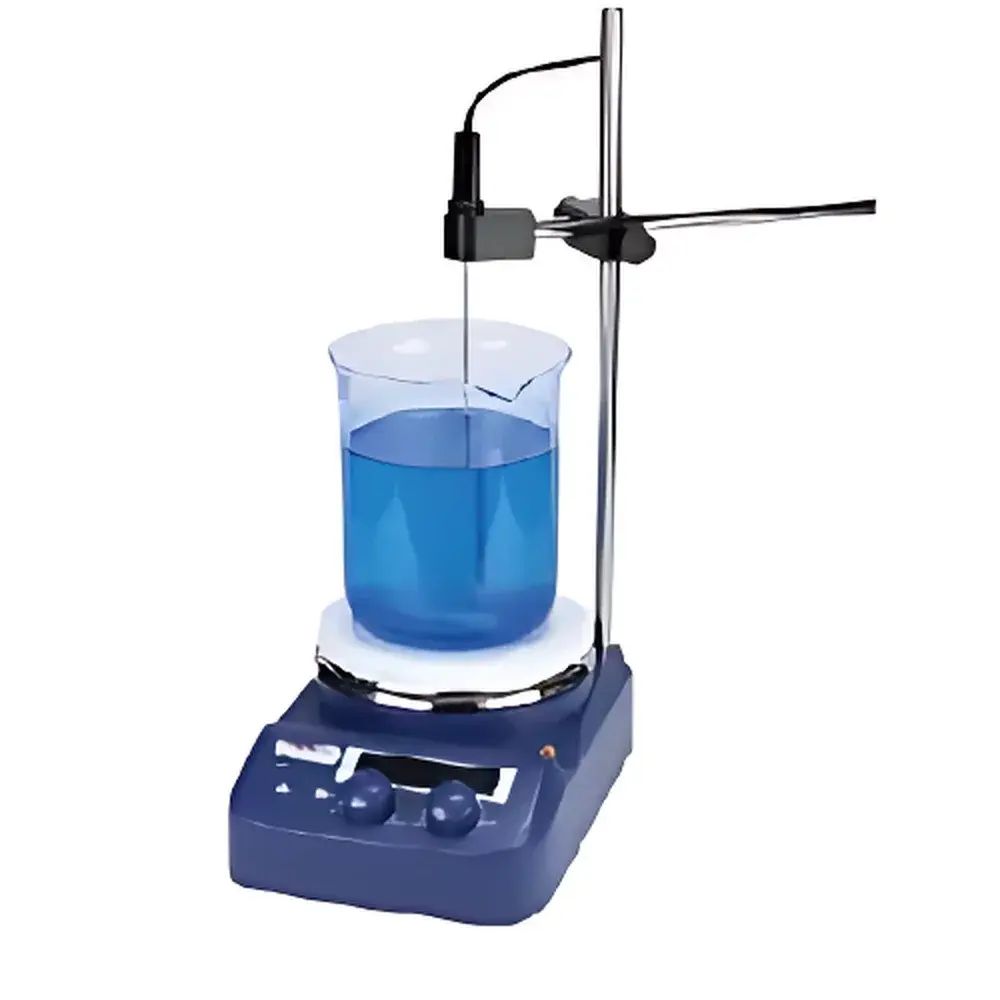
Scilogex MS-H280-Pro Digital Hotplate Magnetic Stirrer
| Brand | Scilogex |
|---|---|
| Model | MS-H280-Pro |
| Origin | USA |
| Heating Temperature Range | Ambient to 280 °C |
| Temperature Control Accuracy | ±1 °C (<100 °C), ±1% (>100 °C) |
| External PT1000 Sensor Compatibility | Yes (±0.5 °C) |
| Stirring Speed Range | 100–1500 rpm |
| Max. Stirring Volume (H₂O) | 3 L |
| Plate Diameter | φ135 mm |
| Plate Material | Stainless Steel with Ceramic Coating |
| Motor Type | DC Motor |
| Input Power | 515 W |
| Heating Power | 500 W |
| Safety Cut-off Temperature | 320 °C |
| Residual Heat Warning Threshold | 50 °C |
| IP Rating | IP21 |
| Dimensions (W×D×H) | 150 × 260 × 80 mm |
| Weight | 1.8 kg |
| Voltage | 200–240 VAC, 50/60 Hz |
Overview
The Scilogex MS-H280-Pro Digital Hotplate Magnetic Stirrer is an engineered solution for precise, reproducible mixing and temperature-controlled sample preparation in research laboratories, quality control environments, and academic teaching labs. It operates on the principle of magnetic coupling—where a rotating permanent magnet beneath the ceramic-coated stainless steel plate induces rotational motion in a PTFE- or glass-coated magnetic stir bar immersed in the sample vessel. Simultaneously, resistive heating elements embedded beneath the plate deliver uniform thermal energy across the surface, enabling synchronized stirring and heating without mechanical shaft penetration. Designed for routine applications requiring elevated temperatures—including solvent reflux, polymer dissolution, enzymatic reactions, and buffer equilibration—the MS-H280-Pro supports workflows compliant with ISO/IEC 17025, ASTM E29, and GLP documentation standards through its dual LED display, traceable temperature control, and integrated safety architecture.
Key Features
- Independent dual-safety circuitry: Automatic thermal cut-off at 320 °C prevents overheating under fault conditions; residual heat warning remains active post-shutdown when plate surface exceeds 50 °C—even with power connected—ensuring operator protection during cooldown.
- Ceramic-coated stainless steel heating plate (φ135 mm): Offers high thermal conductivity, chemical resistance to common solvents and acids, and long-term dimensional stability under repeated thermal cycling.
- Dual LED display: Simultaneously shows setpoint and real-time values for both temperature (resolution ±1 °C) and stirring speed (100–1500 rpm), enabling immediate verification of operational parameters without menu navigation.
- External temperature feedback via PT1000 sensor: Enables closed-loop control of actual sample temperature rather than plate surface temperature—critical for viscosity-sensitive reactions or low-thermal-mass vessels—achieving ±0.5 °C accuracy when calibrated per ISO 17025 procedures.
- UL/CSA-recognized safety certifications: Certified to cTUVus (UL 61010-1), CE (EN 61010-1), and FCC Part 15 Subpart B, confirming compliance with North American and European electrical safety and electromagnetic compatibility requirements.
- IP21-rated enclosure: Dust-protected housing with drip-resistant orientation meets DIN EN 60529 specifications for use in standard laboratory environments with ambient humidity ≤80% RH and operating temperatures between 5–40 °C.
Sample Compatibility & Compliance
The MS-H280-Pro accommodates standard laboratory glassware up to 500 mL capacity using optional aluminum heating blocks (sold separately), including single-well fixtures for round-bottom flasks (50–500 mL). Its 3 L water-equivalent stirring capacity supports large-volume digestions, extraction protocols, and preparative-scale syntheses. Compatible stir bars range from 10 mm to 50 mm in length, with PTFE-coated variants recommended for aqueous systems and glass-coated versions for alkaline or high-pH media. The device conforms to IEC 61010-1:2010 for laboratory electrical equipment and satisfies key elements of FDA 21 CFR Part 11 when used with validated SOPs—particularly where manual entry of setpoints and time-stamped parameter logging are documented as part of analytical method validation.
Software & Data Management
While the MS-H280-Pro does not feature onboard data logging or USB connectivity, its RS232 interface (hardware-ready but firmware-disabled by default) provides a pathway for future integration into automated lab networks via third-party SCADA or LIMS platforms. Users may implement external data acquisition using TTL-level serial adapters and custom Python or LabVIEW scripts—enabling timestamped capture of setpoint, actual temperature, and RPM values at user-defined intervals. For audit-trail compliance, all parameter changes must be manually recorded in bound logbooks or electronic notebooks aligned with ALCOA+ principles (Attributable, Legible, Contemporaneous, Original, Accurate, Complete, Consistent, Enduring, Available).
Applications
- Controlled-temperature dissolution testing per USP for pharmaceutical formulations.
- Preparation of homogeneous catalyst suspensions in organometallic synthesis.
- Buffer equilibration and pH adjustment prior to HPLC or electrophoresis runs.
- Accelerated aging studies of polymer blends under isothermal shear conditions.
- Standardized heavy metal digestion protocols (EPA Method 3050B) requiring sustained 150–200 °C heating with continuous agitation.
- Teaching laboratory demonstrations of Arrhenius kinetics, where reaction rate dependence on temperature is quantified across a defined thermal gradient.
FAQ
Does the MS-H280-Pro support programmable ramp-soak temperature profiles?
No—this model implements only static setpoint control. For multi-step thermal protocols, users must manually adjust setpoints or integrate with external programmable controllers via the RS232 port.
Can the PT1000 sensor be calibrated independently of the unit’s internal reference?
Yes—Scilogex provides calibration certificates traceable to NIST standards for optional PT1000-A/B/C probes. Field recalibration requires a certified dry-block calibrator and adherence to ISO/IEC 17025 procedures.
Is the heating plate compatible with magnetic stir bars larger than 50 mm?
The maximum recommended stir bar length is 50 mm due to torque limitations of the 3 W output motor. Longer bars may cause inconsistent rotation or stalling, particularly above 1000 rpm or in viscous media.
What maintenance is required to ensure long-term accuracy?
Annual verification of temperature accuracy using a calibrated thermocouple probe and periodic cleaning of the ceramic surface with ethanol or isopropanol—avoiding abrasive cleaners that degrade emissivity and thermal response.
Does the unit meet GMP requirements for use in regulated manufacturing?
As a Class A laboratory instrument, it fulfills the design and safety prerequisites of EU GMP Annex 15 and PIC/S PI 007-6 when deployed within a validated process environment, including documented IQ/OQ protocols and routine performance qualification against reference standards.



