
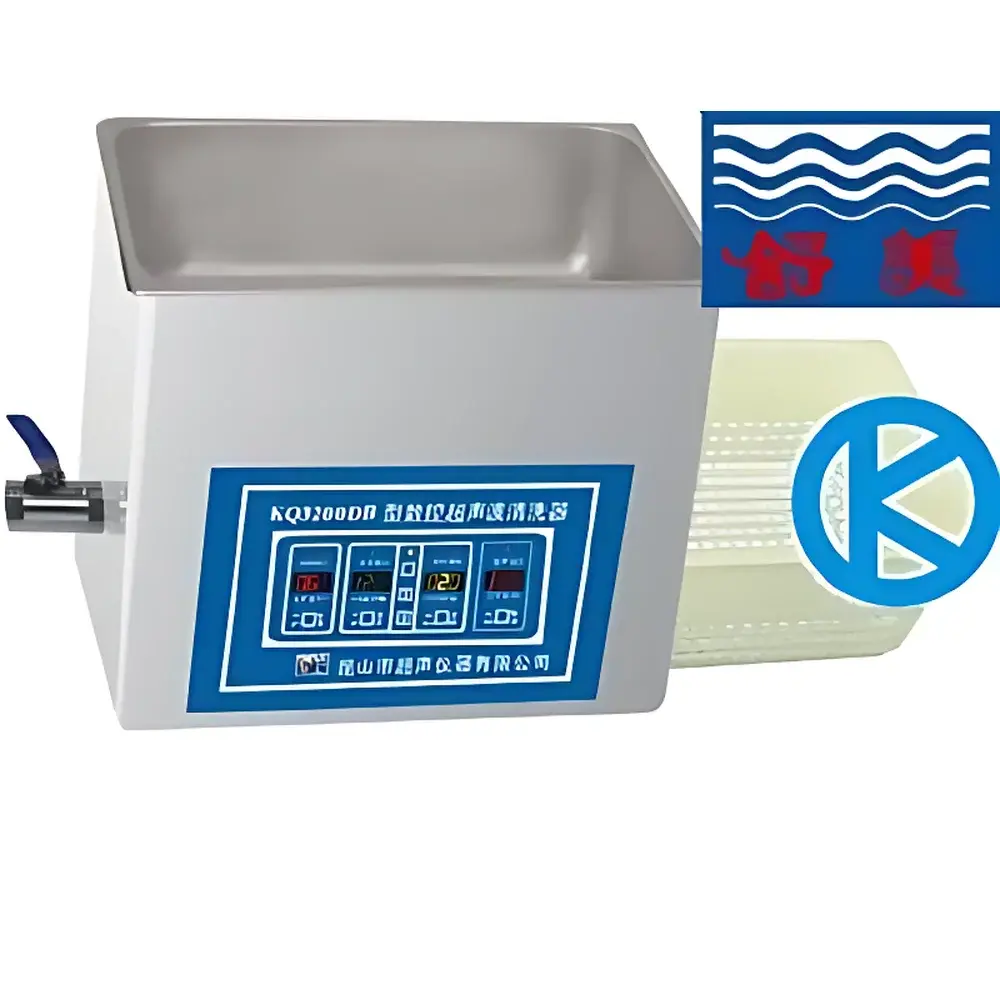
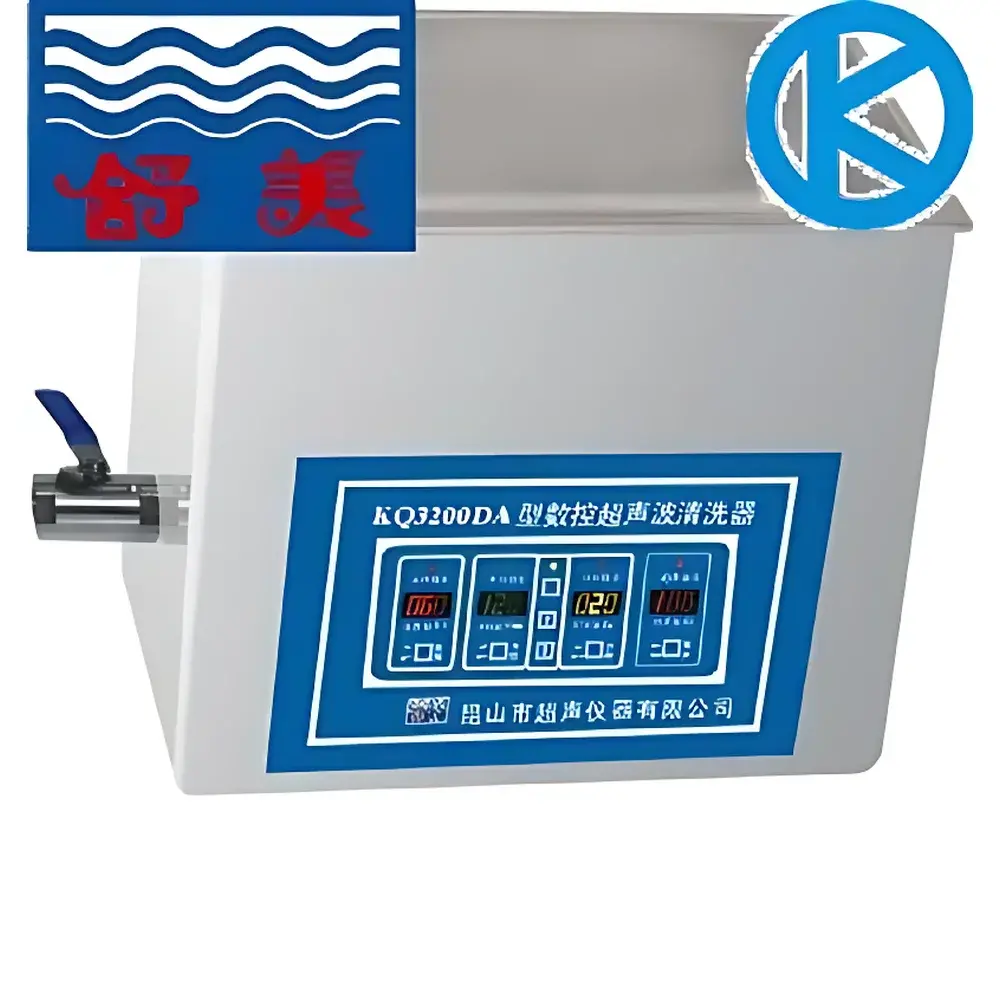
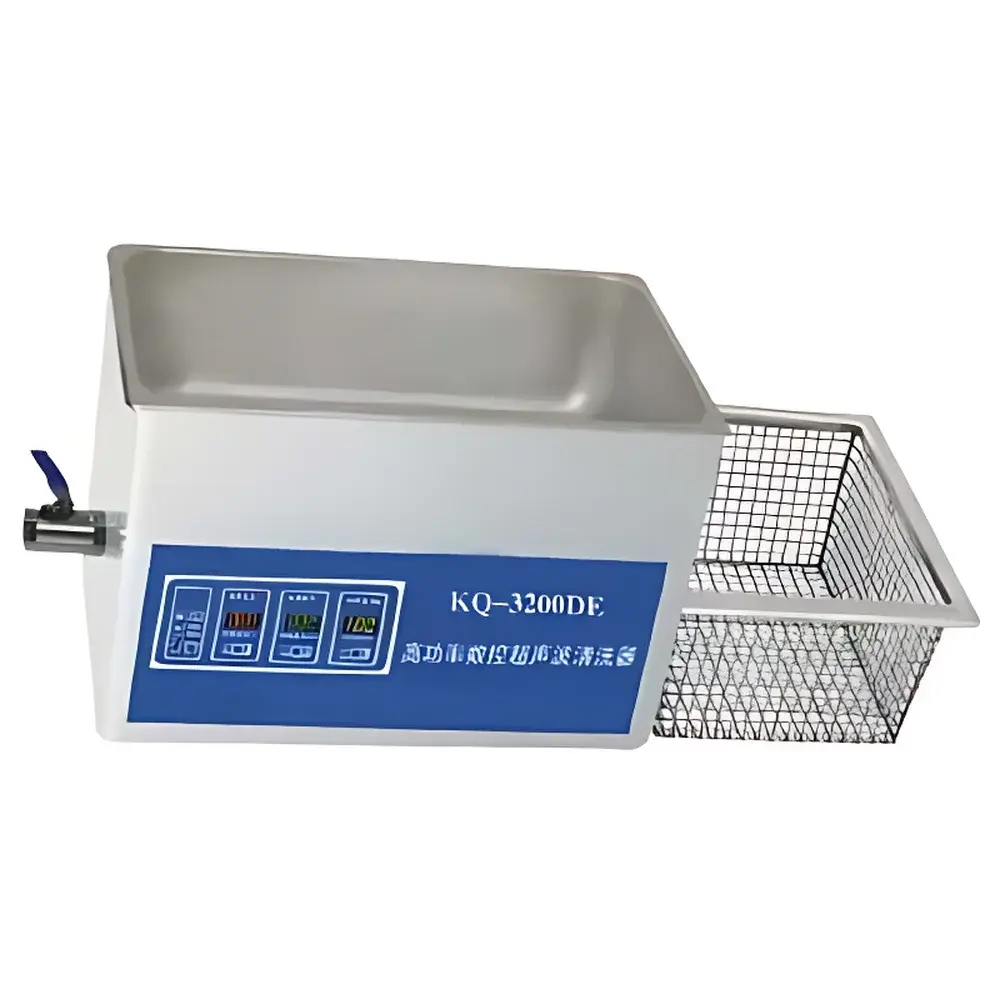
Shumei KQ-3200DE Benchtop Digital Ultrasonic Cleaner
| Brand | Shumei |
|---|---|
| Origin | Jiangsu, China |
| Model | KQ-3200DE |
| Capacity | 6 L |
| Ultrasonic Frequency | 40 kHz |
| Ultrasonic Power Output | 150 W (adjustable 40–100%) |
| Heating Range | 20–80 °C |
| Heating Power | 600 W |
| Timer Range | 1–480 min |
| Tank Material | Stainless Steel (SUS304) |
| Basket | Stainless Steel Mesh Rack |
| Drain Valve | Manual |
| Sound Reduction Lid | Included |
| Dimensions (L×W×H) | 320 × 174 × 340 mm |
| Internal Tank Dimensions (L×W×H) | 300 × 150 × 150 mm |
Overview
The Shumei KQ-3200DE is a benchtop digital ultrasonic cleaner engineered for precision cleaning, degassing, and sample preparation in academic laboratories, quality control environments, and R&D facilities. It operates on the principle of ultrasonic cavitation—generating high-frequency pressure waves (40 kHz) in liquid media to produce microscopic vacuum bubbles that collapse with localized energy release. This physical mechanism enables effective removal of particulate contaminants, organic residues, and surface-adsorbed films from delicate components such as optical lenses, microfluidic devices, semiconductor wafers, and analytical instrumentation parts without mechanical abrasion or chemical aggression. Its integrated transducer design ensures uniform acoustic field distribution across the 6 L stainless steel tank, supporting reproducible cleaning performance under controlled thermal and temporal parameters.
Key Features
- Digital microprocessor control with real-time display of set and actual values for temperature, time, and ultrasonic power level
- Adjustable ultrasonic output (40–100% of 150 W nominal power), enabling optimization for sensitive substrates or heavily soiled samples
- Precise thermostatic heating system (20–80 °C range; 600 W heater) with PID-based regulation and over-temperature safety cutoff
- Extended timer function (1–480 minutes) with auto-shutdown and audible end-of-cycle alert
- Stainless steel (SUS304) tank and mesh basket—welded construction for corrosion resistance and long-term structural integrity
- Integrated low-level fluid detection and dry-run protection to prevent transducer damage during operation
- Cumulative operational hour counter (up to 999,999 hours) for maintenance scheduling and GLP-compliant usage logging
- Manual drain valve and included sound-dampening lid to reduce ambient noise and improve operator safety
- Comprehensive electrical protection: over-voltage, over-current, and over-temperature fault indication with automatic shutdown
Sample Compatibility & Compliance
The KQ-3200DE accommodates a broad spectrum of laboratory-compatible materials including glassware (vials, cuvettes, pipette tips), metal components (surgical tools, calibration standards), ceramic substrates, and polymer-based microdevices. It is routinely employed in pre-analytical workflows prior to HPLC injection, SEM sample mounting, or mass spectrometry analysis—where residual contamination can compromise data fidelity. While not certified to IEC 61000-4 or ISO 13485 out-of-the-box, its robust construction and fail-safe logic align with general laboratory safety practices per ANSI Z358.1 and OSHA guidelines. Users performing regulated work (e.g., pharmaceutical QC or clinical diagnostics) may configure operational protocols—including parameter lockout, audit trail documentation via external logging, and routine verification using reference standards—to support compliance with ISO/IEC 17025, USP , or internal SOPs.
Software & Data Management
This unit operates via embedded single-chip microcontroller firmware with no external software dependency. All operating parameters are stored in non-volatile memory and persist through power cycles. The front-panel interface supports immediate recall of last-used settings and allows independent adjustment of time, temperature, and power—without requiring mode switching. For laboratories implementing electronic recordkeeping, the cumulative runtime counter and visual fault indicators (e.g., “LOW WATER”, “OVER TEMP”) provide traceable evidence of instrument status history. When integrated into networked lab infrastructures, external data loggers or PLC systems can monitor relay outputs (optional accessory) to capture start/stop events and thermal stability windows for 21 CFR Part 11-aligned validation packages.
Applications
- Routine cleaning of HPLC columns, syringe filters, and autosampler vials
- Removal of polishing compounds from optical components and metrology artifacts
- Preparation of TEM grids and AFM cantilevers prior to imaging
- Extraction of analytes from solid matrices in environmental or food testing labs
- Cell lysis and homogenization in molecular biology workflows (with appropriate buffer selection)
- De-gassing of solvents prior to gas chromatography or viscometry measurements
- Post-printing cleaning of 3D-printed microfluidic chips and PDMS molds
FAQ
What is the recommended cleaning solution for this ultrasonic cleaner?
Aqueous alkaline or neutral pH detergents compatible with stainless steel and the sample material are preferred. Avoid halogenated solvents, strong acids, or flammable liquids unless specifically validated for use with this model.
Can the KQ-3200DE be used for sterilization?
No. This device performs cleaning and surface decontamination via cavitation—not microbial inactivation. Sterilization requires validated methods such as autoclaving, ethylene oxide, or hydrogen peroxide plasma.
Is the stainless steel tank electropolished?
The tank is fabricated from standard SUS304 stainless steel with a brushed finish. Electropolishing is not standard but can be specified as a custom option for enhanced corrosion resistance in aggressive chemistries.
Does it support continuous operation?
Yes—within thermal limits. With adequate cooling intervals between cycles and proper ventilation, the unit supports extended daily use. The built-in thermal protection prevents sustained overheating.
How often should the cleaning solution be replaced?
Solution replacement frequency depends on load and soil type. As a general guideline, change the bath after every 4–8 hours of cumulative ultrasonic exposure or when visible turbidity or residue accumulation occurs.



