
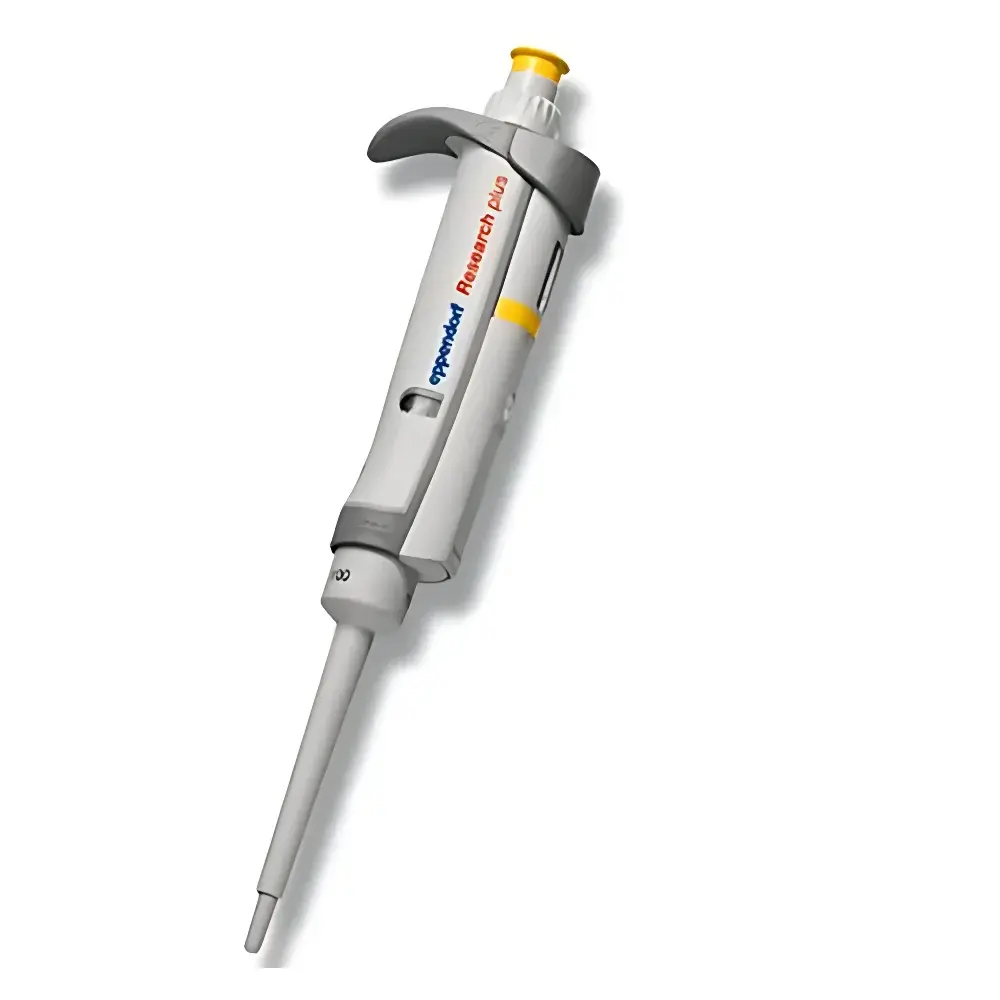
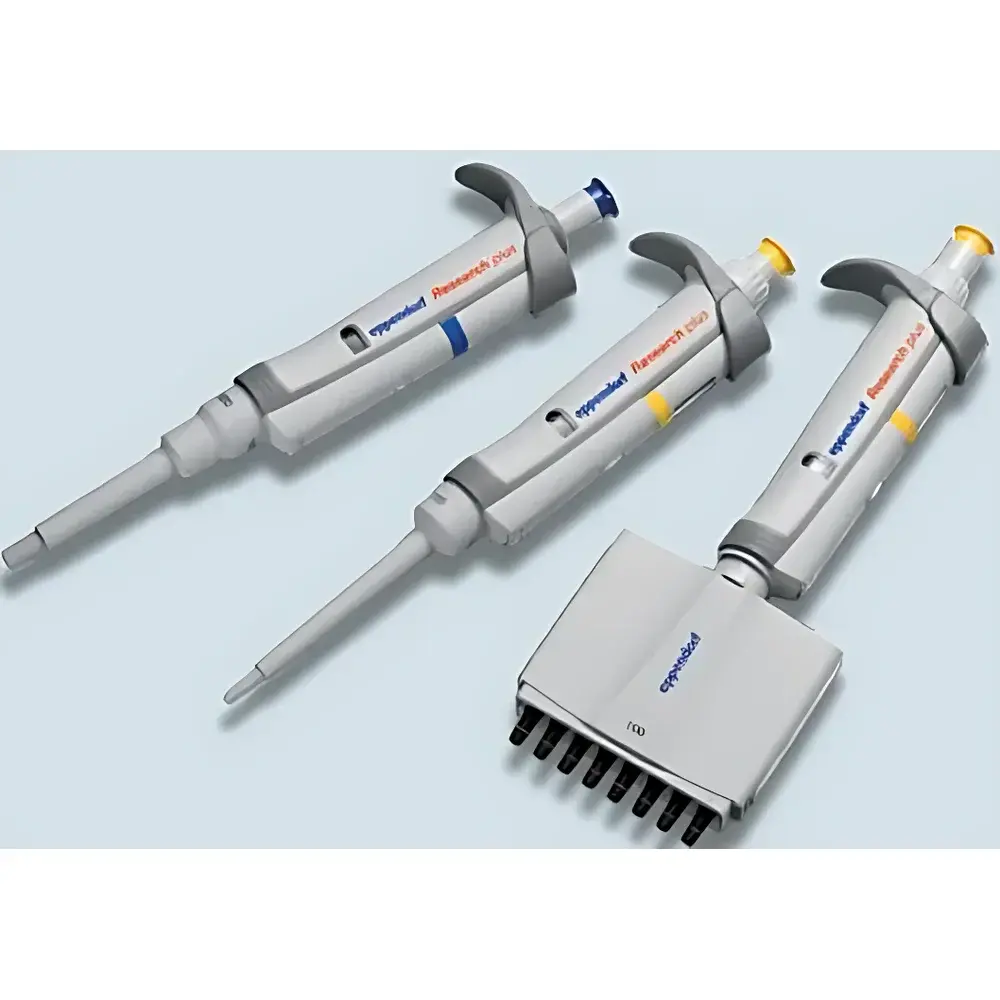
Eppendorf Research Plus Single-Channel Adjustable-Volume Pipette, 0.5–5 mL
| Brand | Eppendorf |
|---|---|
| Origin | Germany |
| Type | Manual Single-Channel Pipette |
| Volume Range | 0.5–5 mL |
| Maximum Capacity | 5 mL |
| Accuracy | ±0.012 mL |
| Compliance | ISO 8655-2 compliant |
| Calibration Interval | Recommended annually per GLP guidelines |
Overview
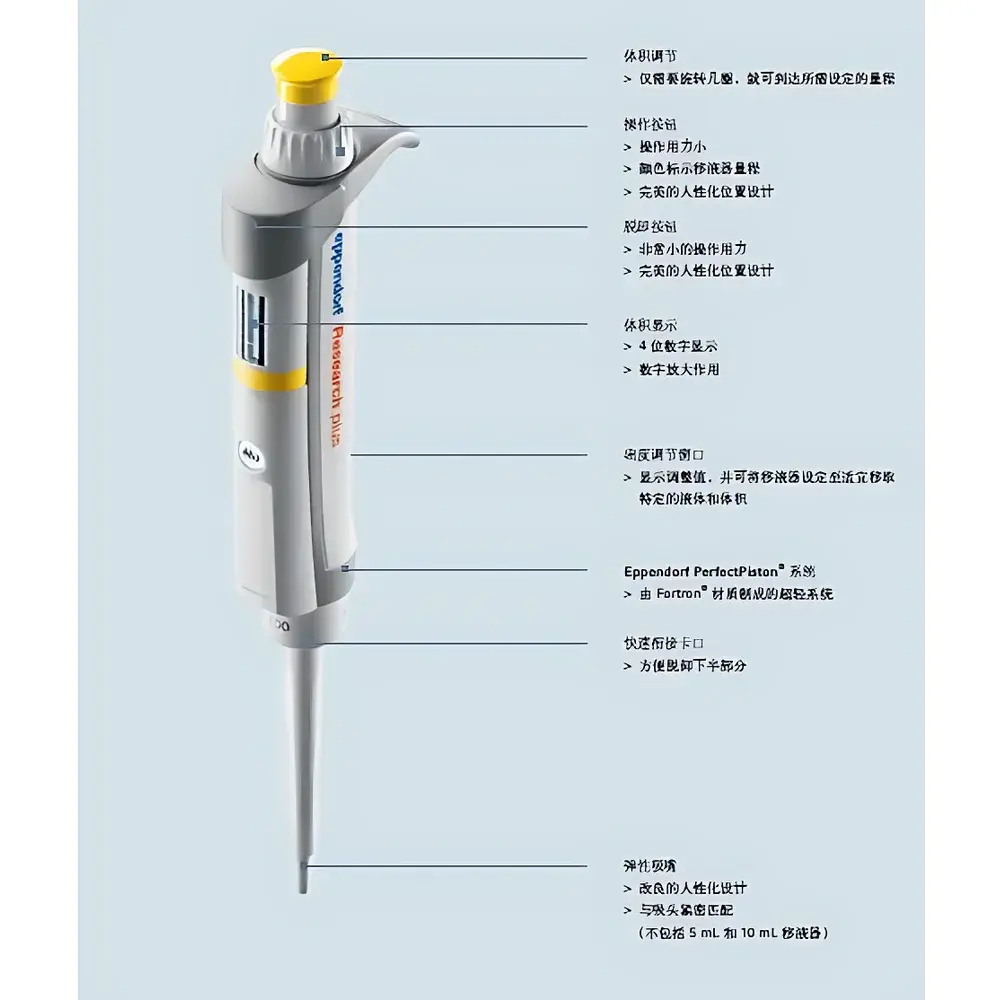
The Eppendorf Research Plus Single-Channel Adjustable-Volume Pipette (0.5–5 mL) is a precision-engineered manual liquid handling instrument designed for high-reproducibility volumetric transfer in research, clinical diagnostics, and quality control laboratories. Built upon Eppendorf’s decades-long heritage in pipette innovation, this model employs an air displacement principle with a patented spring-loaded tip cone mechanism that ensures consistent seal integrity across varying tip brands and lot batches. Its low-force piston actuation reduces user fatigue during repetitive operations, while the ergonomic, forward-balanced design minimizes wrist strain—critical for compliance with ISO 20958-3 ergonomic assessment criteria. The pipette is manufactured in Hamburg, Germany, under strict adherence to DIN EN ISO 9001 and ISO 13485 quality management systems, ensuring batch-to-batch consistency and traceability.
Key Features
- Adjustable volume range from 0.5 mL to 5.0 mL in 0.01 mL increments, calibrated at 20 °C using distilled water (ISO 8655-2 methodology)
- Integrated mechanical volume lock prevents accidental setting changes during transport or multi-step protocols
- Autoclavable upper body (121 °C, 20 min, 1 bar) and replaceable lower components—including O-rings and piston seals—for extended service life and contamination control
- Optimized tip ejection force (≤1.8 N) compatible with universal and low-retention pipette tips meeting ISO 8655-5 specifications
- Integrated calibration tool port allows on-site adjustment using Eppendorf Calibration Kits (Cat. No. 0030 122.070), supporting internal QC and audit readiness
- Serialized laser-engraved identification number enables full traceability within LIMS or electronic lab notebook (ELN) workflows
Sample Compatibility & Compliance
This pipette is validated for aqueous solutions, buffers, diluted acids and bases, and common organic solvents (e.g., ethanol, isopropanol, acetonitrile) within its specified operating temperature range (15–30 °C). It meets the metrological requirements of ISO 8655-2:2022 for accuracy and precision, with typical coefficient of variation (CV) ≤0.6% at nominal volume and ≤1.2% at 10% of nominal volume. For regulated environments, the Research Plus supports Good Laboratory Practice (GLP) and Good Manufacturing Practice (GMP) documentation through optional calibration certificates (traceable to PTB, Germany) and maintenance logs. While not inherently 21 CFR Part 11 compliant as a standalone device, its use with Eppendorf’s electronic calibration records and secure ELN integration satisfies audit trail requirements when deployed within validated laboratory information management systems.
Software & Data Management
Although the manual Research Plus does not feature embedded electronics or Bluetooth connectivity, it integrates seamlessly into digital lab ecosystems via Eppendorf’s free *pipetteManager* software (v3.2+). This desktop application enables centralized tracking of calibration due dates, maintenance history, user assignment, and location mapping across multi-instrument inventories. When paired with Eppendorf’s *Calibration Assistant* mobile app (iOS/Android), technicians can scan the pipette’s QR code, record calibration data with photo evidence, and auto-generate PDF reports compliant with ISO/IEC 17025 clause 7.7. All metadata—including environmental conditions (temperature/humidity), operator ID, and reference standard details—is timestamped and exportable in CSV or XML format for regulatory submission.
Applications
The 0.5–5 mL Research Plus is routinely deployed in applications requiring robust, mid-range liquid delivery where viscosity and vapor pressure are moderate: preparing culture media dilutions in microbiology; dispensing reagents for ELISA and PCR master mixes; serial dilution of standards in environmental testing (e.g., EPA Method 525.3); buffer exchange in protein purification workflows; and sample aliquoting for ICP-MS or HPLC analysis. Its mechanical stability makes it particularly suitable for laminar flow hood use and glovebox-integrated workflows where electromagnetic interference precludes motorized alternatives. In teaching laboratories, its transparent operating mechanism serves as an instructional tool for demonstrating fundamental principles of fluid displacement and metrological uncertainty.
FAQ
Is this pipette autoclavable?
Yes—the upper body (including shaft and volume adjustment mechanism) is fully autoclavable at 121 °C for 20 minutes. The lower parts (tip cone, piston, seals) must be disassembled and autoclaved separately per Eppendorf’s Service Manual Rev. D.
What calibration standards are required for ISO 8655-2 compliance?
Calibration must be performed using gravimetric methods with certified Class A or ASTM E542-07 volumetric glassware, traceable reference weights (±0.0001 g resolution), and environmental monitoring (temperature, humidity, air pressure). Eppendorf recommends annual calibration or after 10,000 cycles, whichever occurs first.
Can this pipette be used with positive-displacement tips?
No—this is an air-displacement pipette and is incompatible with positive-displacement (piston-type) tips. It requires conical, friction-fit aerosol-barrier or low-retention tips meeting ISO 8655-5 dimensional tolerances.
Does Eppendorf provide a certificate of conformance with shipment?
Each unit ships with a Factory Certificate of Conformance (CoC) indicating compliance with ISO 8655-2 and DIN EN ISO 9001. A UKAS-accredited calibration certificate is available as a configurable option (Cat. No. 0030 122.071).
How does the mechanical volume lock enhance workflow integrity?
The lock physically immobilizes the volume adjustment ring, preventing inadvertent changes during centrifugation, vortexing, or transport between workstations—reducing risk of volumetric error in multi-step assays such as qPCR setup or cell viability titration.



