
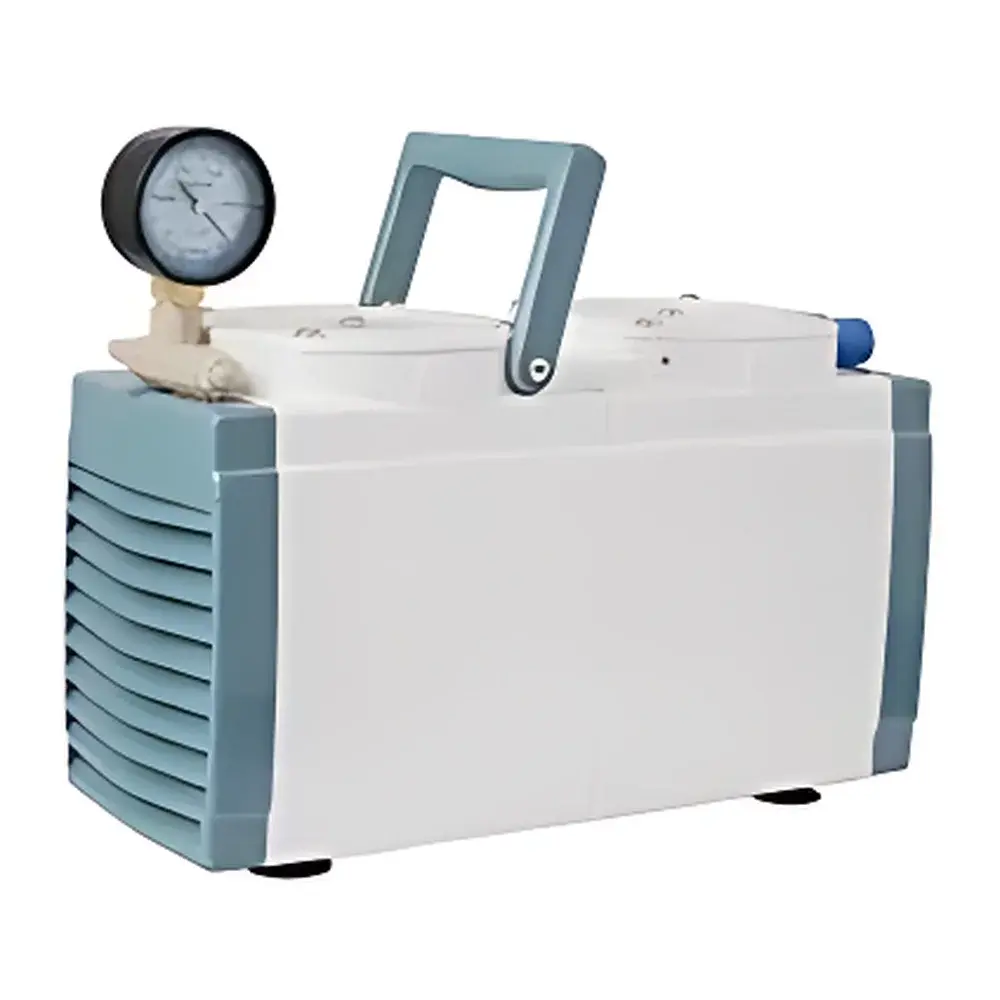
JINTENG GM-0.5B Diaphragm Vacuum Pump
| Brand | JINTENG |
|---|---|
| Origin | Tianjin, China |
| Model | GM-0.5B |
| Pump Type | Diaphragm Vacuum Pump |
| Oil-Free Operation | Yes |
| Ultimate Vacuum | 0.095 MPa (≈50 mbar) |
| Air Displacement Rate | 30 L/min |
| Motor Power | 160 W |
| Dimensions (L×W×H) | 300 × 120 × 235 mm |
| Weight | 10 kg |
| Operating Temperature Range | 7–40 °C |
| Maximum Surface Temperature | <55 °C |
| Noise Level | <50 dB(A) |
| Inlet/Outlet Port Diameter | Ø6 mm |
| Cooling | Self-contained air-cooled exhaust system |
| Duty Cycle | Continuous operation capable |
| Pressure Regulation | Adjustable vacuum output |
Overview
The JINTENG GM-0.5B Diaphragm Vacuum Pump is an oil-free, laboratory-grade vacuum source engineered for precision filtration, solvent evaporation, vacuum drying, and gas sampling applications. Utilizing a dual-head diaphragm displacement mechanism, it generates vacuum via reciprocating elastomeric diaphragms driven by an eccentric cam—eliminating the need for lubricating oil and ensuring contamination-free operation. This principle delivers consistent, pulse-dampened airflow with high volumetric efficiency and minimal backstreaming risk. Designed for integration with analytical instrumentation—including HPLC sample preparation modules, rotary evaporators, and vacuum ovens—the GM-0.5B meets the operational demands of ISO/IEC 17025-compliant laboratories where trace-level cleanliness and repeatable vacuum performance are critical.
Key Features
- Oil-free diaphragm technology ensures zero hydrocarbon contamination—essential for pharmaceutical QC, environmental analysis, and food safety testing where sample integrity must be preserved.
- Dual-pump-head configuration enhances suction stability and extends service life by distributing mechanical load across two synchronized diaphragm assemblies.
- Aluminum die-cast housing provides structural rigidity, thermal dissipation, and corrosion resistance while maintaining low mass (10 kg) for benchtop mobility and modular system integration.
- Integrated air-cooling exhaust system enables uninterrupted 24-hour operation without external cooling or duty-cycle limitations—validated under ambient conditions of 7–40 °C.
- Adjustable vacuum regulation allows fine-tuning of negative pressure between atmospheric and 0.095 MPa (50 mbar), supporting variable-speed filtration of sensitive biological membranes or viscous polymer solutions.
- Low-noise design (<50 dB[A]) complies with WHO and ISO 14040 guidelines for laboratory acoustic environments, minimizing operator fatigue during extended use.
Sample Compatibility & Compliance
The GM-0.5B is compatible with standard glassware (e.g., Büchner funnels, filter flasks, desiccators) and polymeric vacuum manifolds rated for ≤0.1 MPa differential pressure. Its chemically inert EPDM diaphragms resist degradation from common solvents including methanol, acetone, ethyl acetate, and aqueous buffers—supporting GLP-aligned workflows in regulated environments. While not certified to UL/CE or ATEX standards, its construction aligns with IEC 61010-1 safety requirements for laboratory electrical equipment. The pump satisfies functional prerequisites for ASTM D854 (specific gravity of soils), USP (chromatographic system suitability), and ISO 5667-3 (water quality sampling), particularly when used as a vacuum source for membrane filtration or headspace extraction.
Software & Data Management
As a standalone mechanical vacuum source, the GM-0.5B operates without embedded firmware or digital interfaces. It features a manual on/off switch and analog vacuum adjustment knob—ensuring electromagnetic compatibility (EMC) in proximity to sensitive instrumentation such as mass spectrometers or NMR consoles. For labs requiring audit trails, the pump may be integrated into larger vacuum networks equipped with external pressure transducers (e.g., MKS Baratron) and data loggers compliant with FDA 21 CFR Part 11 when paired with validated SCADA systems. No proprietary software or driver installation is required.
Applications
- Routine vacuum filtration of cell cultures, precipitates, and particulate suspensions in molecular biology and clinical diagnostics.
- Supporting rotary evaporation of heat-sensitive compounds in synthetic organic chemistry labs.
- Vacuum-assisted degassing of HPLC mobile phase reservoirs prior to gradient runs.
- Gas sampling and pre-concentration for GC-MS analysis in environmental monitoring programs.
- Controlled vacuum drying of hygroscopic reference standards in metrology laboratories.
- Forensic evidence processing—including latent fingerprint development via vacuum metal deposition (VMD) protocols.
FAQ
Is the GM-0.5B suitable for use with aggressive solvents such as chloroform or concentrated acids?
The EPDM diaphragm offers moderate resistance to polar organics but is not recommended for prolonged exposure to halogenated solvents or strong oxidizers; consult the chemical compatibility chart before deployment.
Can this pump achieve high vacuum levels required for mass spectrometry inlet systems?
No—it is optimized for rough vacuum (50 mbar range); for high-vacuum applications, a secondary turbomolecular or diffusion pump stage is required.
Does the pump include overload or thermal protection?
Yes—integrated thermal cut-off switches deactivate the motor if surface temperature exceeds 55 °C, preventing diaphragm deformation and ensuring long-term reliability.
What maintenance intervals are recommended for continuous operation?
Diaphragm replacement is advised every 6,000–8,000 operating hours under typical lab conditions; no routine oil changes or valve servicing are necessary due to oil-free architecture.



