
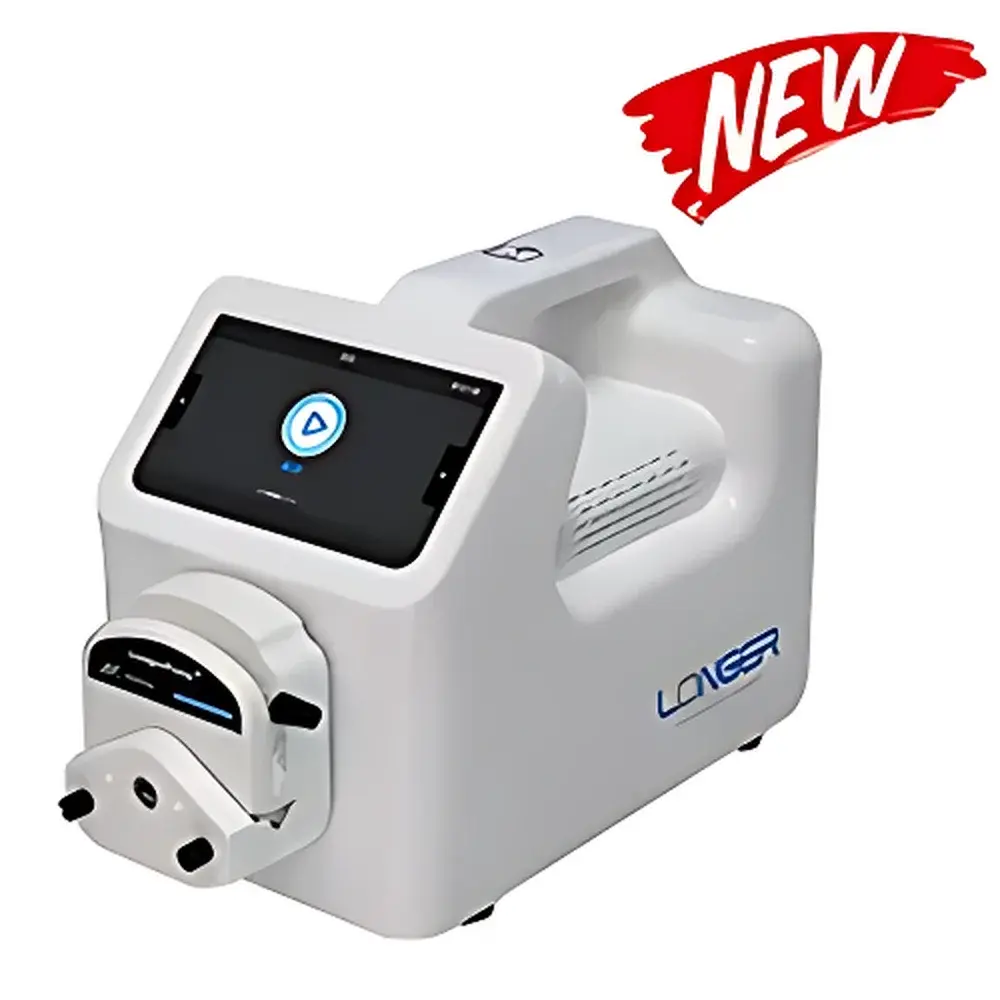
Longer L300-1FS Intelligent Touchscreen Peristaltic Pump
| Brand | LongerPump |
|---|---|
| Origin | Hebei, China |
| Model | L300-1FS |
| Flow Rate Range | ≤1500 mL/min |
| Speed Range | 0.1–300 rpm (CW/CCW) |
| Display | 7-inch 1024×600 TFT LCD |
| Control Interfaces | USB, RS-485 (RJ11), DB9, analog I/O (0–5 V / 0–10 V / 4–20 mA / 0–10 kHz), footswitch |
| Programmable Schemes | 7 user-defined + 1 preconfigured external-control scheme |
| Distribution Accuracy | <2% error |
| Calibration | Auto-calibration via user-input test volume |
| Protection Rating | IP31 |
| Power Supply | AC 220 V ±20%, 50/60 Hz (L300-1FS-A variant) |
| Operating Temperature | 0–40 °C |
| Weight | 5.0 kg |
Overview
The Longer L300-1FS is an industrial-grade intelligent peristaltic pump engineered for precision fluid handling in regulated laboratory, pharmaceutical, bioprocessing, and pilot-scale manufacturing environments. Based on the well-established principle of positive displacement via roller compression of elastomeric tubing, the L300-1FS delivers repeatable, pulse-free flow across a wide dynamic range—from ultra-low volumes (0.15 µL/min) to high-throughput transfer (up to 1500 mL/min). Its core architecture integrates a brushless DC motor with closed-loop speed control, ensuring stable rotational output from 0.1 rpm to 300 rpm in both clockwise and counterclockwise directions. Unlike basic peristaltic pumps, the L300-1FS embeds firmware-level intelligence—including automatic pump head and tubing identification via RFID/NFC tags mounted on compatible accessories—thereby eliminating manual configuration errors and enhancing traceability in GLP/GMP workflows.
Key Features
- 7-inch true-color TFT LCD touchscreen (1024 × 600 resolution) with intuitive graphical interface supporting dual-language operation (English/Chinese)
- Auto-recognition of pump head and tubing models via proximity sensor at handle mount—validates mechanical compatibility and loads optimized flow coefficients
- High-resolution speed control: 0.1 rpm resolution below 100 rpm; 1 rpm above—enabling fine-tuned dosing for sensitive reagent delivery or cell culture media perfusion
- Comprehensive programmable workflow engine: supports up to 7 user-saved schemes, each containing up to 10 sequential steps with mixed control logic
- Nine operational modules: constant speed, linear acceleration/deceleration, stepwise ramping, sinusoidal modulation, uniform dispensing, incremental/decremental dispensing
- Eight logical control modules: direction switching, time delay, event-triggered execution, status output signaling, pause/resume, jump-to-step, loop iteration, and hard stop
- Multi-mode external control: TTL-level digital I/O, analog voltage/current input (0–5 V / 0–10 V / 4–20 mA), frequency signal (0–10 kHz), and footswitch activation
- Standardized communication protocol: Modbus RTU over USB and RS-485 (RJ11 connector); configurable baud rates (1200–38400 bps) for integration into SCADA, PLC, or LIMS platforms
- Onboard calibration utility: users enter measured dispensed volume to auto-adjust flow rate mapping—critical for maintaining volumetric accuracy across tubing aging cycles
- IP31-rated enclosure with reinforced chassis design for long-term reliability under continuous duty in non-hazardous ambient conditions
Sample Compatibility & Compliance
The L300-1FS accommodates a broad spectrum of peristaltic tubing materials—including silicone, Viton®, Tygon®, and PharMed®—with interchangeable pump heads supporting inner diameters from 0.1 mm to 9.5 mm. This flexibility enables adaptation to diverse fluid properties (viscosity, abrasiveness, chemical compatibility) without hardware modification. While the base unit does not carry CE marking by default, CE-compliant versions are available upon explicit order specification—ensuring conformity with EU Machinery Directive 2006/42/EC and EMC Directive 2014/30/EU. The device meets Class II electromagnetic compatibility requirements per IEC 61326-1, and its analog and digital I/O circuits comply with IEC 61000-4 immunity standards. For regulated applications, audit-trail-capable software logging (via external host) and parameter locking features support alignment with FDA 21 CFR Part 11 expectations when deployed within validated systems.
Software & Data Management
Although the L300-1FS operates autonomously via its embedded controller, it is fully interoperable with third-party supervisory software through open Modbus registers. All critical operational parameters—including real-time speed, direction, elapsed time, step counter, and status flags—are mapped to accessible holding registers. Users may develop custom HMI dashboards or integrate pump control into broader process automation frameworks using standard OPC UA or Modbus TCP gateways. The internal memory retains seven user-defined parameter sets with alphanumeric naming, facilitating rapid reconfiguration between SOP-driven protocols (e.g., buffer exchange vs. gradient elution). Delayed start, suction reversal (anti-drip), and infinite-loop dispensing modes are stored persistently and recalled without host dependency—enhancing standalone robustness during power-resilient operations.
Applications
- Pharmaceutical R&D: Precise reagent dosing in formulation development, dissolution testing, and automated sample preparation for HPLC or LC-MS workflows
- Biotechnology: Sterile media perfusion in bioreactors, pH/DO probe calibration fluid delivery, and fraction collector synchronization
- Clinical diagnostics: Sample aspiration and diluent metering in automated immunoassay platforms and hematology analyzers
- Chemical synthesis: Controlled addition of catalysts or monomers in flow chemistry reactors requiring low-shear, contamination-free transfer
- Environmental testing: Sequential extraction of soil/water samples in EPA Method-compliant leaching studies
- Food & beverage QA: Consistent flavoring agent dosing, viscosity-standardized texture analysis, and allergen cross-contamination mitigation
FAQ
Does the L300-1FS support validation documentation for GxP environments?
Yes—while the pump itself is not supplied with formal IQ/OQ documentation, its deterministic behavior, parameter traceability, and external control capabilities make it suitable for inclusion in vendor-supported validation packages. Customers may request factory calibration certificates and material compliance declarations (e.g., RoHS, REACH) at time of order.
Can the pump be integrated into a PLC-controlled production line?
Absolutely—the RS-485 (RJ11) port implements standard Modbus RTU, enabling direct read/write access to all operational registers using common PLC programming suites (e.g., Siemens TIA Portal, Allen-Bradley Studio 5000). Digital I/O signals provide hardware-level interlocks for safety-critical sequencing.
How does automatic tubing recognition improve measurement integrity?
By reading embedded identifiers on certified Longer tubing assemblies, the pump loads pre-characterized flow-rate vs. rpm curves—bypassing manual lookup tables and reducing human error in setup. This ensures consistent volumetric delivery even when operators change tubing batches or switch between applications.
Is firmware upgrade supported in-field?
Yes—firmware updates are delivered as .bin files via USB stick and applied through the Settings menu. Version history and checksum verification prevent unauthorized or corrupted installations.
What maintenance intervals are recommended for sustained accuracy?
No scheduled recalibration is required under normal use; however, periodic verification using gravimetric or volumetric methods every 6 months—or after tubing replacement—is advised. Roller wear inspection and housing cleaning should occur quarterly in high-duty-cycle installations.



