
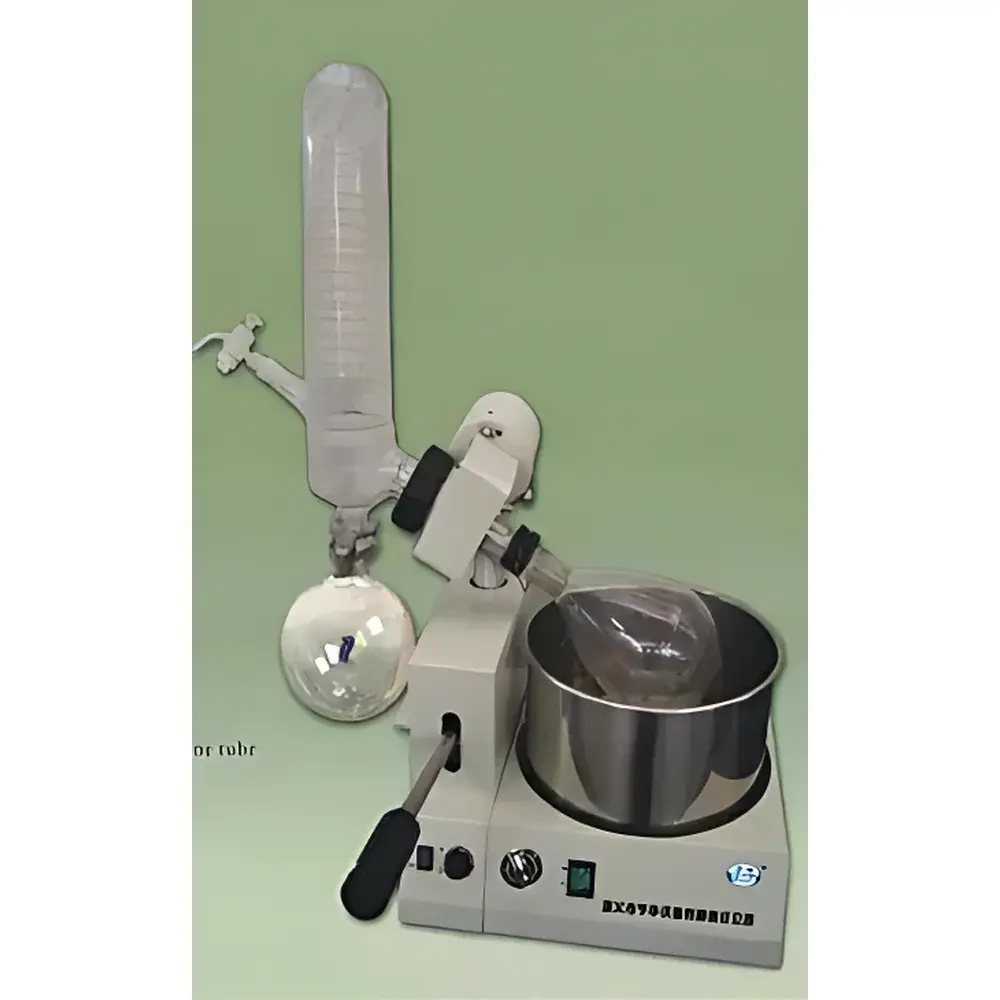
YUHUA YRE-2010A Rotary Evaporator
| Brand | YUHUA |
|---|---|
| Origin | Henan, China |
| Model | YRE-2010A |
| Power Supply | AC 220 V, 50 Hz |
| Input Power | 1.55 kVA |
| Rotational Speed Range | 0–130 rpm |
| Evaporation Flask Capacity | 50–2000 mL |
| Condenser Type | Vertical dual-coil, standard-taper ground glass joint (ball-and-socket), compatible with ice/water cooling |
| Ultimate Vacuum | < 0.1 MPa |
| Vertical Lifting Stroke | 120 mm |
| Heating Bath Power | 1.5 kW |
| Heating Bath Temperature Range (water) | RT to 98 °C |
| Instrument Footprint | 400 mm × 490 mm |
| Net Weight | 21 kg |
| Lifting Mechanism | Manual hand-crank |
Overview
The YUHUA YRE-2010A Rotary Evaporator is a benchtop vacuum distillation system engineered for efficient solvent removal, concentration, and gentle sample recovery under reduced pressure. It operates on the principle of rotary evaporation—where a rotating evaporation flask increases surface area and promotes uniform thin-film formation, while controlled heating and vacuum lower the boiling point of solvents. This enables rapid, low-temperature evaporation of heat-sensitive compounds commonly encountered in organic synthesis, natural product isolation, pharmaceutical formulation, and analytical sample preparation. Designed for routine laboratory use, the YRE-2010A integrates mechanical stability, thermal precision, and operational safety into a compact footprint suitable for shared lab environments and QC/QA workflows.
Key Features
- Digitally controlled microprocessor temperature system with real-time display and ±1 °C thermal stability across the water bath range (RT to 98 °C)
- Stepless electronic speed regulation enabling precise rotational control from 0 to 130 rpm—optimized for film thickness modulation and bumping suppression
- Vertical manual lifting mechanism with 120 mm stroke, ensuring safe and repeatable flask immersion and removal without motorized complexity
- Dual-coil vertical condenser with standard-taper (ball-and-socket) ground glass joints—designed for high-efficiency vapor condensation using either circulating coolant or ice-water mixtures
- Robust stainless-steel frame and borosilicate 3.3 glassware set (evaporation flask, condenser, receiving flask, and adapter)—resistant to thermal shock and common organic solvents
- Integrated over-temperature protection and grounding compliance per IEC 61010-1 for laboratory electrical safety
Sample Compatibility & Compliance
The YRE-2010A accommodates standard ground-glass jointed glassware (e.g., 24/29, 29/32 taper sizes) and supports evaporation volumes from 50 mL to 2 L, making it suitable for small-scale reaction workups and mid-throughput purification tasks. Its vacuum compatibility (< 0.1 MPa) allows operation with common vacuum sources—including diaphragm pumps and water aspirators—enabling solvent removal of acetone, ethanol, ethyl acetate, dichloromethane, and other low-boiling organics. While not certified to ISO/IEC 17025 or FDA 21 CFR Part 11 out-of-the-box, its analog controls and manual lift design align with GLP-compliant documentation practices when paired with external logbooks and calibration records. Routine verification of bath temperature accuracy (via traceable PT100 probe) and vacuum integrity (with calibrated gauge) supports audit-readiness in regulated environments.
Software & Data Management
The YRE-2010A operates via standalone hardware controls—no embedded software, firmware updates, or network connectivity. Temperature setpoint and rotation speed are adjusted manually and displayed on integrated LED indicators. This architecture eliminates cybersecurity concerns, reduces validation burden, and ensures long-term operational consistency in resource-constrained or GxP-aligned labs where deterministic behavior is prioritized over digital integration. Users may document process parameters (e.g., bath temp, rpm, vacuum level, duration) in paper-based or LIMS-linked electronic batch records. For laboratories requiring automated data capture, third-party USB/RS232-enabled temperature loggers or vacuum transducers can be externally interfaced.
Applications
- Solvent removal following Grignard, Suzuki, or Wittig reactions without thermal degradation of products
- Concentration of crude extracts in phytochemistry and nutraceutical R&D
- Recovery of chiral catalysts or expensive ligands from catalytic reaction mixtures
- Preparative-scale fractionation prior to HPLC or flash chromatography
- Removal of residual solvents from API intermediates in compliance with ICH Q3C guidelines
- Educational demonstrations of colligative properties, phase equilibria, and vacuum thermodynamics
FAQ
What is the maximum recommended flask size for this unit?
The YRE-2010A is rated for up to a 2 L evaporation flask; however, optimal thin-film formation and bumping control are achieved with 1 L or smaller flasks at speeds above 60 rpm.
Can the heating bath accommodate silicone oil as a heat transfer medium?
Yes—the stainless-steel bath is compatible with silicone oil; however, the stated temperature range (RT–98 °C) applies strictly to aqueous operation. Oil use requires user-defined upper-limit safeguards and viscosity considerations for convection efficiency.
Is the condenser compatible with dry ice–acetone cooling?
The vertical dual-coil condenser supports sub-ambient cooling when connected to a recirculating chiller; direct dry ice–acetone immersion is not recommended due to thermal stress risk on ground-glass joints and potential seal failure.
Does the unit include vacuum sealing grease or glassware assembly tools?
No—standard accessories include only the main unit, heating bath, condenser, and receiving flask. Ground-glass joint grease, clamps, and vacuum tubing must be sourced separately per lab protocol.
How often should the PTFE shaft seal be inspected?
Inspect the rotary seal visually before each use for cracking or deformation; replace annually or after 500 operating hours—whichever occurs first—to maintain vacuum integrity and prevent solvent ingress into the drive mechanism.



