
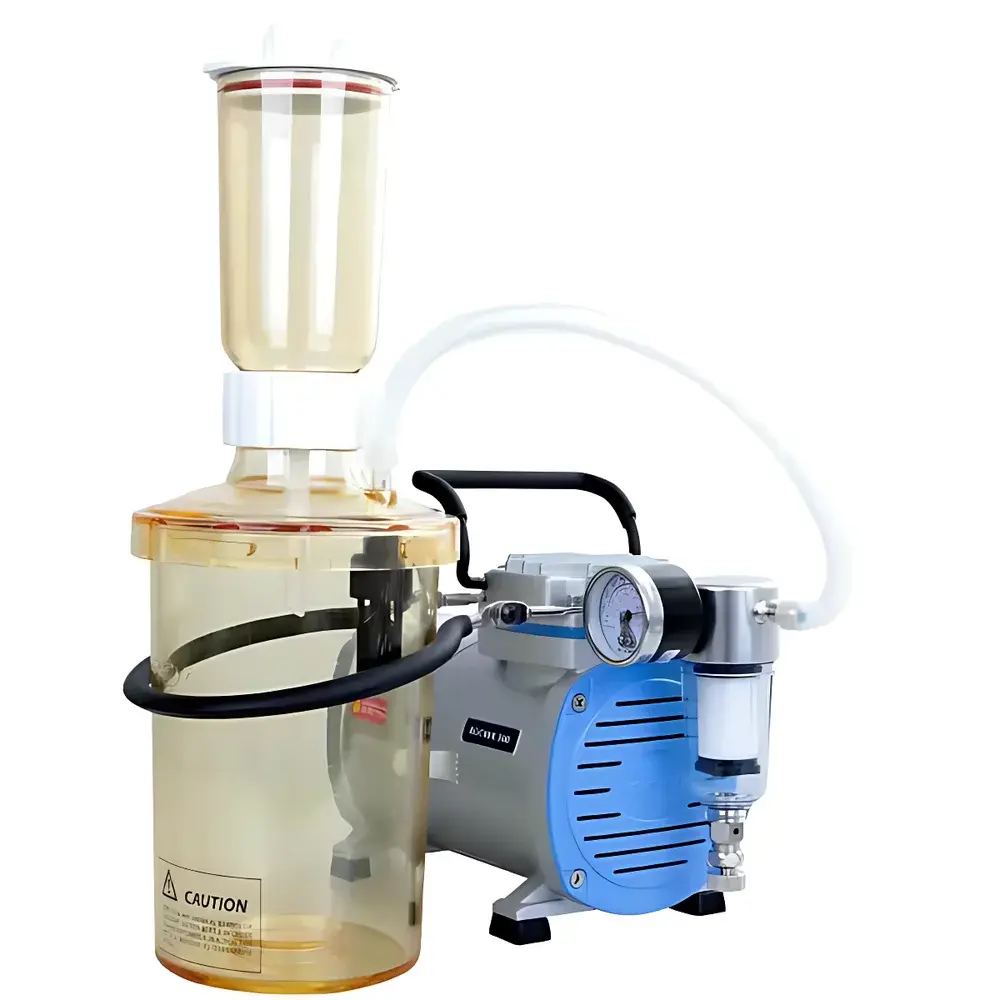
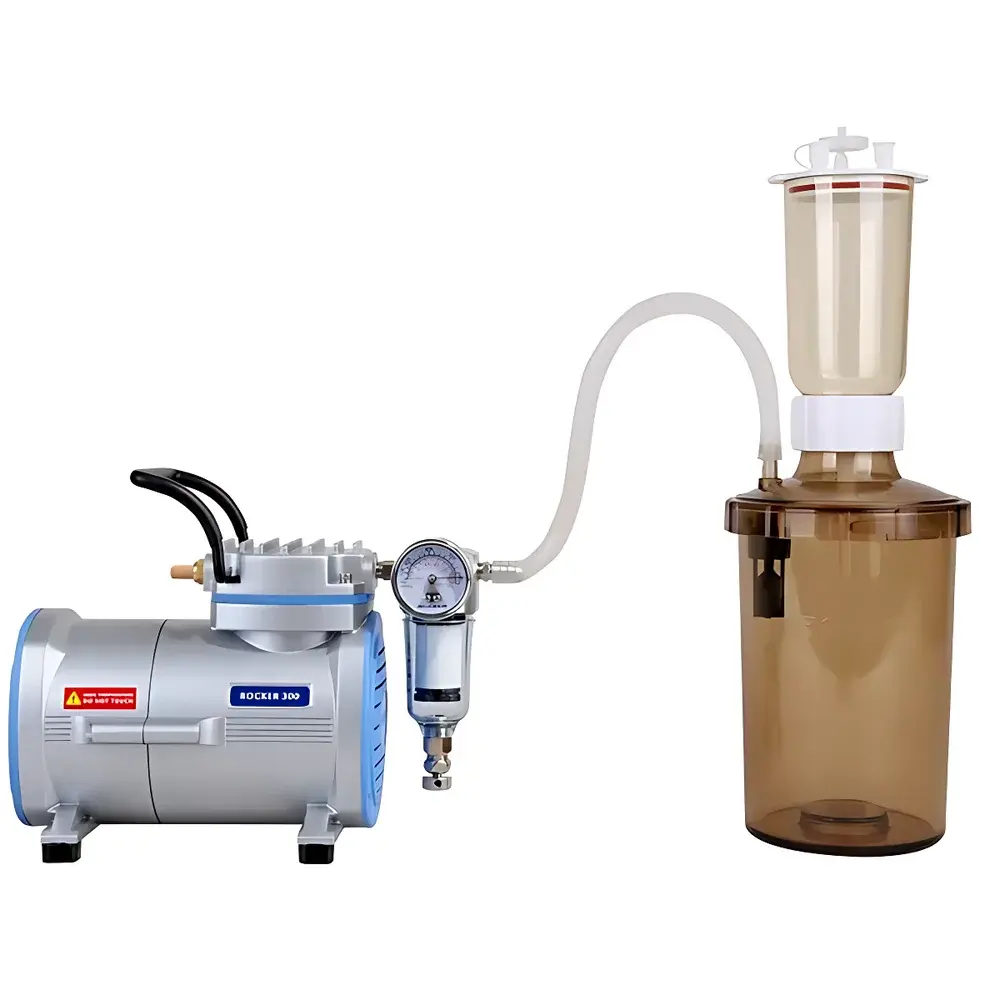
ROCKER Rocker300-LF30 Oil-Free Vacuum Filtration System
| Brand | ROCKER |
|---|---|
| Origin | Taiwan |
| Manufacturer Type | Authorized Distributor |
| Regional Category | Domestic (Taiwan) |
| Model | Rocker300-LF30 |
| Price | Upon Request |
| Power Supply | 220 V / 50 Hz |
| Power Consumption | 60 W |
| Current Draw | 0.3 A |
| Ultimate Vacuum | 99 mbar (685 mmHg) |
| Air Flow Rate | 20 L/min |
| Motor Speed | 1450 RPM |
| Motor Output | 1/8 HP |
| Funnel Capacity | 300 mL |
| Waste Bottle Capacity | 1200 mL |
| Compatible Membrane Diameter | 47 mm |
| Effective Filtration Area | 12.5 cm² |
| Tubing Inner Diameter | 8 mm (5/16 inch) |
| Funnel Material | Polyethersulfone (PES) |
| Waste Bottle Material | Polycarbonate (PC) |
| Filter Support Ring Material | Polypropylene (PP) |
| Lid Material | Polypropylene (PP) |
| Overflow Protection Mechanism | PPR Float Valve |
Overview
The ROCKER Rocker300-LF30 Oil-Free Vacuum Filtration System is a compact, laboratory-grade vacuum filtration platform engineered for reproducible, contamination-free sample processing in life science and bioprocessing workflows. It operates on positive-displacement piston pump technology—eliminating the need for lubricating oil—and delivers stable vacuum pressure (99 mbar) with a continuous airflow of 20 L/min. Unlike oil-lubricated systems, this design prevents hydrocarbon vapor carryover, ensuring integrity of sensitive biological samples such as cell lysates, protein solutions, and sterile filtrates. The system integrates seamlessly into GLP-compliant environments where particulate and organic residue control are critical—particularly during suspended solids analysis (e.g., ASTM D5907), buffer clarification, or pre-filtration steps prior to HPLC or ultrafiltration. Its modular architecture allows independent use of the Rocker300 vacuum pump or full integration with the LF30 filtration assembly, supporting both routine QC testing and research-scale preparation.
Key Features
- Oil-free piston pump technology: Eliminates risk of oil mist contamination; requires no periodic oil replacement or maintenance.
- Quick-connect twist-lock mechanism: Patented M381450 interface enables secure, tool-free attachment between funnel and waste bottle—reducing setup time and leak potential.
- Dual-stage overflow protection: Integrated PPR float valve in both the vacuum pump inlet line and the waste bottle base automatically seals the gas path upon liquid contact, preventing pump damage and cross-contamination.
- High-temperature compatible PES funnel: Polyethersulfone construction withstands repeated autoclaving at 121°C (up to 180°C short-term), ensuring sterility assurance for aseptic applications.
- Optimized flow dynamics: PP support ring features precision-machined radial channels that enhance lateral flow distribution across the 47 mm membrane surface, increasing effective filtration rate by up to 25% versus conventional flat-bottom designs.
- Modular waste handling: Optional waste extraction cap converts the 1200 mL polycarbonate bottle into a direct-transfer vessel—facilitating downstream disposal or further processing without disassembly.
Sample Compatibility & Compliance
The Rocker300-LF30 accommodates standard 47 mm diameter membranes—including mixed cellulose ester (MCE), polyvinylidene fluoride (PVDF), nylon, and PES—with an effective filtration area of 12.5 cm². Its PES funnel and PC waste bottle exhibit broad chemical resistance to aqueous buffers, alcohols, and mild organic solvents (e.g., ≤30% acetonitrile, ≤50% methanol). All wetted components comply with USP Class VI biocompatibility standards. The system supports ISO 7218:2018 microbiological testing protocols and aligns with EPA Method 160.1 for total suspended solids (TSS) quantification. While not intrinsically certified for GMP manufacturing, its design facilitates audit readiness under FDA 21 CFR Part 11 when paired with validated electronic logbooks and user access controls.
Software & Data Management
This is a standalone benchtop instrument with no embedded microprocessor or digital interface. Vacuum performance parameters (pressure, flow) are not logged or programmable. However, its mechanical consistency—verified through factory calibration against NIST-traceable pressure transducers—ensures high inter-unit reproducibility essential for method transfer between laboratories. Users may integrate it into broader data ecosystems via external pressure sensors (e.g., connected to LabArchives or ELN platforms) using analog 0–5 V output adapters (sold separately). Documentation packages include IQ/OQ templates compliant with ISO/IEC 17025 requirements for equipment qualification in accredited testing labs.
Applications
- Quantitative determination of suspended solids in environmental water samples per ASTM D5907 and ISO 11923.
- Clarification of mammalian cell culture harvests prior to depth filtration or chromatography.
- Routine filtration of culture media, reagents, and buffers in molecular biology and diagnostics labs.
- Pre-concentration of low-biomass environmental samples (e.g., seawater, wastewater) onto 47 mm membranes for subsequent microscopy or DNA extraction.
- Sterile filtration validation studies using challenge organisms (e.g., Brevundimonas diminuta) on 0.22 µm membranes.
FAQ
Is the Rocker300-LF30 suitable for filtering organic solvents?
It is compatible with polar solvents such as ethanol, isopropanol, and diluted acetonitrile (<30%), but not recommended for chlorinated or aromatic hydrocarbons (e.g., chloroform, toluene) due to potential PC bottle stress cracking.
Can the system be operated continuously for extended periods?
Yes—the pump is rated for intermittent duty cycles up to 30 minutes ON / 10 minutes OFF at ambient temperatures ≤35°C; continuous operation beyond 60 minutes requires active cooling or duty cycling.
Does the LF30 filtration assembly support vacuum-assisted membrane drying post-filtration?
No; the float valve disables vacuum flow once the waste bottle reaches ~80% capacity, limiting residual moisture removal. For complete drying, users should transfer membranes to a desiccator or centrifugal concentrator.
Are replacement parts traceable to lot-specific manufacturing records?
Yes—ROCKER assigns unique batch identifiers to all PES funnels, PC bottles, and PPR float assemblies; certificates of conformance are available upon request for regulatory submissions.
What is the maximum operating temperature for the PES funnel during autoclaving?
The funnel is validated for 121°C, 15 psi, 20-minute cycles per ISO 17665-1; exposure to 180°C is permissible only for dry-heat depyrogenation (non-liquid contact) and must be limited to ≤1 hour.
Related Products




