Protein Technologies PurePep® Chorus Automated Peptide Synthesizer
| Brand | Protein Technologies |
|---|---|
| Origin | USA |
| Manufacturer Type | Original Equipment Manufacturer (OEM) |
| Product Category | Imported Life Science Instrument |
| Model | PurePep® Chorus |
| Amino Acid Delivery | Fully Automated |
| Reagent Delivery | Fully Automated |
| Synthesis Scale per Reactor | 0.005–1.0 mmol |
| Total Capacity (6RV Configuration) | 6.0 mmol |
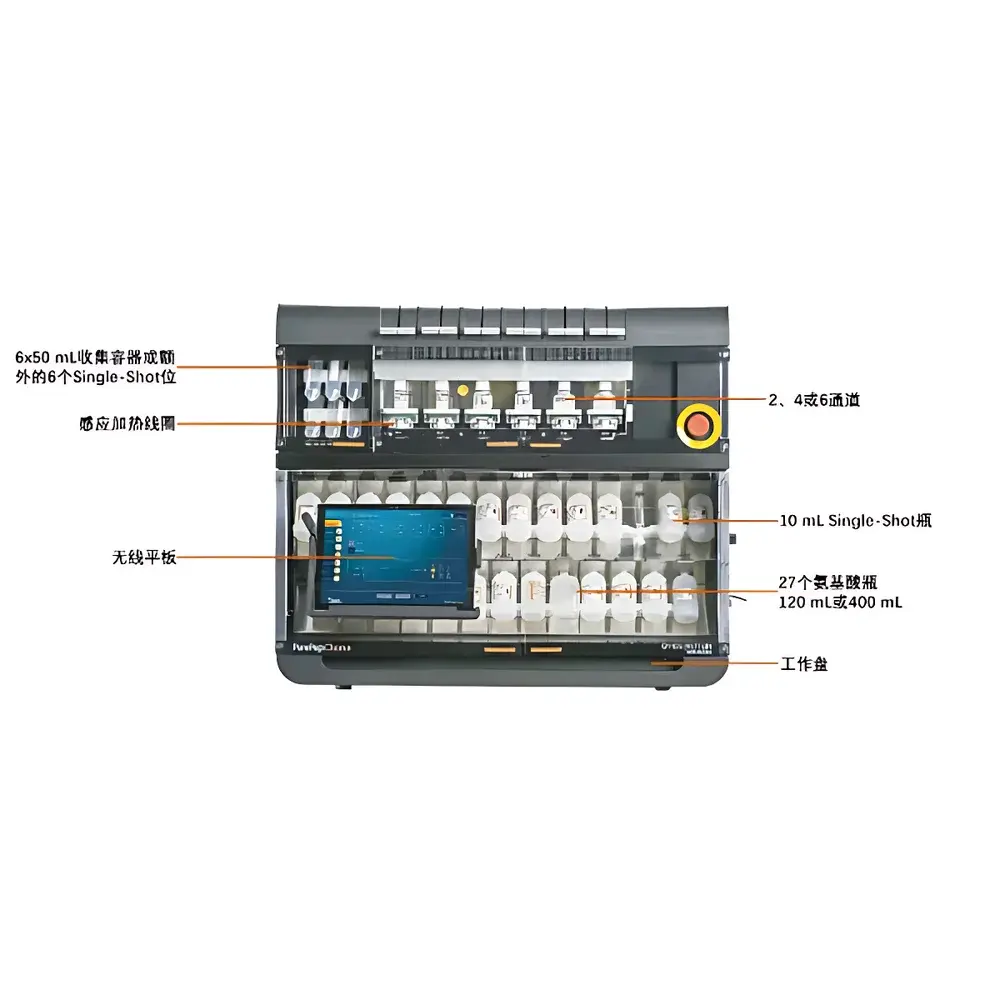
| Reactor Configurations | 2-, 4-, or 6-Reactor Vessel (RV) modular system, field-upgradable |
| Reactor Vessel Options | Disposable polypropylene (10 mL, 45 mL) or borosilicate glass (10 mL, 25 mL, 40 mL) |
Overview
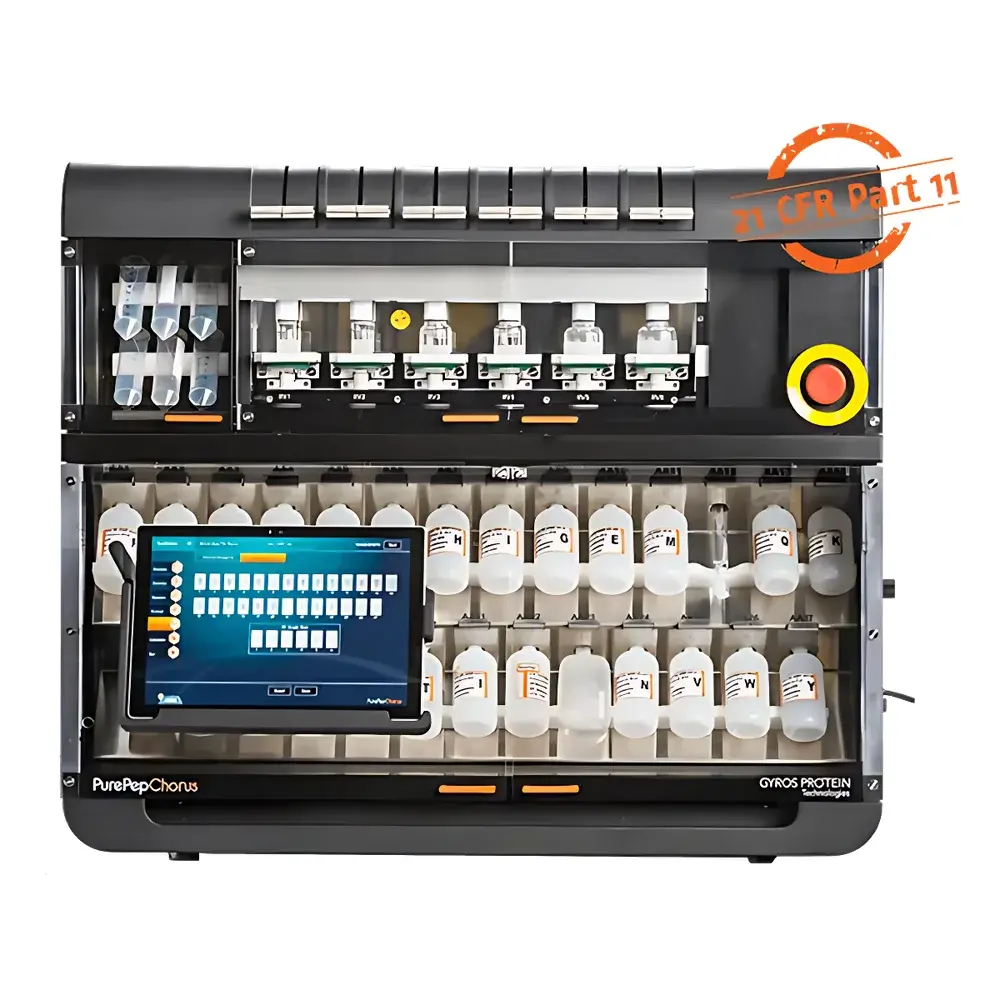
The Protein Technologies PurePep® Chorus is a benchtop, fully automated solid-phase peptide synthesizer engineered for reproducible, scalable, and regulatory-compliant synthesis in academic, pharmaceutical, and biotechnology laboratories. It implements Fmoc- and Boc-based solid-phase peptide synthesis (SPPS) using precise fluidic control, real-time reaction monitoring, and modular thermal management. Its core architecture centers on the proprietary PurePep® Pathway valve manifold—a zero-dead-volume, chemically inert, maintenance-free fluidic system constructed from PEEK and sapphire components, validated for long-term exposure to aggressive reagents including piperidine, TFA, HOBt, DIC, and chlorinated solvents. Unlike conventional peristaltic or syringe-pump-driven systems, the PurePep® Pathway eliminates cross-contamination risks between cycles and ensures stoichiometric delivery accuracy across all synthesis scales (5 µmol to 1.0 mmol). The instrument supports both standard and difficult-sequence synthesis through integrated temperature-controlled induction heating, programmable nitrogen sparging, and real-time UV monitoring of deprotection kinetics—enabling method optimization during first-run synthesis rather than empirical iteration.
Key Features
- Modular Scalability: Factory-configurable 2-, 4-, or 6-reactor vessel (RV) platforms; field-upgradeable without hardware replacement or downtime.
- PurePep® Pathway Fluidics: Chemically resistant, zero-dead-volume valve block with sapphire-seat actuators; certified for >10,000 synthesis cycles without performance degradation or seal replacement.
- Intellisynth UV Monitoring: In-line UV-Vis detection (210–320 nm) at each reactor position; captures real-time deprotection absorbance profiles; generates cycle-specific kinetic curves and comparative overlay plots for troubleshooting recalcitrant sequences.
- Controlled Induction Heating & Oscillation: Independent, closed-loop temperature control (25–90 °C ±0.5 °C) per reactor group; synchronized orbital shaking ensures uniform resin suspension and heat transfer—critical for coupling efficiency in sterically hindered residues.
- Automated Cleavage & Collection: On-instrument, fully programmable TFA-mediated cleavage; timed or event-triggered execution; collection into standard 50 mL conical tubes; compatible with scavenger resin integration.
- Pre-activation Capability: Simultaneous activation of up to three amino acids under DIC/HOBt or OxymaPure/DIC conditions; ideal for coupling N-methylated, β-branched, or pseudoproline dipeptides.
Sample Compatibility & Compliance
The PurePep® Chorus accommodates a broad range of resin types—including Wang, Rink amide, 2-Cl-Trt, and Sieber amide—and supports both standard and specialty linkers (e.g., HMBA, PAL, SASRIN). Resin loading capacities span 0.1–1.2 mmol/g, compatible with 10–45 mL disposable polypropylene or borosilicate glass vessels. All wetted materials meet USP Class VI and FDA 21 CFR Part 11 requirements for material compatibility and extractables profiling. The system complies with ISO 9001:2015 manufacturing standards and includes full IQ/OQ documentation packages validated by GPT-certified field engineers. Electronic audit trails, user role-based access control, electronic signatures, and data integrity safeguards are embedded in firmware and software to support GLP, GMP, and ICH E6(R3) environments.
Software & Data Management
IntelliSynth™ v5.2 software provides intuitive icon-driven workflow navigation, sequence import via FASTA or single-letter code, and drag-and-drop method assembly. Preloaded templates cover common protocols (e.g., standard Fmoc, microwave-assisted, pseudoproline incorporation), while advanced scripting allows custom step logic, conditional branching, and dynamic parameter adjustment. Concurrent task scheduling enables method programming during active synthesis runs. All raw UV traces, temperature logs, reagent dispense volumes, and timing metadata are timestamped, encrypted, and stored in ACID-compliant SQLite databases. Export formats include CSV, PDF analytical reports, and XML for LIMS integration. Software validation documentation—including risk assessment (ICH Q9), traceability matrices, and UAT test scripts—is supplied as part of the compliance package.
Applications
- High-fidelity synthesis of therapeutic peptides (e.g., GLP-1 analogs, antimicrobial peptides, epitope libraries)
- Production of labeled peptides for NMR, MS, and fluorescence studies
- Rapid prototyping of structure–activity relationship (SAR) libraries (up to 6 sequences per run)
- cGMP-aligned synthesis of clinical trial material (CTM) under documented process controls
- Method development for challenging sequences containing multiple consecutive sterically hindered residues (e.g., Val, Ile, Thr, N-Me-Gly)
- Automated parallel synthesis for immunogenicity screening and vaccine candidate evaluation
FAQ
Is the PurePep® Chorus compliant with FDA 21 CFR Part 11?
Yes—the system includes full electronic signature capability, audit trail logging, role-based permissions, and data encryption aligned with Part 11 Subpart B requirements.
Can I upgrade from a 2-RV to a 6-RV configuration in my lab?
Yes—modular reactor decks and corresponding fluidic manifolds are designed for in-lab field installation without recalibration or service engineer intervention.
What solvent savings does PurePep® EasyClean (PEC) provide?
PEC reduces total solvent consumption by ≥90% versus manual HPLC purification of crude peptides, with full automation of loading, washing, elution, and fraction collection across up to six samples simultaneously.
Does the instrument support Boc chemistry?
Yes—dedicated reagent lines, acid-resistant seals, and optimized wash protocols enable robust Boc-SPPS, including HF cleavage-compatible configurations upon request.
How is temperature uniformity verified across reactors?
Each reactor vessel is equipped with independent Pt100 RTD sensors and calibrated induction coils; factory verification includes thermal mapping per ASTM E2251-22 across full operating range (25–90 °C) with ≤0.8 °C spatial deviation.