
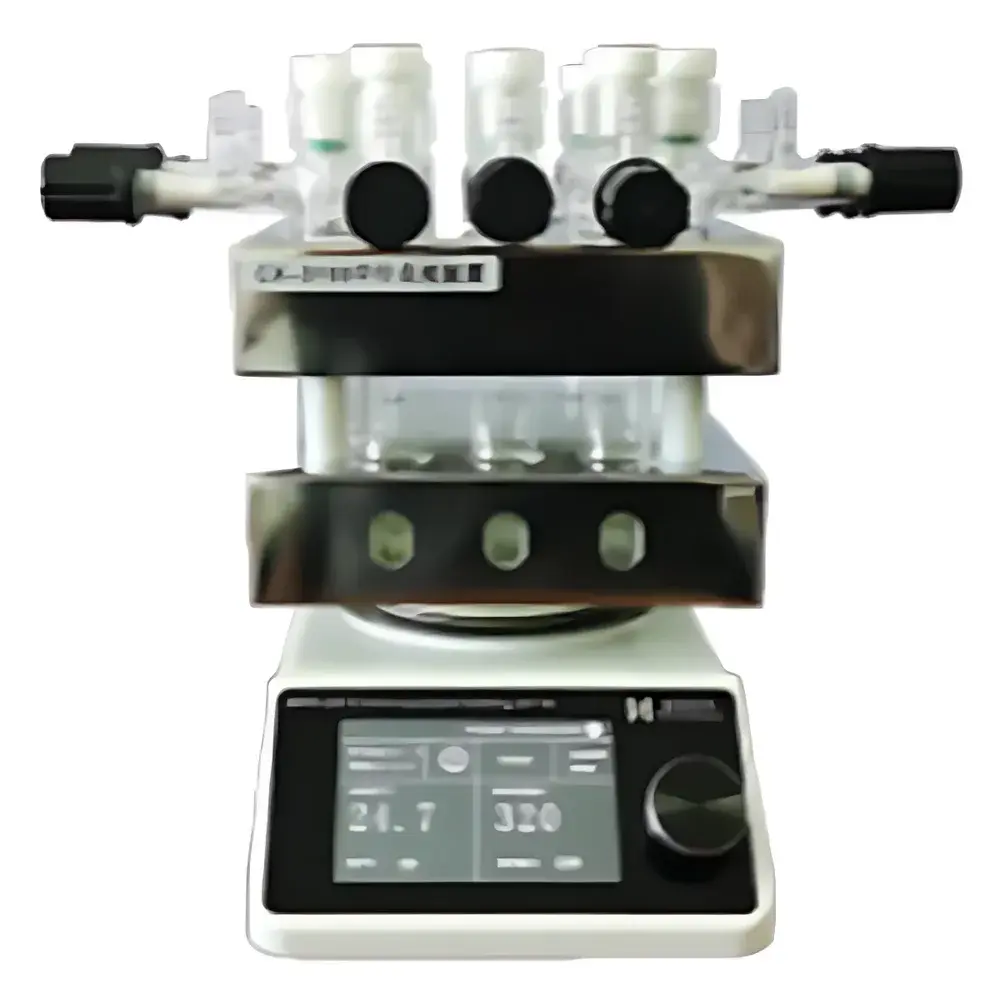
Hanking CX Series Parallel Synthesis Reactor
| Brand | Hanking |
|---|---|
| Origin | Shanghai, China |
| Model | CX Series |
| Capacity | 10–250 mL per reactor |
| Configuration Options | 6-, 7-, 12-, or 15-position modular blocks |
| Reactor Type | Modular parallel synthesis station with integrated thermal control, magnetic stirring, and optional inert gas/vacuum handling |
Overview
The Hanking CX Series Parallel Synthesis Reactor is an engineered platform for controlled, multi-vessel chemical synthesis under reproducible thermal, mechanical, and atmospheric conditions. Designed around the principles of parallel reaction engineering, it enables simultaneous execution of up to 15 independent synthetic transformations—each with individually adjustable temperature, stirring speed, and headspace environment. Unlike conventional single-vessel reactors, the CX Series implements a distributed thermal management architecture: each reaction block integrates precision-machined coolant channels directly beneath the vessel seats, enabling rapid thermal equilibration and high-fidelity temperature uniformity (±0.5 °C across all positions at steady state). This architecture supports both exothermic screening and cryogenic reactions (down to –40 °C with external chiller), making it suitable for methodology development in medicinal chemistry, organometallic catalysis, and polymerization kinetics where reaction consistency across replicates is critical.
Key Features
- Modular Reaction Blocks: Interchangeable 6-, 7-, 12-, and 15-position aluminum alloy blocks with PTFE-coated thermal interfaces; compatible with standard borosilicate glass vials (10–250 mL) and screw-cap or septum-sealed configurations.
- Integrated Cryo-Thermal Control: Dual-path fluid circulation system embedded within each block; accepts external chillers or heating circulators (–40 °C to +200 °C operational range with appropriate fluid).
- Synchronized Process Execution: Centralized controller coordinates simultaneous heating, cooling, and stirring across all vessels—eliminating inter-run variability caused by sequential operation.
- High-Torque Magnetic Stirring: Equipped with Hanking MRS-series stirrers delivering up to 1200 rpm and >800 g·cm torque; optimized for heterogeneous mixtures, slurries, and viscous media (up to 10,000 cP).
- Optical Monitoring Interface: Tempered quartz observation window with anti-fog coating; permits real-time visual assessment of reflux behavior, phase separation, precipitate formation, and colorimetric changes without interrupting reaction integrity.
- Corrosion-Resistant Construction: Mainframe housing and reactor blocks feature electropolished 316 stainless steel with dual-layer PFA/PTFE encapsulation; resistant to halogenated solvents, strong acids (e.g., HCl, HNO₃), and anhydrous reagents commonly used in cross-coupling and lithiation protocols.
Sample Compatibility & Compliance
The CX Series accommodates a broad spectrum of reaction formats—including open-reflux, sealed-tube, Schlenk-line compatible gas exchange (N₂, Ar), vacuum-assisted dehydration, and pressure-rated operations (up to 2 bar with optional reinforced caps). Vessel compatibility extends to standard 24/40, 29/32, and 34/45 jointed glassware, as well as custom-designed microreactors with magnetic coupling interfaces. The system complies with ISO 13849-1 (safety-related parts of control systems) and meets electromagnetic compatibility requirements per IEC 61326-1. While not certified for GMP manufacturing environments, its hardware design and operational repeatability support GLP-compliant documentation workflows when paired with validated electronic lab notebooks (ELNs) and audit-trail-enabled data loggers.
Software & Data Management
The CX Series operates via a touchscreen HMI with embedded firmware supporting programmable ramp-hold profiles, real-time PID parameter tuning, and event-triggered logging (temperature, RPM, elapsed time). Data export is available in CSV format with timestamped metadata per vessel. For integration into regulated environments, optional USB-to-Ethernet gateway modules enable connection to LIMS platforms and support 21 CFR Part 11–compliant digital signatures when used with third-party validation packages. All firmware updates are delivered via signed binary files with SHA-256 checksum verification to ensure traceability and integrity.
Applications
- Lead compound optimization in early-stage drug discovery, including Suzuki, Heck, and Buchwald–Hartwig couplings under varied ligand/base/solvent matrices.
- High-throughput catalyst screening for asymmetric epoxidation, hydrogenation, and C–H activation reactions.
- Polymerization studies requiring precise thermal history control (e.g., RAFT, ATRP) across multiple monomer/initiator ratios.
- Inorganic material synthesis—metal–organic frameworks (MOFs), perovskites, and quantum dot precursors—where solvent removal kinetics and nucleation temperature gradients must be systematically mapped.
- Method development for USP/EP-compliant impurity profiling, where parallel small-scale reactions reduce batch-to-batch analytical variance.
FAQ
Can the CX Series perform reactions under anhydrous or oxygen-sensitive conditions?
Yes—each module supports inert gas purging via dedicated inlet/outlet ports; optional manifold kits enable simultaneous N₂ or Ar sparging across all vessels with flow-rate monitoring.
Is remote monitoring supported?
The base unit does not include Wi-Fi or cloud connectivity; however, analog voltage outputs (0–10 V) and Modbus RTU over RS-485 allow integration with SCADA or building management systems.
What maintenance is required for long-term reliability?
Annual calibration of temperature sensors and verification of stirrer torque output are recommended; coolant circuit flushing every 6 months prevents glycol degradation and channel fouling.
Are custom block geometries available?
OEM mechanical drawings and thermal interface specifications are provided under NDA for integration with proprietary reactor vessels or automated liquid handling systems.
Does the system meet explosion-proof requirements for solvent-rich environments?
No—the CX Series is rated for general laboratory use (IEC 61010-1 Class II); installation in Zone 1/2 hazardous areas requires external explosion-proof enclosures and third-party certification.



