
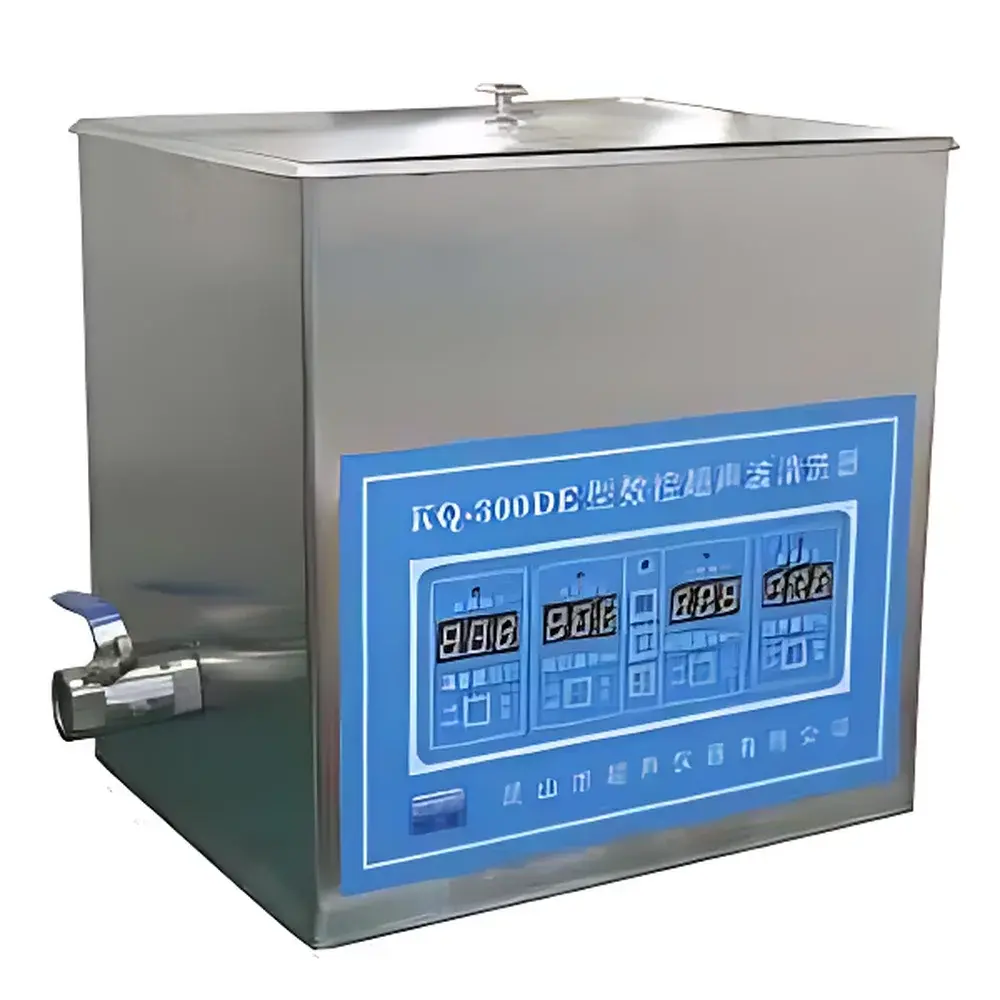
Shumei KQ-300DE Desktop Digital Ultrasonic Cleaner
| Brand | Shumei |
|---|---|
| Origin | Jiangsu, China |
| Model | KQ-300DE |
| Type | General-purpose ultrasonic cleaner |
| Capacity | 10 L |
| Ultrasonic Frequency | 300 kHz |
| Ultrasonic Power Output | 300 W |
| Power Adjustment Range | 40–100% |
| Heating Temperature Range | 10–80 °C |
| Timer Range | 1–480 min |
| Sound-Dampening Lid | Included |
| Drain Valve | Manual |
| Construction | Stainless steel tank and housing (except select entry models) |
| Transducer Configuration | Multiple 50 W piezoelectric transducers bonded to tank bottom |
| Safety Features | Low-level liquid detection, over-temperature, over-voltage, and over-current protection |
| Control System | Microprocessor-based digital interface with real-time display of set/actual temperature, elapsed time, cumulative operating hours (up to 999,999 h), and power level |
| Compliance | Designed for laboratory environments adhering to GLP principles |
Overview
The Shumei KQ-300DE is a benchtop digital ultrasonic cleaner engineered for precision cleaning, degassing, and sample preparation in research laboratories, quality control facilities, and academic institutions. It operates on the principle of high-frequency acoustic cavitation—generated by piezoelectric transducers bonded directly to the stainless steel tank base—at a nominal frequency of 300 kHz. This frequency delivers fine, uniform energy distribution ideal for delicate substrates including optical components, microfluidic devices, semiconductor wafers, and biological samples requiring non-abrasive removal of particulates, organic residues, or entrapped air. Unlike lower-frequency cleaners optimized for heavy industrial parts, the 300 kHz output minimizes surface erosion while maximizing micro-cleaning efficacy in low-viscosity aqueous and mild solvent-based solutions. The unit integrates ultrasonic generation and tank structure into a single rigid assembly, eliminating coupling losses and ensuring mechanical stability during extended operation cycles.
Key Features
- 10-liter capacity stainless steel tank (300 × 240 × 150 mm internal dimensions) with electropolished finish for corrosion resistance and ease of decontamination
- Four independently driven 50 W piezoelectric transducers (total 300 W nominal output), providing uniform energy density across the entire tank volume
- Digital microprocessor controller with dual-line LCD: displays real-time bath temperature, set temperature, elapsed time, cumulative operating hours (up to 999,999 h), and selected power level (40–100% in 10% increments)
- Precise thermostatic heating system (600 W heater) with adjustable setpoint from 10 to 80 °C ±1 °C accuracy; PID-controlled regulation ensures minimal thermal overshoot
- Programmable timer (1–480 minutes) with auto-shutdown and audible end-of-cycle alert
- Integrated safety interlocks: automatic shutdown upon low liquid level detection, over-temperature (>85 °C), over-voltage (>242 VAC), and over-current conditions
- Acoustic attenuation lid included to reduce ambient noise and minimize solvent evaporation during heated operation
- Manual drain valve located at tank base for rapid solution exchange; compatible with standard laboratory floor drains
- Stainless steel wire mesh basket (argon-welded construction) included for sample suspension and protection from direct transducer contact
Sample Compatibility & Compliance
The KQ-300DE supports a broad range of sample types—including glassware, metal fixtures, ceramic substrates, polymer microplates, and disassembled analytical instrumentation components—provided they are chemically compatible with aqueous or mild organic cleaning media (e.g., isopropanol, ethanol, or diluted alkaline detergents). Its 300 kHz frequency is particularly effective for sub-micron particle removal from MEMS devices, HPLC columns, and TEM grids without inducing pitting or delamination. While not certified to IEC 61000-4 electromagnetic immunity standards out-of-box, the unit meets CE marking requirements for laboratory equipment under Directive 2014/30/EU (EMC) and 2014/35/EU (LVD). It is routinely deployed in GLP-compliant laboratories where cleaning process documentation—including time, temperature, power setting, and solution composition—is maintained per internal SOPs aligned with ISO 13485 and USP guidance on equipment cleaning validation.
Software & Data Management
The KQ-300DE operates via embedded firmware with no external software dependency. All operational parameters are stored in non-volatile memory, retaining user-defined settings (temperature, time, power) after power cycling. Cumulative runtime logging enables preventive maintenance scheduling—for example, transducer performance trending or heater element lifecycle assessment. Though it lacks USB/Ethernet connectivity or FDA 21 CFR Part 11-compliant electronic signature capability, its deterministic digital interface supports audit-ready manual recordkeeping. Laboratories integrating the unit into validated workflows commonly pair it with printed logbooks or LIMS entries referencing batch-specific cleaning parameters, solution lot numbers, and operator IDs—fully traceable within standard GLP/GMP frameworks.
Applications
- Cleaning of precision optics, fiber optic connectors, and photomask blanks prior to metrology
- Degassing of HPLC mobile phases and calibration standards to eliminate bubble-induced baseline noise
- Cell lysis and homogenization support for proteomics sample prep (e.g., combined with enzymatic digestion buffers)
- Removal of solder flux residues from PCB assemblies before X-ray fluorescence analysis
- Preparation of reference standards for ICP-MS and AAS by eliminating adsorbed contaminants from volumetric flasks and pipette tips
- Supporting ASTM D2622 and ISO 8772 methodologies for residual contaminant quantification on metallic test coupons
FAQ
Is the KQ-300DE suitable for cleaning delicate MEMS sensors?
Yes—the 300 kHz frequency generates smaller, more numerous cavitation bubbles than 40 kHz units, reducing mechanical stress on fragile microstructures while maintaining cleaning efficiency.
Can I use chlorinated solvents in this cleaner?
No. Chlorinated hydrocarbons (e.g., trichloroethylene) are incompatible with stainless steel tanks and may degrade seals or transducer adhesives. Only water-miscible, non-halogenated solvents are recommended.
Does the unit include a heater calibration certificate?
No factory calibration certificate is supplied, but the integrated PT100 sensor allows third-party verification using NIST-traceable thermometers per ISO/IEC 17025 procedures.
What is the expected service life of the transducers under continuous operation?
Rated for >10,000 hours of cumulative operation when operated within specified temperature and duty cycle limits (≤80% power for >4-hour cycles recommended).
How often should the stainless steel tank be passivated?
Passivation is advised every 6 months in high-use labs or after exposure to acidic/basic cleaning agents, following ASTM A967 or AMS 2700 specifications.



