
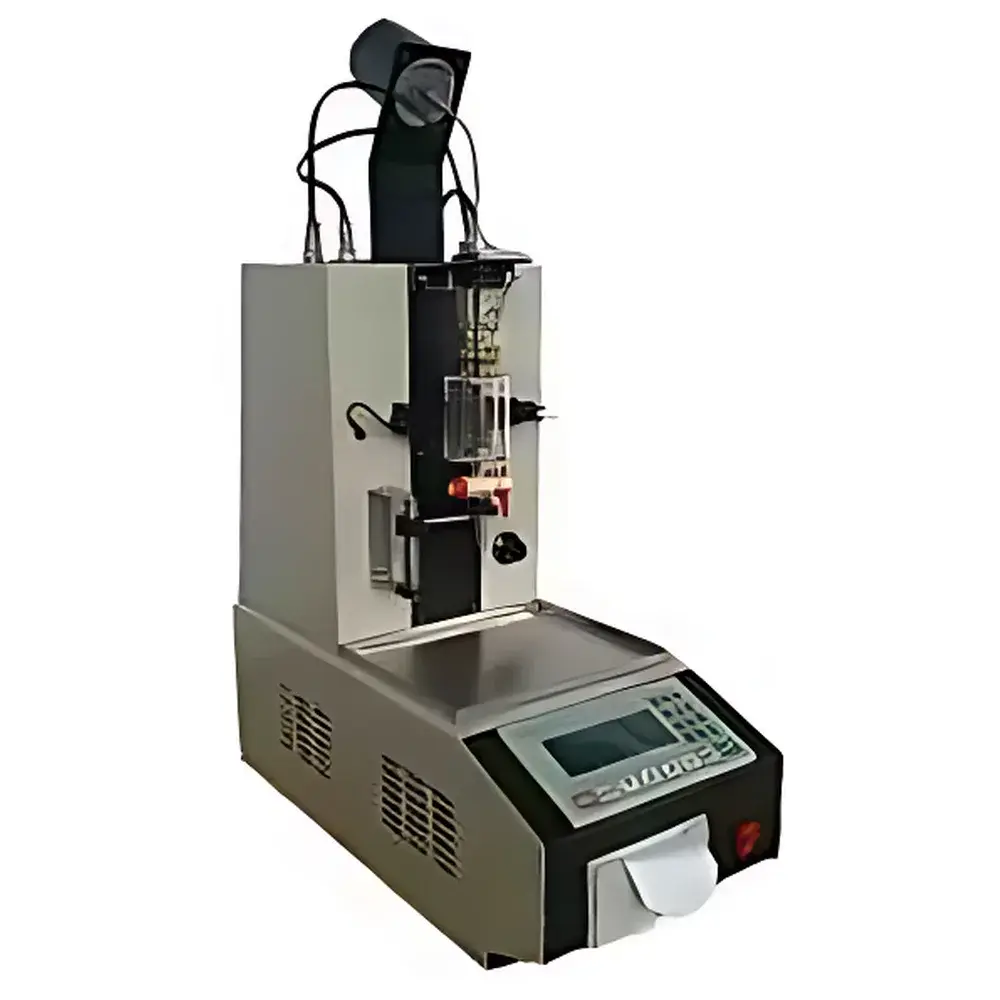
Shanghai Xufeng AP-L1S Automatic Aniline Point Tester
| [Brand | Shanghai Xufeng |
|---|---|
| Origin | Shanghai, China |
| Model | AP-L1S |
| Temperature Range | Ambient to 170 °C |
| Repeatability | ±0.2 °C (light-colored oils), ±0.4 °C (dark-colored oils, ASTM Color > 8) |
| Temperature Sensor | Pt100 platinum resistance thermometer |
| Temperature Control Accuracy | ±0.1 °C |
| Heating Power | 30 W |
| Stirring Motor Power | 6 W |
| Display | Touch-enabled LCD panel |
| Data Storage | 99 test records |
| Interface | RS232 serial port |
| Printer | Integrated thermal dot-matrix printer |
| Dimensions | 400 × 430 × 450 mm (W×D×H) |
| Weight | ~24 kg] |
Overview
The Shanghai Xufeng AP-L1S Automatic Aniline Point Tester is a precision laboratory instrument engineered for the automated determination of aniline point and mixed aniline point in petroleum products and hydrocarbon solvents. Based on the fundamental thermodynamic principle that aniline and hydrocarbon phases become miscible at a characteristic temperature—the aniline point—this instrument employs controlled heating, real-time optical phase detection, and precise Pt100-based temperature measurement to identify the exact temperature at which a homogeneous solution forms. Designed in strict compliance with GB/T 262, ASTM D611, and ISO 2977, the AP-L1S supports routine quality control, refinery feedstock characterization, and formulation validation across refining, lubricant manufacturing, and petrochemical R&D laboratories.
Key Features
- Four configurable test modes: Standard Mode (fully compliant with GB/T 262 and ASTM D611), Rapid Mode (optimized cycle time without compromising reproducibility), Search Mode (for unknown or borderline samples), and Special Oil Mode (for highly viscous or dark-colored samples with ASTM Color > 8)
- Automated thermal profiling: integrated heating, isothermal hold, and active cooling (via passive ambient dissipation; AP-L1S is ambient-range only)
- Optical detection system with automatic light-intensity compensation to ensure consistent phase transition recognition across sample color gradients
- Self-diagnostic firmware with hardware-level fault detection and thermal cut-off protection
- Onboard data management: stores up to 99 complete test records with timestamps, mode selection, raw temperature profiles, and final aniline point values
- Integrated thermal dot-matrix printer with pre-test sample ID entry; printed reports include test date, expected aniline point, measured result, and operator-defined identifiers
- Touch-responsive LCD interface displaying real-time parameters: system clock, arithmetic mean (with outlier rejection), current test mode, sample temperature, photometric signal level, and diagnostic status
Sample Compatibility & Compliance
The AP-L1S accommodates both light- and dark-colored petroleum fractions—including naphthas, kerosenes, diesel fuels, base oils, and aromatic solvents—without manual intervention or optical filter changes. Its robust photometric detection algorithm compensates for variable turbidity and absorbance, enabling reliable aniline point determination even for samples exceeding ASTM D1500 Color No. 8. All operational sequences adhere strictly to the procedural requirements of GB/T 262 (Chinese National Standard), ASTM D611 (American Society for Testing and Materials), and ISO 2977 (International Organization for Standardization). The instrument’s temperature control architecture meets the ±0.1 °C stability requirement specified in these standards for the critical 1–2 °C window around phase transition. While not certified for GLP or GMP environments out-of-the-box, its deterministic thermal ramping, audit-ready print logs, and non-volatile memory support traceability under ISO/IEC 17025-accredited testing workflows.
Software & Data Management
The AP-L1S operates via embedded firmware with no external PC dependency. All test logic, calibration handling, and statistical processing—including arithmetic averaging with Grubbs’-type outlier rejection—are executed onboard. Test records are stored in non-volatile memory with full metadata: date/time stamp, selected mode, raw temperature vs. time series (at 0.5 s intervals), photometric response curve, final reported value, and operator-entered sample ID. Data export is supported via RS232 serial interface using ASCII-delimited format compatible with LIMS integration or spreadsheet import. Firmware includes factory-calibrated Pt100 lookup tables traceable to ITS-90; user-accessible calibration offset adjustment is available for metrological verification. No proprietary software installation or license is required.
Applications
- Refinery process monitoring: correlation of aniline point with aromatic content and hydrogenation severity
- Lubricant base oil classification per API Group III/IV specifications
- Solvent compatibility assessment for elastomer and polymer applications
- Quality assurance of jet fuel (Jet A/A-1) per ASTM D1655 Annex A4
- Research-grade hydrocarbon mixture characterization in academic and industrial labs
- Supporting ASTM D2887 simulated distillation correlation studies
FAQ
What is the difference between AP-L1S and AP-L2?
The AP-L1S is an ambient-range instrument (room temperature to 170 °C), while the AP-L2 integrates a Peltier-based cooling module enabling operation from 0 °C to 170 °C—essential for samples with expected aniline points below ambient.
Does the instrument comply with FDA 21 CFR Part 11 requirements?
No. The AP-L1S does not implement electronic signatures, audit trails, or role-based access control. It is intended for non-regulated QC and R&D use; for regulated environments, supplemental procedural controls must be applied.
Can the AP-L1S measure samples with high sulfur or asphaltene content?
Yes—provided the sample remains fluid within the operating temperature range and does not foul the optical cell or sample vial. Routine cleaning of the photodetector window and vial surfaces is recommended after testing heavy fractions.
Is third-party calibration certification available?
Shanghai Xufeng provides NIST-traceable temperature verification reports upon request. Calibration against certified reference materials (e.g., n-decane, n-dodecane) may be performed in-house following ASTM D611 Annex A1 guidelines.





