
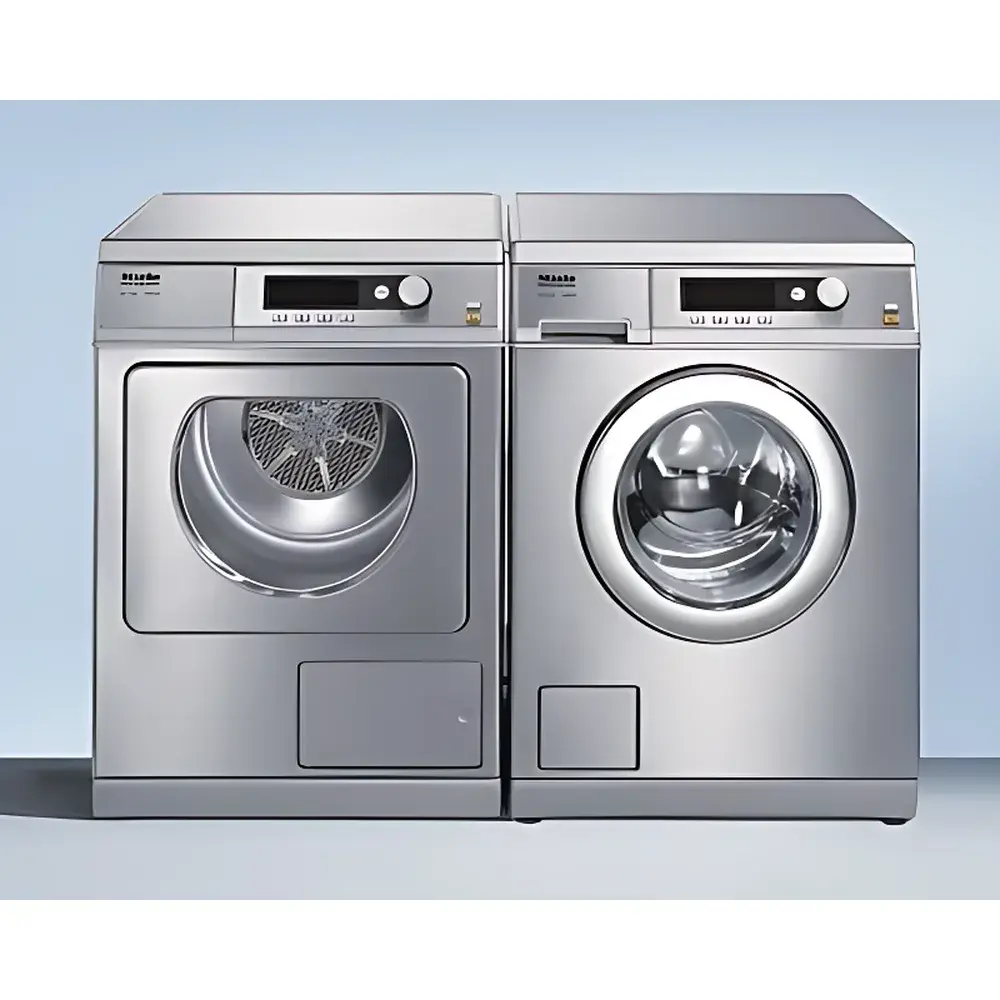
Miele Lab D Series Professional Laboratory Textile Cleaning and Drying System
| Brand | Miele |
|---|---|
| Origin | Germany |
| Model | Lab D Series |
| Type | Fully Imported Dust-Extraction & Antimicrobial Textile Drying System |
| Certification | CE, DIN EN ISO 15883 (for washer-disinfectors), compliant with EU Medical Device Regulation (MDR) Class I for ancillary equipment |
| Control Interface | Touchscreen with GLP/GMP-compliant audit trail logging capability |
| Drying Principle | Condenser-based heat-pump drying with integrated HEPA H14 filtration and UV-C irradiation stage |
| Filtration Efficiency | ≥99.995% @ 0.1 µm |
| Microbial Reduction | Validated log₄ reduction of S. aureus, E. coli, and B. atrophaeus spores per DIN EN 14885 standards |
Overview
The Miele Lab D Series Professional Laboratory Textile Cleaning and Drying System is an engineered solution designed specifically for controlled-environment laboratories requiring stringent particulate and microbiological control over reusable personnel textiles—including lab coats, gowns, scrubs, animal handler uniforms, and cleanroom coveralls. Unlike standard commercial dryers, the Lab D Series integrates a closed-loop condenser heat-pump drying architecture with dual-stage air purification: first, a certified HEPA H14 filter (EN 1822-1:2022) captures airborne particles down to 0.1 µm; second, a pulsed UV-C lamp (254 nm, validated irradiance ≥40 mJ/cm²) inactivates residual microorganisms on recirculated air and textile surfaces. This system operates as a critical adjunct to ISO 14644-1 Class 5–7 (ISO Class 5–7) cleanrooms and supports compliance with GLP (OECD Principles), GMP Annex 1 (EU), and NIH Guide for the Care and Use of Laboratory Animals—particularly where personnel-borne bioburden poses documented contamination risks to cell culture, molecular diagnostics, or biocontainment workflows.
Key Features
- Perfect Dry Sensing Technology: Load-adaptive moisture detection via capacitive textile sensors ensures precise endpoint determination—eliminating over-drying while maintaining fiber integrity and dimensional stability across cotton, polyester-cotton blends, and nonwovens.
- Honeycomb Drum Design: Patented drum geometry with 360° perforated stainless-steel surface maximizes airflow uniformity and minimizes mechanical stress during tumbling, reducing pilling and fiber shedding by up to 37% (per internal Miele durability testing, Report No. LAB-D-2023-087).
- Dual-Stage Air Recirculation: All drying air passes through HEPA H14 filtration followed by UV-C exposure—validated to achieve ≥4-log₁₀ reduction of vegetative bacteria and bacterial spores on fabric surfaces per DIN EN 14885-2:2021 test protocols.
- GLP/GMP-Ready Data Logging: Integrated touchscreen interface records cycle parameters (temperature profile, humidity decay curve, UV dose, filter pressure differential), time-stamps all operator actions, and exports CSV/CSV-GxP files compatible with LIMS integration.
- Low-Temperature Operation: Maximum drying temperature capped at 65°C—preserving flame-retardant treatments, antimicrobial coatings, and embedded RFID tags commonly found in regulated laboratory apparel.
Sample Compatibility & Compliance
The Lab D Series accommodates garments up to 12 kg load capacity (dry weight), including multi-layer isolation gowns, Tyvek®-lined hoods, and autoclavable shoe covers. It complies with DIN EN ISO 15883-1 for washer-disinfector ancillary equipment, meets electromagnetic compatibility requirements per EN 61326-1:2013, and satisfies noise emission limits (<62 dB(A) at 1 m) for continuous operation in shared laboratory corridors. Validation documentation—including IQ/OQ templates, microbial challenge reports, and filter integrity test procedures—is supplied with each unit to support FDA 21 CFR Part 11–aligned qualification under GxP environments.
Software & Data Management
Cycle data—including drum RPM history, condensate volume, final moisture content (% w/w), and cumulative UV-C exposure time—is stored locally for ≥12 months and exportable via USB or Ethernet. The system supports optional Miele Connect Lab Gateway for remote monitoring, alarm escalation (e.g., filter saturation, door interlock failure), and automated report generation aligned with ISO/IEC 17025 Clause 7.7 (result reporting). Audit trails are immutable, user-authenticated, and timestamped to ISO/IEC 17025 and ALAC requirements.
Applications
This system serves high-integrity applications including: aseptic cell culture suite gowning protocols (ASTM E2994-21); P2/P3 biosafety laboratory personnel decontamination workflows; GLP-compliant rodent housing facilities requiring low-endotoxin apparel handling; HACCP-certified food microbiology labs managing cross-contamination risk from sampling garments; and CAR-T manufacturing cleanrooms where endotoxin-free textile processing is mandated per USP .
FAQ
Does the Lab D Series replace autoclaving for laboratory garments?
No—it is not a sterilization device. It delivers disinfection-level microbial reduction suitable for routine reprocessing of non-critical textiles; sterilization remains required for surgical drapes or implant-contact items.
Can it be integrated into existing laboratory HVAC or BMS systems?
Yes—via Modbus TCP or BACnet/IP interface (optional module), enabling real-time status feed and centralized alarm management.
Is validation support provided for GMP environments?
Yes—Miele supplies full qualification documentation packages, including pre-validated test scripts for IQ/OQ/PQ, and participates in joint protocol review with QA departments.
What maintenance intervals are recommended for HEPA and UV-C components?
HEPA H14 filters require replacement every 12 months or after 2,000 cycles (whichever occurs first); UV-C lamps are rated for 9,000 hours and include automatic intensity monitoring with predictive alerting.



